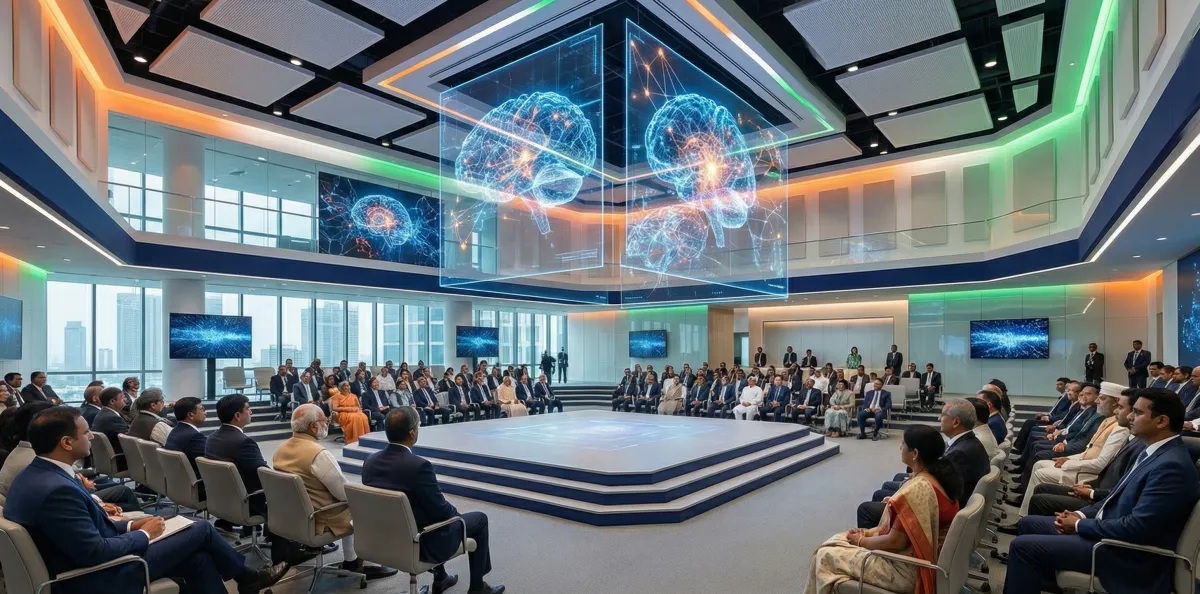
New Delhi, India – The much-anticipated India AI Impact Summit, touted as one of the world's largest gatherings on artificial intelligence, recently concluded amidst a whirlwind of organizational challenges, unexpected controversies, and nevertheless, significant pledges from global tech behemoths. While the event's execution drew criticism, its underlying message was clear: India is aggressively positioning itself as a pivotal player in the burgeoning global AI landscape, aiming to attract a staggering $200 billion in AI investment over the next two years.
A Summit Marred by Disorganization and Drama
The summit, held at the Bharat Mandapam in New Delhi, faced numerous logistical hurdles. Attendees and media personnel alike reported significant frustrations, ranging from unprecedented traffic gridlock in the Indian capital to confusing and conflicting instructions from security at the venue. CNBC's Arjun Kharpal, reporting live from the ground, described it as one of the most challenging assignments of his career, citing difficulties in navigating the city and gaining timely access to event areas. Indian IT minister Ashwini Vaishnaw publicly apologized for the "problems" experienced on the first day, acknowledging the organizational shortcomings.
Beyond the logistical snarls, the summit was punctuated by a series of high-profile controversies that captured global attention.
Bill Gates' Abrupt Withdrawal
One of the most notable incidents was the last-minute withdrawal of Bill Gates, who was scheduled to deliver a keynote address. Amidst ongoing scrutiny following his mention in the Epstein files, uncertainty surrounded his participation. While the Gates Foundation initially confirmed his speech, a subsequent announcement on Thursday confirmed his pull-out, adding another layer of drama to the event.
The Robotic Dog Debacle
A peculiar incident involved Galgotias University, which was reportedly asked to leave the summit after presenting a robot dog they allegedly claimed as their own creation. A professor from the university had told a state-run broadcaster that the robot was "developed" by the institution. However, online users quickly pointed out that the robot was manufactured by the Chinese firm Unitree. The university later issued a statement clarifying that the robotic programming was part of their endeavor to teach students AI programming and deployment of real-world skills using globally available tools, denying claims of having built the robot itself.
The Viral Hand-Holding Moment
Perhaps the most talked-about social media moment involved OpenAI CEO Sam Altman and Anthropic CEO Dario Amodei. During a group photo opportunity with Prime Minister Narendra Modi, delegates were instructed to hold hands. However, Altman and Amodei were observed not following the instruction, leading to an instantly viral moment across social media platforms and intense scrutiny. Altman later attributed it to confusion, stating he wasn't sure what he was supposed to do. This seemingly minor gaffe gained traction, especially given Anthropic's recent Super Bowl ad taking subtle digs at OpenAI's decision to test advertisements in ChatGPT, underscoring the subtle rivalries and competitive dynamics within the AI industry.
India's Irresistible Lure: Partnerships and $200 Billion Dreams
Despite the chaotic backdrop, the India AI Impact Summit successfully attracted a constellation of top tech leaders, including Alphabet CEO Sundar Pichai, OpenAI's Sam Altman, and Anthropic's Dario Amodei. Their presence underscored India's undeniable appeal as a rapidly growing market and a significant hub for technological talent.
Sam Altman, expressing his enthusiasm, remarked on the "incredible" excitement surrounding India's AI potential. Tech giants used the summit as a platform to unveil strategic announcements and forge new partnerships within the country. OpenAI, for instance, declared its intention to be the inaugural customer of Tata Consultancy Services' data center business, a move that signals deeper collaboration and investment in India's digital infrastructure. Google also announced a series of partnerships with local researchers and educational institutions, specifically focusing on integrating and advancing its Gemini artificial intelligence features within the Indian ecosystem.
The Indian government seized the opportunity to champion the nation's aspirations as an AI powerhouse. Officials reiterated the ambitious target of attracting $200 billion in AI investment over the next two years, a testament to the country's commitment to fostering innovation, talent development, and robust AI infrastructure.
Looking Ahead: Navigating Growth and Governance
The India AI Impact Summit, with its blend of logistical challenges and monumental ambitions, serves as a microcosm of India's broader journey into the AI era. The chaotic scenes, while perhaps embarrassing for the organizers, did little to dampen the long-term enthusiasm of global tech players. India's vast talent pool, burgeoning digital economy, and strategic geopolitical position make it an increasingly attractive destination for AI investment and development.
However, the summit also implicitly highlighted the growing pains associated with rapid technological acceleration and large-scale international events. Moving forward, India will need to demonstrate not only its capacity for innovation but also its ability to manage complex logistical undertakings and uphold ethical standards, especially in a field as sensitive as AI.
The $200 billion investment goal is audacious, but with continued government support, a vibrant startup ecosystem, and sustained interest from global tech giants, India is poised to make significant strides in shaping the future of artificial intelligence. The path may be chaotic at times, but the dreams are undeniably grand.