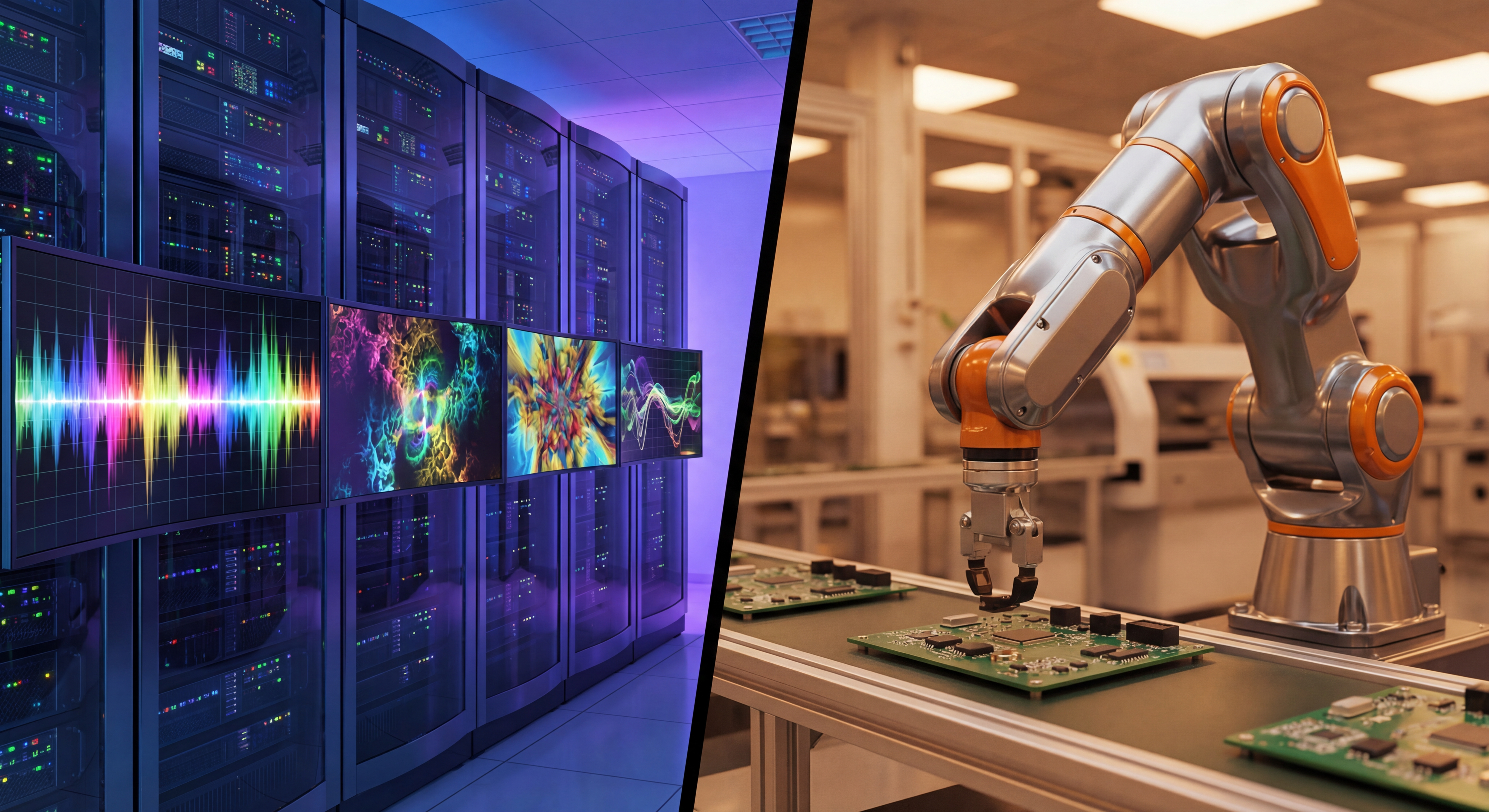
OpenAI spent more than two years building Sora into the most recognizable AI video generator in the world. On Tuesday, it killed it. Without a shutdown date or apparent warning — even to its Disney partners — OpenAI announced it was discontinuing the Sora app, its social network, and the Sora 2 API. The reason, in the company's own words: "world simulation research to advance robotics." The entertainment era is over. The physical world is next.
The Announcement — and Its Stunning Abruptness
The official Sora account on X posted the news without ceremony and without a specific shutdown date. A farewell video was generated using Sora characters, accompanied by a caption that read: "Today, after careful internal discussion about our broader research priorities, we've made the difficult decision to discontinue Sora. We know many of you invested significant time and energy into Sora — building not just gens, but also audiences and real communities. The creativity that emerged exceeded what we could have expected."
What made the announcement particularly striking was its timing. VentureBeat, which broke the detailed story, noted that Sora had been receiving product updates through the very week of the shutdown announcement. The teams building it had apparently not been given advance warning either — Sora engineers were informed internally only days before the public post appeared.
OpenAI's statement to VentureBeat confirmed the direction: "We've decided to discontinue Sora in the consumer app and API. As we focus and compute demand grows, the Sora research team continues to focus on world simulation research to advance robotics that will help people solve real-world, physical tasks." That single sentence encapsulates a major strategic shift: the technology that learned to simulate physics, motion, and the visual world is now a tool for training robots — not for making fan videos.
The Disney Deal Collapse
The most concrete casualty of the shutdown is a deal that looked transformative just three months ago. In December 2025, OpenAI and Disney announced a $1 billion equity partnership. The terms were ambitious: Disney characters usable inside Sora, fan-generated videos distributable on Disney+, and OpenAI's models powering new subscriber experiences across Disney's multi-brand content ecosystem. It was OpenAI's most high-profile entertainment deal, and a clear signal that AI-generated video was poised to be taken seriously by Hollywood's biggest name.
The Sora and Disney teams were reportedly working together as recently as several days before the shutdown, according to sources cited by VentureBeat. The Hollywood Reporter confirmed that the Disney deal was canceled as a direct result of the Sora shutdown — making it one of the more jarring business reversals in recent AI history. A billion-dollar partnership, built over months, evaporated in a week.
The implications for the entertainment industry extend well beyond Disney. Studios, production houses, and media companies that had begun structuring workflows around Sora's capabilities — treating it as an emerging infrastructure layer for AI-assisted content creation — now face an abrupt recalibration. The platform they were building on no longer exists.
OpenAI's Stated Rationale — Robotics and AGI
The official explanation is strategically coherent even if it arrived without warning. Sora was never primarily a consumer media product — it was a research project aimed at teaching AI systems to understand the physical world through video. Every hour of generated video was, in effect, a lesson in how objects move, how light behaves, how gravity works. That underlying capability — what researchers call "world simulation" — turns out to be more valuable as a substrate for robotics training than as a consumer entertainment feature.
Sources told VentureBeat that the compute is being reallocated specifically toward AGI development, which OpenAI has defined as "AI systems that outperform humans at most economically valuable labor." That definition is telling. Video generation for entertainment is not economically transformative in the way that AGI performing physical labor would be. Manufacturing, logistics, healthcare, agriculture — these are trillion-dollar markets. Fan videos on Disney+ are not.
Simultaneously, OpenAI announced a restructuring of its non-profit Foundation arm, pledging $1 billion in 2026 across life sciences, jobs and economic impact, AI resilience, and community programs. The pattern is consistent: OpenAI is explicitly retreating from AI-generated content and entertainment, and concentrating resources on AGI, physical AI, and enterprise infrastructure. It is choosing where to compete rather than trying to win everywhere.
The Energy and Compute Cost Context
To understand why compute reallocation is being treated as urgent, it helps to understand what video generation actually costs. Generating high-quality video is among the most energy-intensive tasks in AI — significantly more demanding than text or even image generation. A single minute of Sora video requires sustained GPU utilization across multiple parallel inference passes, generating and checking frames at a scale that dwarfs conversational AI workloads.
That cost has become harder to justify in 2026's energy environment. The ongoing U.S.-Israel-Iran conflict has disrupted Middle East oil markets, raising global energy prices and putting upward pressure on data center operating costs across the industry. OpenAI, which does not own its compute infrastructure outright and relies substantially on Microsoft Azure, is acutely sensitive to per-token and per-inference energy costs.
Shedding a free consumer video application — one competing against well-funded rivals who had largely caught up technologically — becomes an easy calculation when the freed compute can be redirected toward enterprise products with clear revenue potential and robotics research with potentially transformative upside.
The Enterprise Turf War With Anthropic
The Sora shutdown is also inseparable from the competitive dynamics now playing out between OpenAI and Anthropic in the enterprise market. Reuters reported on March 23 that OpenAI is offering private equity firms a 17.5% guaranteed minimum return — well above comparable instruments — to form joint ventures for enterprise AI deployment. Anthropic, by contrast, offered no such financial guarantees in its own PE outreach.
The targets are revealing: OpenAI is pursuing TPG and Advent International; Anthropic is courting Blackstone, Hellman & Friedman, and Permira. Both companies are racing to "lock in as many desks as possible" before the enterprise market consolidates, in the words of Matt Kropp at BCG's AI unit. SimilarWeb and Ramp spending data cited in Reuters' reporting show Anthropic has gained significant enterprise share in recent months, driven by Claude's coding and agentic capabilities — creating real urgency for OpenAI to match that traction.
OpenAI's response is a "Super App" strategy: consolidating ChatGPT, Codex, the Atlas browser agent, and other products into a unified interface targeting enterprise workflows. By shedding Sora's compute overhead — along with the engineering resources tied up maintaining a consumer media product — OpenAI frees capacity for the Super App push and for Codex enterprise deployments, which carry substantially higher revenue per compute unit than free video generation.
What This Means for the AI Video Industry
Sora's exit does not kill AI video. It reshapes the competitive landscape around the players who remained focused on it.
Runway, Luma AI, Kling (from Chinese tech company Kuaishou), and Minimax all built strong competing platforms during the two-year window when Sora received a "mixed reception" at launch in late 2024 and only intermittent updates thereafter. None of them paused development waiting for OpenAI to dominate. Google's VideoFX / Veo remains active; Meta's video generation tools continue to evolve. The market is real and growing — OpenAI is simply ceding it.
For competitors, Sora's shutdown removes the most technically credible rival from the consumer and creator video space. It may also remove the price anchor that OpenAI's free tier represented, giving Runway and others more room to charge for premium capabilities. The paradox is that OpenAI's exit could be better for the AI video industry's commercial health than its continued participation.
For enterprise customers who had integrated Sora's API into production workflows, the immediate challenge is migration. The Sora 2 API is being discontinued along with the consumer app — a detail that will sting organizations that had built on it. OpenAI has said it is "exploring ways to support export and preservation of your work," but migration paths for API-dependent use cases remain unclear.
A Brief History of Sora — From Marvel to Mothballing
Sora's arc was genuinely impressive before it ended. When OpenAI first previewed the model in February 2024, the demonstrations were unlike anything the industry had produced — 60-second photorealistic videos that maintained physical coherence across scenes, treated lighting and motion with an accuracy that made competitors look crude by comparison. The reaction from AI researchers, filmmakers, and technologists was near-unanimous: this was a step-change.
The commercial deployment in late 2024 landed with more friction. Competitors had closed the gap during OpenAI's lengthy research-to-product cycle. Sora Turbo, the faster version released at launch, was capable but no longer uniquely dominant. The app's social features attracted an enthusiastic community — the iOS version briefly hit number one on the App Store, and the Android app followed — but sustained engagement proved elusive. The Disney deal in December 2025 represented OpenAI's best attempt to establish a defensible entertainment moat around Sora's technology.
That moat lasted approximately 90 days. The shutdown, arriving in March 2026 before a single Disney+ fan video was ever published, closes a chapter that began with genuine technological breakthrough and ended with a strategic pivot that, on reflection, may prove more consequential than anything Sora ever generated.
The Signal This Sends to the Industry
Perhaps the most important takeaway from Sora's shutdown is what it reveals about how the leading AI labs now think about resource allocation. The era of shipping impressive demos across every possible modality — video, audio, image, text, code — is giving way to deliberate concentration. OpenAI is not trying to win everywhere. Neither is Anthropic, which has spent 2026 concentrating on enterprise safety and agentic computing rather than chasing consumer entertainment. Google DeepMind remains the broadest participant, but even there, resource allocation is increasingly visible in which products receive sustained investment versus which stagnate.
The underlying logic is compute economics. At current energy prices and with AGI timelines compressing, the opportunity cost of running a free consumer video application — when that same compute could be training robotic world models or powering enterprise Codex deployments — is simply too high. Sora was always a means to an end. OpenAI has decided the end has changed.
For the broader AI industry, the message is clear: the consumer entertainment era of generative AI is passing its peak. The capital, the compute, and the strategic focus are rotating toward physical AI, enterprise infrastructure, and AGI research. Sora's shutdown is not a retreat — it is a reorientation. And the real world is where OpenAI has decided to make its bet.