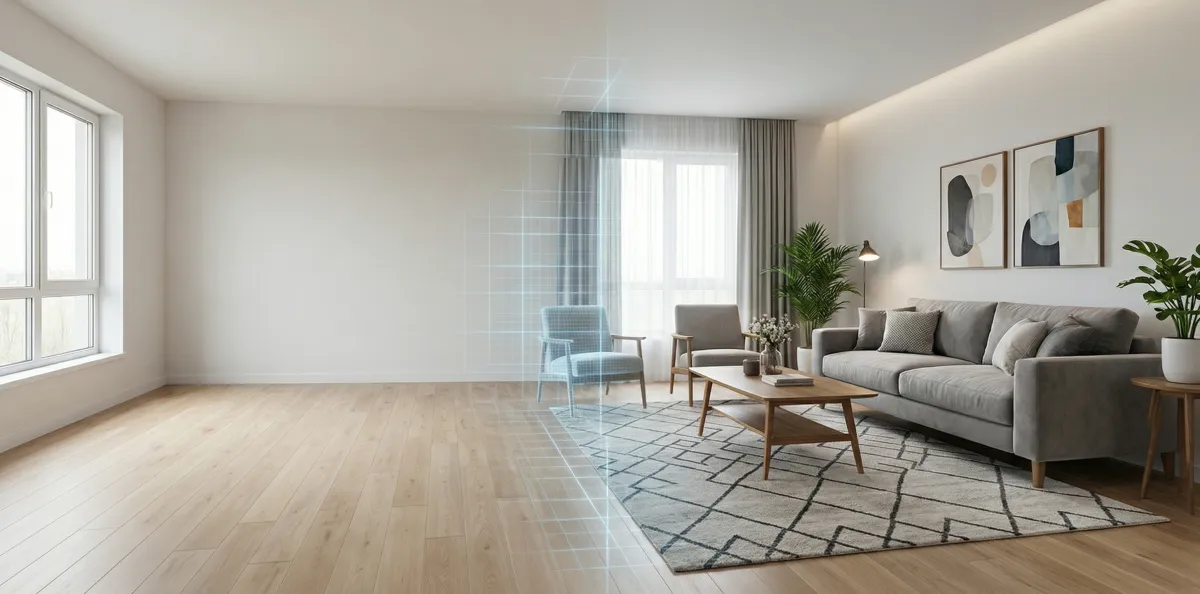
An empty house doesn't sell. Real estate professionals have known this for decades—staged homes sell 73% faster and command prices up to 20% higher than vacant properties. But traditional staging comes with a hefty price tag: $2,000-$10,000 per property, weeks of logistics, and the constant risk of furniture damage or theft.
Enter AI-powered virtual staging. In 2026, machine learning platforms are transforming bare rooms into photorealistic, professionally furnished spaces in minutes—for a fraction of traditional costs. The technology has matured to the point where even experienced agents struggle to distinguish AI-staged photos from real furniture, and buyers are increasingly comfortable making offers on virtually staged listings.
The shift is reshaping how properties are marketed, who can afford professional staging, and what "ready to list" means in an increasingly digital-first real estate market.
The Traditional Staging Problem
Physical staging made sense in a different era. Hire a staging company, rent furniture for 60-90 days, coordinate delivery and installation, pay monthly rental fees, and hope the property sells before the contract expires. For luxury properties, the investment often pays off. For mid-market and entry-level homes, the math rarely works.
The result: most homes list unstaged. Vacant rooms photograph poorly, appearing smaller and less inviting than they are. Buyers struggle to visualize the space's potential. Listings languish. Sellers drop prices.
According to the National Association of Realtors, 82% of buyers' agents say staging makes it easier for buyers to visualize a property as their future home. Yet only 23% of listings actually get staged, primarily due to cost constraints.
That's the gap AI staging is filling.
How AI Virtual Staging Works
Modern AI staging platforms use advanced computer vision models—typically variants of diffusion models or GANs (Generative Adversarial Networks)—trained on millions of interior design images. The process is surprisingly straightforward from a user perspective:
- Upload photos of empty or poorly furnished rooms
- Select style preferences (modern, traditional, minimalist, etc.)
- AI generates multiple staged variations in minutes
- Download high-resolution images ready for MLS listings
Behind the scenes, the AI analyzes room dimensions, lighting conditions, architectural features, and perspective geometry to ensure furniture placement looks natural and physically accurate. Advanced models even account for shadows, reflections, and how natural light would interact with added objects.
Platforms like RealEstage.ai have democratized the technology, offering agents and sellers an intuitive web interface where they can upload room photos and receive professionally staged variations within minutes. The platform uses Google's Gemini AI to generate photorealistic staging that maintains proper perspective, lighting consistency, and architectural integrity—all without requiring any design expertise from the user.
The Economics: 95% Cost Reduction
The financial case for AI staging is compelling:
- Traditional staging: $2,000-$10,000 per property, plus monthly rental fees
- AI staging: $29-$99 per property for unlimited rooms and variations
A typical AI staging package costs less than $100 and delivers:
- Unlimited style variations
- Multiple furniture arrangements per room
- Instant revisions
- No physical logistics or scheduling
- No risk of damage or theft
- Photos ready in hours, not weeks
For real estate agents operating on thin margins, the difference is transformative. Staging is no longer reserved for high-end listings—it's economically viable for every property, from starter homes to luxury estates.
The Quality Debate: Can You Tell It's AI?
Early AI staging (2020-2022) was easy to spot. Furniture looked flat, shadows were wrong, and perspective issues were obvious. But by 2026, the technology has reached a level of photorealism that challenges even trained eyes.
Modern systems handle complex scenarios that stumped earlier models:
- Correct perspective: Furniture aligns with room geometry and camera angle
- Accurate lighting: Shadows, highlights, and reflections match ambient light
- Proper scale: Furniture sizes are realistic for room dimensions
- Material realism: Textures, fabrics, and surfaces look physically accurate
- Contextual coherence: Design choices match architectural style and target demographic
Blind tests conducted by real estate marketing firms show that buyers can correctly identify AI-staged photos only 60-65% of the time—barely better than chance. More importantly, buyer preference studies reveal no significant difference in appeal between high-quality AI staging and traditional staging.
The key insight: buyers don't care whether furniture is real—they care whether the space feels inviting and helps them visualize living there. AI staging achieves that goal at a fraction of the cost.
Legal and Ethical Considerations
Virtual staging isn't without controversy. The National Association of Realtors and most MLS systems require clear disclosure when listing photos are virtually staged. Standard practice includes:
- Watermarking staged photos with "Virtually Staged" text
- Including disclosure language in listing descriptions
- Providing unstaged photos alongside staged versions
- Ensuring AI-generated content doesn't misrepresent property features
The ethical line is straightforward: virtual staging can add furniture, but it can't fabricate features. You can stage an empty bedroom with a king bed and nightstands, but you can't use AI to add a fireplace that doesn't exist or enlarge a room's dimensions.
Most platforms enforce these guidelines through automated checks. RealEstage.ai, for example, focuses exclusively on furniture and decor placement without allowing structural modifications—keeping generated content within ethical and legal boundaries.
The "Bait and Switch" Concern
Critics worry that virtual staging misleads buyers who arrive at showings expecting furnished spaces. The data suggests otherwise: studies show that properly disclosed virtual staging actually improves buyer satisfaction by helping them visualize possibilities without the distraction of the current owner's belongings.
"Buyers know the furniture isn't real," explains Sarah Chen, a top-producing agent in Seattle. "What they appreciate is being able to see the space's potential. It's actually more honest than showing a home filled with someone else's stuff, which can be distracting or off-putting."
Impact on the Real Estate Workflow
AI staging is changing how properties move from listing to closing:
Pre-Listing Optimization
Agents can now generate staged versions of a property before it even hits the market, using those images to secure better pricing and buyer interest from day one. The traditional "list high, reduce later" strategy is giving way to "price right with perfect presentation from the start."
Faster Time-to-Market
Traditional staging requires 2-3 weeks to coordinate. AI staging is instant. Properties can list days or even hours after the seller decides to sell—critical in hot markets where timing matters.
Mid-Market Disruption
The biggest impact is in the $200K-$600K price range, where staging was previously cost-prohibitive. These properties now compete with high-end listings in terms of visual presentation, leveling the playing field and potentially reducing the "luxury premium" buyers pay for well-presented homes.
International and Investor Markets
For international buyers or real estate investors who can't visit properties in person, virtually staged listings provide critical context that empty rooms don't. The technology is particularly popular in markets with high volumes of remote transactions.
The Technology Stack: What Powers AI Staging
Modern AI staging platforms typically combine several AI technologies:
Diffusion Models: The latest generation of image synthesis, capable of generating photorealistic images from text descriptions. Platforms like Midjourney, Stable Diffusion, and DALL-E pioneered this approach, but real estate-specific implementations require fine-tuning on interior design datasets.
Inpainting Algorithms: AI that can intelligently fill in selected regions of an image while maintaining consistency with surrounding areas—essential for placing furniture in existing room photos.
Depth Estimation: Computer vision models that analyze room geometry and perspective to ensure furniture placement looks physically plausible.
Style Transfer: Techniques that allow users to specify aesthetic preferences (modern, rustic, minimalist) and have the AI generate appropriate furniture and decor.
Platforms like RealEstage.ai integrate these capabilities into a streamlined user experience powered by Google's Gemini API, handling the complex AI orchestration behind a simple upload-and-generate interface.
Limitations and Future Improvements
Despite rapid progress, AI staging still faces challenges:
Odd Angles and Unusual Spaces: AI struggles with extreme wide-angle shots, fisheye lenses, or highly irregular room shapes. The models are trained primarily on standard real estate photography, so unconventional perspectives can produce artifacts.
Outdoor Spaces: Staging patios, decks, and yards is harder than interior rooms. The infinite variability of outdoor environments makes consistent results more difficult.
Consistency Across Multiple Rooms: If you virtually stage an entire house, maintaining a cohesive design theme across all rooms requires careful prompt engineering or manual style selection—something traditional stagers handle intuitively.
Fine Detail Quality: Zoom in close enough, and you'll still find telltale AI artifacts—slightly off textures, minor perspective issues, or physically impossible object details. For standard web listings, these are invisible. For large print ads or billboards, they become noticeable.
The roadmap for 2026-2027 includes:
- 3D-consistent staging that allows virtual walkthroughs
- AR integration for on-site visualization via smartphone
- Automated style recommendation based on neighborhood comps
- Multi-room coherence engines that ensure consistent design
The Broader Proptech Trend
AI staging is part of a larger transformation in property technology. Real estate was historically one of the most analog industries—paper contracts, in-person showings, manual valuation. That's changing rapidly:
- AI-powered valuation models (AVMs) now rival human appraisers in accuracy
- Virtual tours and 3D scans (Matterport, iGUIDE) are standard for mid-market and above
- Blockchain-based title systems are piloting in several states
- Predictive analytics tell agents when homeowners are likely to list
- Chatbots and AI assistants handle initial buyer inquiries
Virtual staging fits naturally into this ecosystem. In the near future, a typical listing workflow might be:
- 3D scan the property with a smartphone
- AI generates optimized floor plans and measurements
- Virtual staging populates every room
- Automated copywriting drafts the listing description
- Predictive pricing suggests optimal list price
- AI-driven ad targeting surfaces the listing to likely buyers
Each step reduces friction, lowers costs, and compresses timelines. The result: more efficient markets and better outcomes for buyers and sellers.
Market Adoption and Growth Projections
AI staging adoption is accelerating. Market research firm JLL estimates that:
- 15% of US residential listings used AI staging in 2025
- 35% will use it in 2026
- 60%+ by 2028 as the technology becomes industry standard
The commercial real estate sector is following close behind. Vacant office spaces, retail centers, and multi-family developments are being virtually staged to attract tenants and investors—particularly important as urban cores grapple with high vacancy rates post-pandemic.
Globally, the virtual staging market is projected to reach $1.2 billion by 2028, growing at a 28% CAGR. North America leads adoption, but Europe and Asia-Pacific are catching up as AI tools localize for regional design preferences and regulatory requirements.
What This Means for Agents, Sellers, and Buyers
For Real Estate Agents:
AI staging is becoming a competitive requirement rather than a differentiator. Agents who don't offer it risk losing listings to those who do. The good news: the technology is cheap and easy to implement, requiring no technical expertise.
Pro tip: Invest in learning how to select appropriate staging styles for target demographics. The AI can generate the images, but human judgment is still essential for matching aesthetic to market.
For Sellers:
Virtual staging should be a standard ask when interviewing agents. If your agent isn't offering it, find one who does. The ROI is clear: faster sales, higher prices, and minimal upfront cost.
Caution: Don't over-rely on staging to compensate for deferred maintenance or poor condition. AI can add furniture, but it can't hide structural issues or make a fundamentally flawed property appealing.
For Buyers:
Virtually staged listings are now the norm. Learn to read them critically—focus on room dimensions, natural light, architectural features, and condition. The furniture is aspirational; the bones of the house are what matter.
Smart buyers request both staged and unstaged photos to see the space clearly without the AI enhancement, then use the staged versions to visualize their own design ideas.
The Human Element: What AI Can't Replace
Despite the hype, AI staging doesn't eliminate the need for human expertise. Successful real estate marketing still requires:
- Photography skills: AI can't fix bad lighting, poor angles, or dirty spaces. Garbage in, garbage out.
- Design judgment: Choosing the right staging style for target demographics requires market knowledge AI doesn't have.
- Ethical oversight: Humans must ensure AI-generated content doesn't cross legal or ethical lines.
- Personal touch: High-end luxury properties still benefit from physical staging and the curated experience it provides during showings.
The best results come from combining AI efficiency with human judgment—using the technology to handle grunt work while professionals focus on strategy, client relationships, and closing deals.
Conclusion: The Democratization of Professional Staging
AI virtual staging represents a rare win-win in real estate technology. Sellers get professional presentation at a fraction of traditional costs. Agents differentiate their services without major capital investment. Buyers see properties at their best. And the technology continues improving at a rapid pace.
What was once a luxury reserved for high-end listings is now accessible to every homeowner. That democratization—making professional-grade marketing tools available to the mass market—is the real revolution.
As platforms like RealEstage.ai continue to refine the technology and lower barriers to entry, we're moving toward a future where every listing—regardless of price point or location—can present itself professionally. That's good for markets, good for participants, and ultimately good for the broader economy.
The empty house that couldn't sell? In 2026, AI ensures it doesn't have to stay empty—at least not in the photos.