The humanoid robotics industry is experiencing its iPhone moment. After decades of research prototypes and viral videos, general-purpose bipedal robots are entering mass production. The shift from science fiction to factory floor is happening faster than most analysts predicted—and the implications for labor markets, manufacturing, and global competitiveness are profound.
In February 2026, the race to dominate humanoid robotics reached a fever pitch. Tesla ramped mass production of Optimus Gen 3. Apptronik closed a $520 million Series B at a $5 billion valuation. China cemented its dominance with 90% global market share. And the United Auto Workers union called for a "robot tax" to fund displaced manufacturing workers.
Welcome to the era of the humanoid workforce.
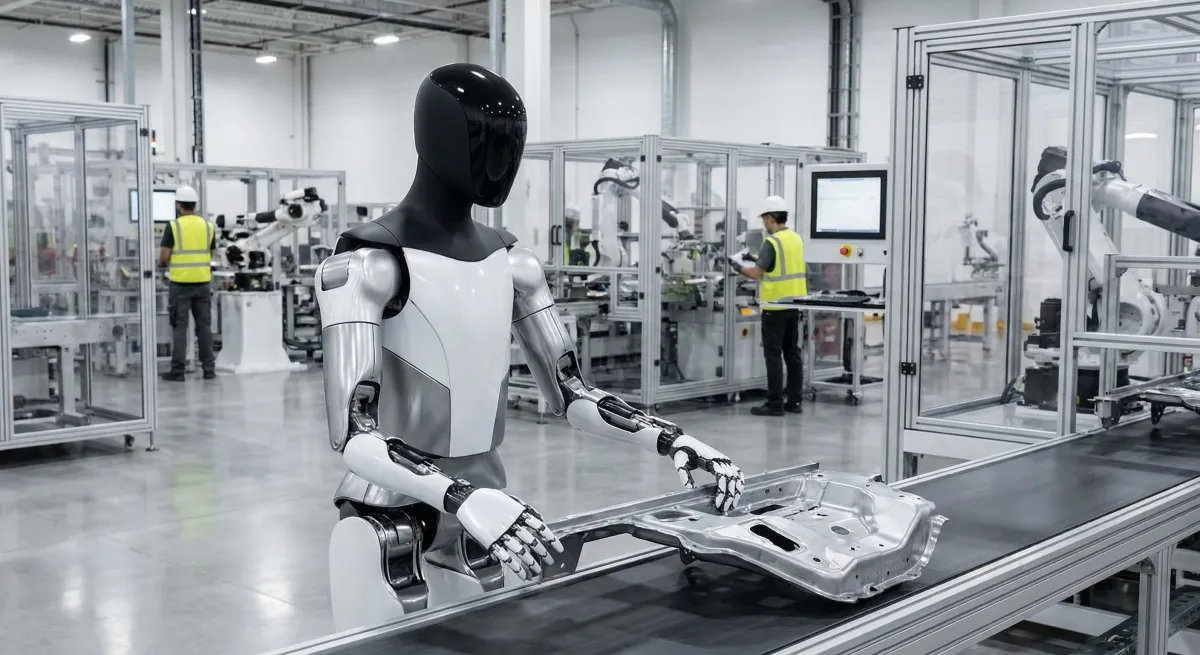
Tesla Optimus: The "Model T" of Robotics
Tesla's Optimus Gen 3 represents a fundamentally different approach to humanoid robotics. While competitors focus on cutting-edge capabilities and research milestones, Tesla is betting on mass manufacturing and aggressive cost reduction—the same playbook that made it the world's most valuable automaker.
The company is targeting a production cost of $20,000 to $30,000 per unit, drastically below the $140,000-$150,000 price point of research-focused platforms like Boston Dynamics' Atlas. Tesla plans to leverage its automotive supply chain, manufacturing expertise, and Full Self-Driving AI infrastructure to achieve economies of scale no competitor can match.
Elon Musk has set an ambitious target: 1 million humanoid robots per year. To support this, Tesla is dedicating a significant portion of its $20 billion 2026 capital expenditure budget to Optimus production. Early units are already deployed in Tesla factories, performing tasks like parts sorting, quality inspection, and material transport.
Industry analysts describe Optimus as the "Model T" of robotics: it won't be the most agile or capable, but it will be the most widely available and affordable. For businesses evaluating humanoid deployment, that calculus matters more than bleeding-edge capabilities.
Apptronik's $520M Bet on Apollo
On February 11, 2026, Texas-based Apptronik announced a $520 million Series B funding round at a $5 billion valuation, signaling that investors believe the humanoid market is real and imminent. The funding will accelerate production of Apollo, Apptronik's general-purpose humanoid designed for logistics and manufacturing.
Apptronik's pitch centers on beating both Chinese competitors and Tesla Optimus to market with a commercially viable product. Unlike Tesla, which is vertically integrated around automotive manufacturing, Apptronik is positioning Apollo as a platform for third-party deployment across industries—a "robotics-as-a-service" model.
The company faces stiff competition. Its direct rivals include Figure AI (backed by OpenAI, NVIDIA, Amazon, and Microsoft), Agility Robotics (Digit robot, deployed at Amazon facilities), and 1X Technologies. Each startup is racing to secure deployment partnerships, lock in supply chain capacity, and prove unit economics at scale.
What's striking is the sheer amount of capital flowing into the sector. Venture investors, traditionally skeptical of hardware plays, are now betting that foundation models for robotics—vision-language-action (VLA) systems trained on internet-scale data—have made general-purpose humanoids economically viable for the first time.
China's Quiet Dominance
While Western media focuses on Tesla and Silicon Valley startups, China has quietly captured 90% of the global humanoid robot market. Companies like Unitree, Fourier Intelligence, and UBTech are shipping thousands of units at price points Western competitors can't touch.
Unitree's G1 humanoid retails for approximately $16,000—less than half the cost of Optimus and a fraction of Boston Dynamics' Atlas. The company demonstrated extreme durability when its G1 model completed over 130,000 steps in -47.4°C temperatures in early February 2026, setting an industry benchmark for harsh-environment operation.
Chinese manufacturers benefit from vertical integration across the robotics supply chain: motors, actuators, sensors, control systems, and AI chips are all produced domestically. This gives them cost advantages Western startups—reliant on global component sourcing—struggle to match.
For sheer hardware value per dollar, the Chinese sector is unbeatable. The strategic question for Western companies isn't whether Chinese humanoids are cheaper (they are), but whether software, AI integration, and service ecosystems can justify premium pricing.
The Labor Question: Robot Taxes and Displaced Workers
The rapid deployment of humanoid robots is triggering a political reckoning. Shawn Fain, president of the United Auto Workers (UAW), has called for a "robot tax" to fund safety nets for displaced manufacturing workers. The proposal echoes calls from economists and policymakers concerned about technological unemployment.
The core argument: if robots replace human workers, the productivity gains and corporate profits should fund retraining, education, and social support for those displaced. Without such mechanisms, automation accelerates inequality—companies and shareholders capture the benefits while workers bear the costs.
Opponents argue robot taxes would slow adoption, harm competitiveness, and ultimately cost more jobs by driving manufacturing offshore. The debate is heating up as deployment scales beyond pilot programs into full production.
What's undeniable is that humanoid robots are no longer a curiosity. Industry forecasts project over 100,000 humanoid shipments in 2026, with exponential growth expected through the end of the decade. That's not enough to transform labor markets overnight, but it's enough to start shifting corporate capex decisions and workforce planning.
Use Cases: Where Humanoids Are Deploying First
The initial wave of humanoid deployment is concentrating in three sectors:
Manufacturing and Assembly
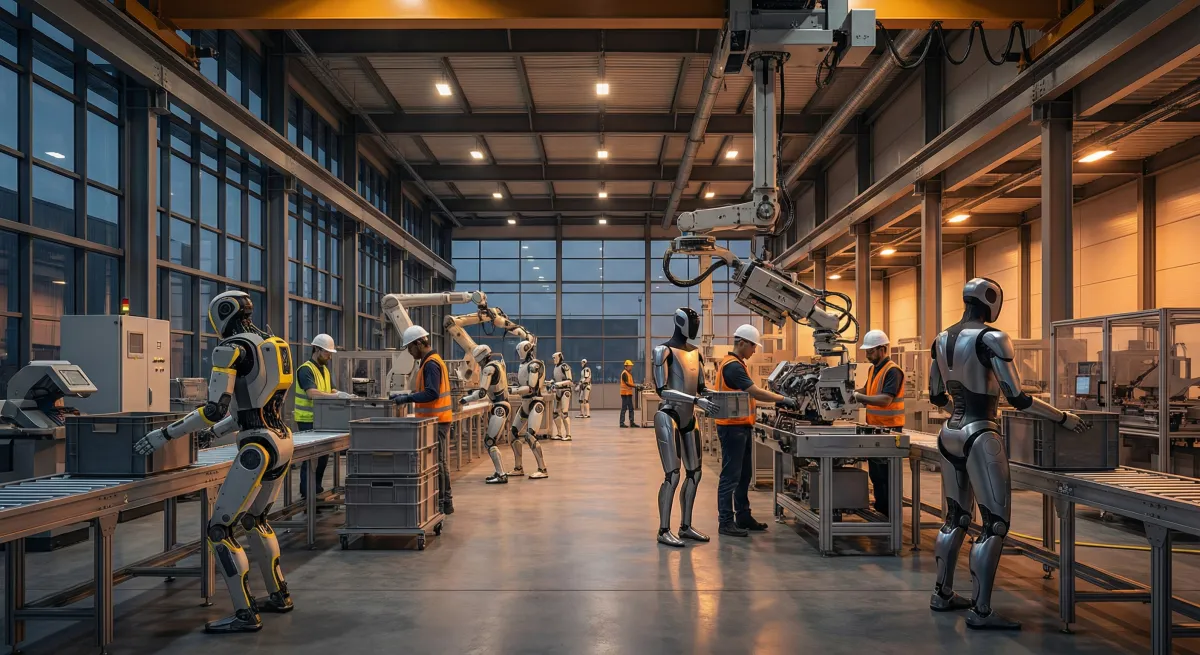
Tesla, BMW (Figure AI partnership), and Hyundai (Boston Dynamics Atlas pilot) are deploying humanoids for tasks requiring dexterity and adaptability: parts handling, quality inspection, tool operation. Unlike fixed industrial robots, humanoids can navigate human-designed workspaces and use existing tools without retrofitting production lines.
Logistics and Warehousing
Amazon is piloting Agility Robotics' Digit for package handling and bin sorting. The promise: humanoids can work in existing warehouse infrastructure, climb stairs, and handle irregular-shaped objects that defeat traditional automation.
Hazardous Environments
Extreme temperatures, toxic materials, and dangerous industrial settings are natural early adopters. Unitree's cold-weather demonstrations and deployment in mining operations showcase humanoids' potential in environments where human safety is a concern.
Notably absent from deployment plans: consumer homes and general service roles. Despite hype around domestic robots, the technology, cost, and safety challenges make commercial and industrial applications far more viable in the near term.
The Technical Reality Check
While headlines celebrate humanoid breakthroughs, the technical challenges remain substantial. Battery life, manipulation dexterity, real-time decision-making, and safety systems are all works in progress. Most deployed humanoids still operate in semi-structured environments with human oversight—full autonomy remains years away.
Boston Dynamics' Atlas demonstrates jaw-dropping dynamic movement (backflips, parkour), but it's not commercially available and remains a research platform. Figure AI's demonstrations show impressive end-to-end learning, but scaling those capabilities to diverse real-world tasks is an unsolved problem. Tesla's Optimus prioritizes manufacturability over cutting-edge performance, but that means early units will be slower and less capable than competitors.
The gap between demo videos and production-ready systems is larger than most coverage suggests. But the trajectory is clear: improvements in AI (vision-language models, imitation learning, sim-to-real transfer) are accelerating progress faster than hardware advances alone could achieve.
The 2030 Outlook
By 2030, industry analysts project annual humanoid shipments could reach 1-2 million units globally. If Tesla hits its 1 million unit target, it will command significant market share even as Chinese manufacturers scale volume production.
The economic impact will depend on deployment velocity and use-case breadth. If humanoids remain confined to niche applications (hazardous environments, specialized manufacturing), labor market disruption will be minimal. But if costs drop below $10,000 and capabilities generalize, the S-curve adoption in logistics, hospitality, and construction could reshape entire sectors.
For policymakers, the question isn't whether to prepare for robot labor—it's how fast it arrives and whether safety nets, retraining programs, and economic redistribution mechanisms can scale in time.
For businesses, the calculus is simpler: labor shortages in developed economies, rising wages, and chronic recruitment challenges make robotics increasingly attractive. The companies that figure out integration, workflow redesign, and human-robot collaboration first will gain structural cost advantages their competitors can't match.
The humanoid robot race isn't just about technology. It's about who controls the future of work.