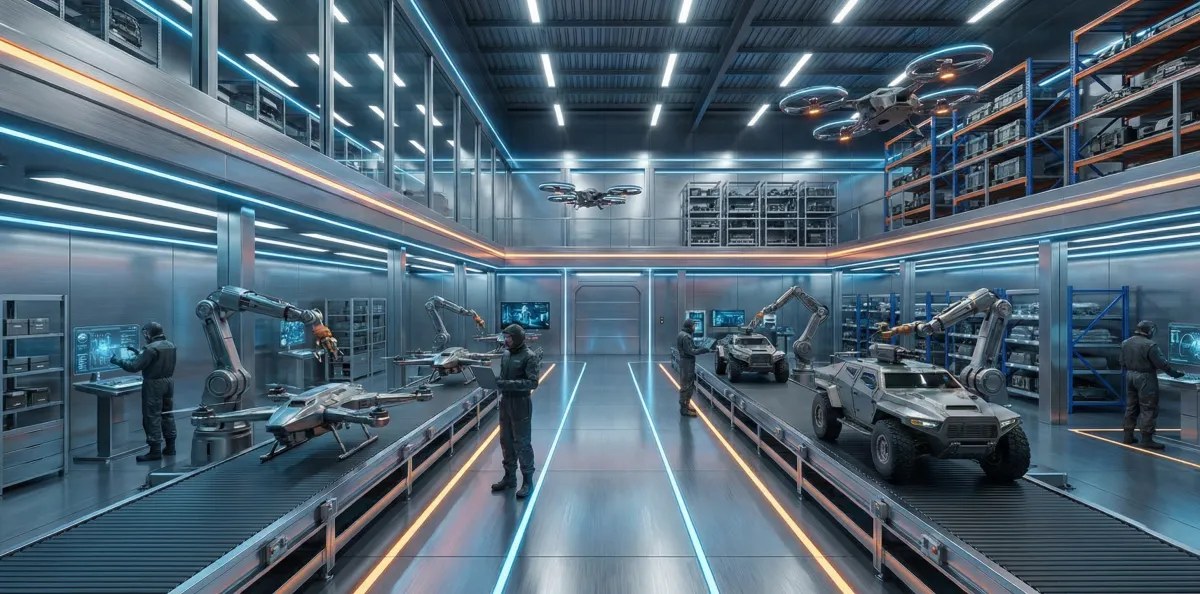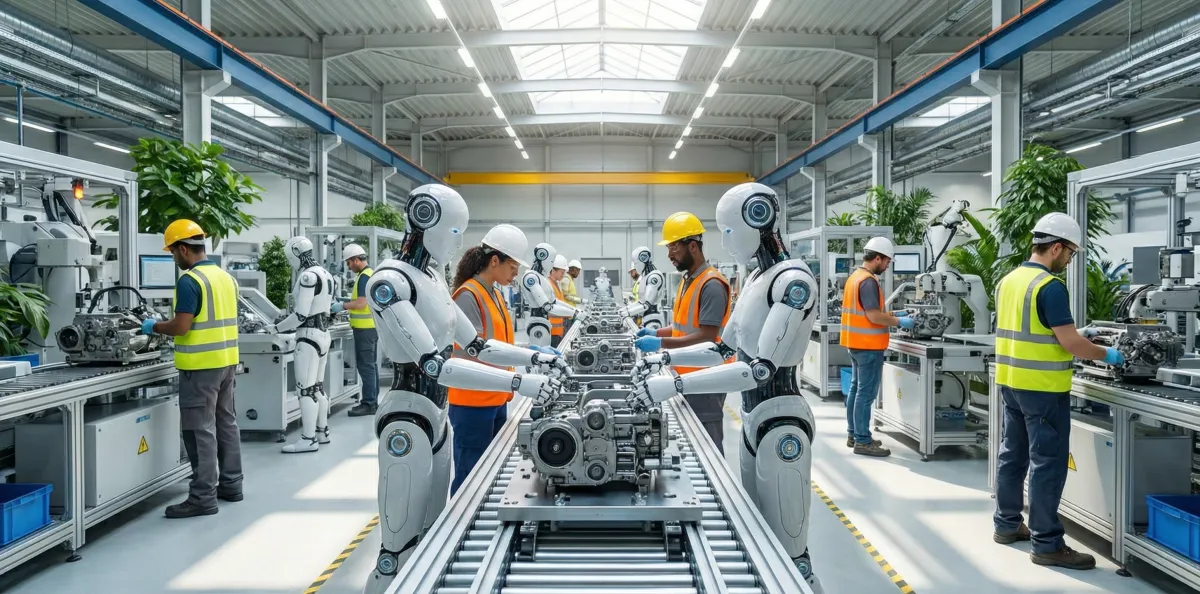
If 2024 was the year of speculation and 2025 was the year of demonstration, 2026 is shaping up to be the beginning of scaled deployment for humanoid robots. Commercial units are now operating at Amazon, GXO Logistics, BMW, Mercedes-Benz, and Tesla facilities. And the capital flowing into the space suggests the market believes this is real.
Who's Actually Deploying?
The field has narrowed to a handful of companies with genuine commercial traction:
- Figure AI raised $1 billion in funding in 2025 and has emerged as a frontrunner in commercial deployment. Its robots are operating in BMW manufacturing facilities, performing tasks like tote carrying, parts inspection, and machine tending.
- Apptronik closed a massive $520 million funding round in February 2026 at a $5 billion valuation, bringing its total Series A to $935 million. Its Apollo robots are operating in designated areas at factories and warehouses run by strategic partners including Mercedes-Benz, GXO Logistics, and Jabil, focused on intralogistics tasks like palletizing and depalletizing.
- Tesla's Optimus reached its third generation (Gen 3). Elon Musk announced plans to scale production to 5,000 units by end of 2025, projecting humanoid robotics could account for 80% of Tesla's future value. However, independent reporting suggests production in 2025 was in the hundreds rather than thousands.
- Agility Robotics' Digit has moved from prototype to commercial warehouse work with Amazon, making it one of the first humanoid-form-factor robots in ongoing production use at scale.
- 1X Technologies, backed by OpenAI, continues developing its NEO humanoid for security and facility management applications.
The Funding Tells the Story
The venture capital numbers are extraordinary. Figure AI's $1 billion raise. Apptronik's $935 million total Series A. These aren't seed rounds — they're war chests for manufacturing scale-up. Goldman Sachs and Bank of America Global Research project 50,000 to 100,000 humanoid units could be deployed by the end of 2026, a dramatic acceleration from the hundreds currently operating.
What Can They Actually Do?
It's critical to separate the demo reel from reality. Today's humanoid robots excel at a specific category of tasks: repetitive, physically structured activities in controlled environments. They can walk, carry boxes, perform pick-and-place operations, and follow programmed routines with increasing reliability.
What they cannot yet do reliably is handle the unstructured complexity that humans navigate effortlessly: adapting to unexpected obstacles, manipulating objects with fine motor dexterity, or responding to novel situations without explicit programming. The gap between "impressive demo" and "reliable 24/7 worker" remains significant — though it's closing faster than most expected, driven in large part by advances in vision-language models and sim-to-real transfer learning.
Workforce Implications
In the near term, humanoid robots will primarily supplement rather than replace human workers. They're targeting the most physically taxing and repetitive roles — the same positions that already suffer from the highest turnover and the most workplace injuries. Apptronik, Agility, and Figure have all specifically framed their robots as solutions for roles that are difficult to fill rather than roles they want to eliminate.
The medium-term outlook (2028-2032) is less certain. As capabilities improve and costs decline through manufacturing scale, robots will likely expand into a broader range of roles. The key variable is the pace of AI advancement in dexterous manipulation and adaptive planning.
Our Take
The humanoid robotics industry has crossed the proof-of-concept threshold. Real robots are working real shifts in real facilities, backed by billions in venture capital and strategic partnerships with major manufacturers and logistics companies. The question is no longer "will humanoid robots work in commercial settings?" — it's "how fast can they scale, and how quickly will capabilities improve?"
Goldman Sachs' projection of 50,000-100,000 units by end of 2026 may be aggressive, but even a fraction of that number represents a meaningful commercial market. The loading dock was just the first stop.