In the flat farmland outside Columbus, Ohio, construction crews are building what may be the most significant shift in American defense manufacturing since the Arsenal of Democracy mobilized during World War II. But this time, the weapons rolling off the line won't be built by aerospace giants like Boeing or Lockheed Martin. They'll be produced by Anduril Industries — a seven-year-old startup founded by the creator of the Oculus VR headset.
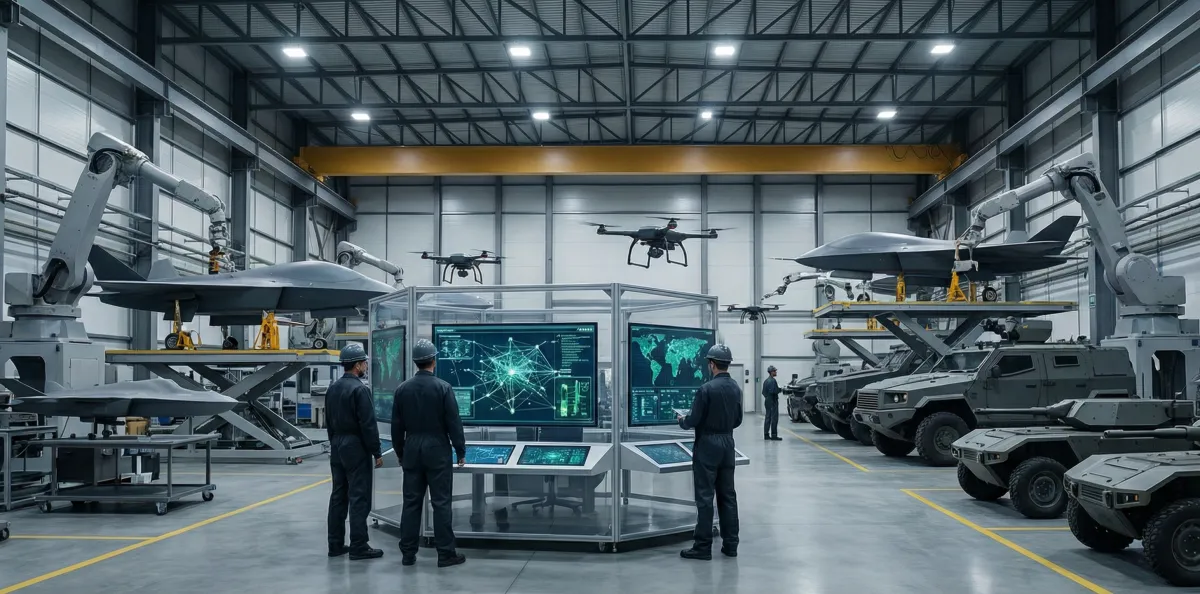
The facility, dubbed Arsenal-1, is designed to manufacture tens of thousands of autonomous weapons systems annually using AI-driven production techniques borrowed from Tesla and Amazon. It represents a generational bet that software-defined warfare, mass production, and Silicon Valley speed can outpace the slow-moving defense industrial base that has dominated American military procurement for decades.
From Virtual Reality to Lethal Autonomy
Palmer Luckey's path from teenage VR tinkerer to defense industry disruptor is unconventional even by Silicon Valley standards. After selling Oculus to Facebook for $2 billion in 2014, Luckey found himself at odds with the company's executive leadership over his political views and was forced out in 2017. Within months, he founded Anduril Industries, named after the reforged sword from The Lord of the Rings — a weapon that only the rightful king could wield.
The metaphor is deliberate. Anduril's mission, as articulated by Luckey and the company's leadership, is to ensure that advanced military technology remains in the hands of the United States and its allies, rather than adversaries. The company has positioned itself as the antithesis of the traditional defense contractor: fast-moving, software-first, and unapologetically pro-military.
The $30.5 Billion Valuation
Anduril's rapid ascent has been remarkable. The company was valued at $30.5 billion as of June 2025, making it one of the most valuable private defense contractors in the world. It ranked #1 on CNBC's 2025 Disruptor 50 list, ahead of companies like SpaceX and OpenAI.
The valuation is backed by real contracts and deployments. Anduril systems are currently operational along the U.S.-Mexico border, where its autonomous surveillance towers detect and track border crossings. The company has won contracts with the U.S. Marine Corps, Special Operations Command, and allied militaries in Australia and the United Kingdom. Its loitering munitions — small, expendable drones that can autonomously identify and strike targets — have been deployed in conflict zones, though the company does not disclose operational details.
Arsenal-1: Hyperscale Defense Manufacturing
In January 2025, Anduril announced the Arsenal-1 project: a hyperscale manufacturing facility near Rickenbacker Airport in Columbus, Ohio. The plant will add approximately 4,000 jobs to the region and is designed to produce autonomous systems at a scale that traditional defense contractors cannot match.
Traditional defense manufacturing operates on low-rate production schedules. A fighter jet program might produce a few dozen aircraft per year. An advanced missile system might produce a few hundred units annually. Arsenal-1 is designed to manufacture tens of thousands of autonomous weapons systems per year — a volume that represents a fundamental shift in production philosophy.
The facility leverages techniques from commercial manufacturing: modular design, software-defined hardware, automated assembly, and continuous iteration. Anduril's products are designed to be inexpensive enough to be expendable in combat while sophisticated enough to outperform legacy systems. The company calls this approach "affordable mass."
Lattice: The AI Platform Powering Anduril's Systems
At the core of Anduril's technology stack is Lattice, an AI-powered software platform that integrates sensors, analyzes data in real time, and coordinates autonomous systems. Lattice can fuse inputs from radars, cameras, acoustic sensors, and satellite feeds to create a unified picture of a battlefield or border region.
The platform uses machine learning models to identify and classify objects — distinguishing between civilian vehicles, military hardware, and potential threats. It can autonomously task drones to investigate anomalies, track targets across multiple sensors, and recommend actions to human operators. In some configurations, Lattice can execute pre-authorized actions autonomously, though the company maintains that lethal decisions always require human approval.
Lattice is modular and designed to run on edge devices with limited computational power, enabling autonomous operation even when communications with central command are degraded or severed. This approach — known as "edge AI" — is critical for contested environments where adversaries may jam or disrupt networks.
The Product Line: From Surveillance to Strike
Anduril's portfolio spans the full spectrum of autonomous systems:
- Sentry Towers: Autonomous surveillance systems deployed along the U.S. southern border. Each tower uses AI-powered computer vision to detect and track movement across vast areas, alerting operators to potential border crossings.
- Ghost: A family of unmanned underwater vehicles designed for submarine detection and mine countermeasures. Ghost systems can operate autonomously for extended periods, patrolling maritime zones without human intervention.
- Anvil: A counter-drone system that uses computer vision and kinetic interceptors to disable hostile drones. Anvil has been deployed by U.S. forces in the Middle East and provided to Ukraine.
- Altius: A loitering munition that can fly for hours, autonomously search for targets, and strike when commanded. Altius is designed to be launched from ships, aircraft, or ground platforms and can operate in GPS-denied environments.
- Roadrunner: A reusable autonomous interceptor designed to defeat cruise missiles and drones. Unlike traditional air defense missiles, Roadrunner can return to base and be refueled if it doesn't engage a target, dramatically reducing cost per mission.
Recruiting Through Competition: The AI Grand Prix
In early 2026, Anduril launched the AI Grand Prix, a competition designed to identify top engineering talent. Participants compete by programming autonomous drones to navigate complex environments, evade defenses, and complete objectives — all in simulation.
Winners receive fast-tracked job applications, bypassing traditional hiring processes. The competition is part of Anduril's broader strategy to recruit talent directly from the gaming and AI communities, many of whom may not have traditional aerospace or defense backgrounds. The company argues that the skills required to build autonomous systems — machine learning, robotics, real-time systems — are more prevalent in tech startups than in legacy defense contractors.
The Traditional Defense Industry Responds
Anduril's rapid rise has not gone unnoticed by incumbents. Lockheed Martin, Northrop Grumman, and Raytheon have all launched internal innovation divisions, acquired startups, and increased investment in autonomous systems. But the cultural and structural differences remain stark.
Traditional defense contractors operate on multi-year development cycles, extensive oversight, and cost-plus contracting models that incentivize stability over speed. Anduril operates on venture capital timelines, ships minimum viable products, and iterates based on operational feedback. Where a traditional contractor might spend five years and $500 million developing a new system, Anduril aims to field prototypes in months and refine them through deployment.
Palmer Luckey has been outspoken in his criticism of the existing system. In a February 2026 CNBC interview, he argued that the U.S. spends "too much money on the wrong thing," pointing to programs like the F-35 fighter jet — which has cost over $1.7 trillion across its lifecycle — as examples of procurement dysfunction. Anduril's approach, he argues, is to build systems that are "good enough" and cheap enough to be fielded in large numbers, rather than exquisite platforms that are too expensive to risk in combat.
The Ethics of Autonomous Weapons
Anduril's work sits at the center of ongoing debates about the role of AI in warfare. International humanitarian organizations, arms control advocates, and technologists have called for restrictions or outright bans on autonomous weapons systems, arguing that removing human judgment from lethal decision-making crosses a moral line.
Palmer Luckey has taken the opposite position, arguing that there is "no moral high ground in using inferior technology" if it results in more civilian casualties or military losses. In his view, AI-powered systems can be more precise, less prone to error, and faster to respond than human-operated alternatives. He has also argued that adversaries like China and Russia are aggressively developing autonomous weapons, and that unilateral restraint by the U.S. would amount to strategic surrender. The U.S. Army's recent autonomous-first combat strategy reflects this shift toward AI-powered battlefield systems.
Anduril maintains that all of its systems preserve "meaningful human control" — operators can override autonomous decisions, and weapons release authority remains with human commanders. However, as autonomous systems become faster and more capable, the practical distinction between human-in-the-loop and human-on-the-loop continues to blur.
The Road to IPO
Anduril is widely expected to pursue an initial public offering within the next two years. An IPO would provide liquidity for early investors, enable further expansion, and mark the arrival of a new generation of defense technology companies in public markets. It would also subject the company to greater scrutiny — both from investors and from regulators concerned about the implications of autonomous weapons.
The company's financial trajectory supports the case for going public. Anduril has grown from a handful of employees in 2017 to over 2,500 as of early 2026, with plans to add thousands more as Arsenal-1 comes online. Revenue details are not disclosed, but the company is believed to be generating hundreds of millions in annual sales, with projections reaching into the billions as large-scale production ramps up.
What Happens Next?
Arsenal-1 is scheduled to begin initial production in late 2026, with full-scale operations expected by 2027. If the facility meets its targets, it will represent a proof of concept that defense manufacturing can operate at commercial scale and speed. Success would likely spur imitators — both among startups and within traditional contractors — accelerating the broader shift toward autonomous, software-defined warfare.
But the project also faces risks. Regulatory scrutiny around autonomous weapons is increasing. Congress has raised questions about oversight and accountability. International allies may impose restrictions on the use of AI-powered systems, limiting export opportunities. And the technical challenges of fielding thousands of autonomous systems — ensuring reliability, security, and interoperability — are non-trivial.
For Palmer Luckey and Anduril, the stakes are existential. The company has bet that the future of defense belongs to those who can build faster, cheaper, and smarter than the incumbents. Arsenal-1 is the proving ground for that thesis. If it works, it will reshape not just how America builds weapons, but how wars are fought.