The United States Army is fundamentally reshaping modern combat doctrine with a sweeping shift toward autonomous systems. Under a new strategy announced this week, unmanned robotic vehicles will lead high-risk ground operations — placing machines, not soldiers, at the tip of the spear in hostile territory.
The pivot comes alongside a $9.8 billion Department of Defense investment in autonomous and unmanned systems development across all service branches, announced February 13. The spending underscores a strategic bet that artificial intelligence and robotics can reduce casualties while maintaining tactical superiority in an era of near-peer competition. This investment parallels private sector efforts like Anduril's $30B push to mass-produce autonomous weapons at commercial scale.
Robots Before Soldiers: A Doctrine Shift
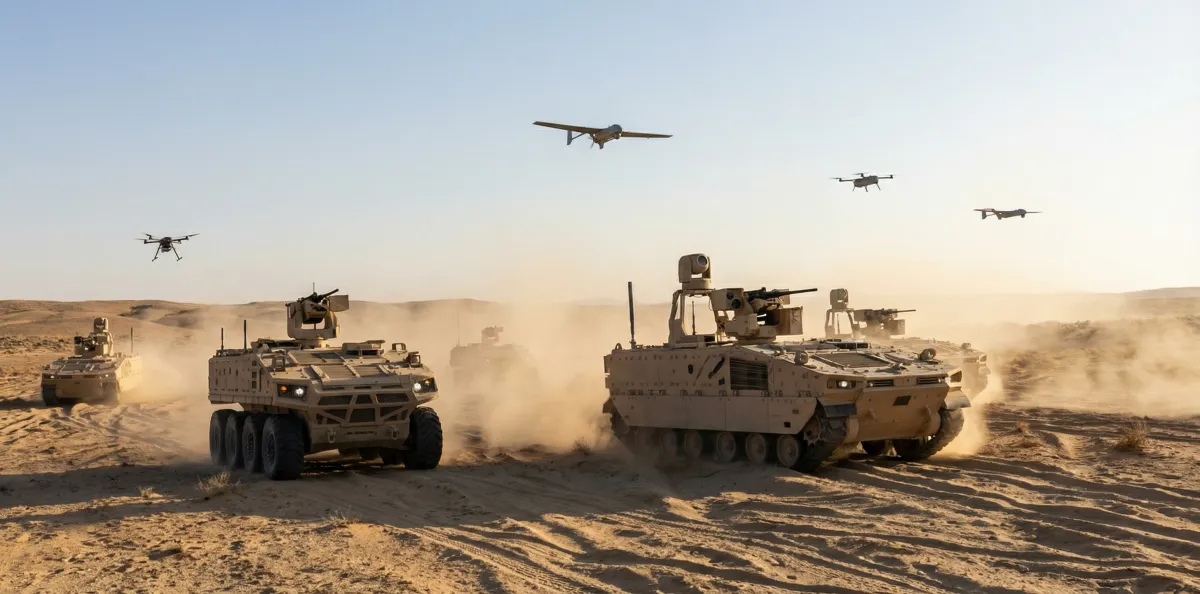
Traditional military doctrine has always prioritized human decision-making at the front lines. That paradigm is now being inverted. The Army's Robotic Combat Vehicle (RCV) program is fielding autonomous platforms capable of reconnaissance, mine-clearing, direct fire support, and logistics — all ahead of crewed units.
At recent field exercises, soldiers demonstrated the new approach: autonomous vehicles like Overland AI's Ripsaw M5 cleared minefields while human operators remained at safe distances. Robotic Combat Vehicles armed with .50-caliber and M240 machine guns provided covering fire as infantry maneuvered into simulated contested areas.
"The goal is not to replace soldiers, but to ensure they're never the first ones in harm's way when a machine can lead instead," said a senior Army official familiar with the program, speaking on background. "We're fundamentally rethinking how ground forces operate."
The Technology Stack
The autonomous systems currently under development rely on a combination of computer vision, lidar, real-time mapping, and AI-based decision algorithms. These platforms use machine learning models trained on thousands of hours of battlefield simulation and real-world terrain data.
Key capabilities include:
- Autonomous navigation: Vehicles can traverse complex terrain without GPS, using sensor fusion and SLAM (simultaneous localization and mapping) algorithms.
- Target recognition: AI models can distinguish between military vehicles, civilian infrastructure, and potential threats in real time. These capabilities build on the same computer vision and AI technologies reshaping law enforcement and surveillance.
- Swarm coordination: Multiple robotic units can communicate and coordinate actions autonomously, adjusting tactics based on battlefield conditions.
- Human-in-the-loop oversight: Despite autonomy, all lethal decisions remain under human control via remote operators.
Field Innovations: 3D Printing and Rapid Adaptation
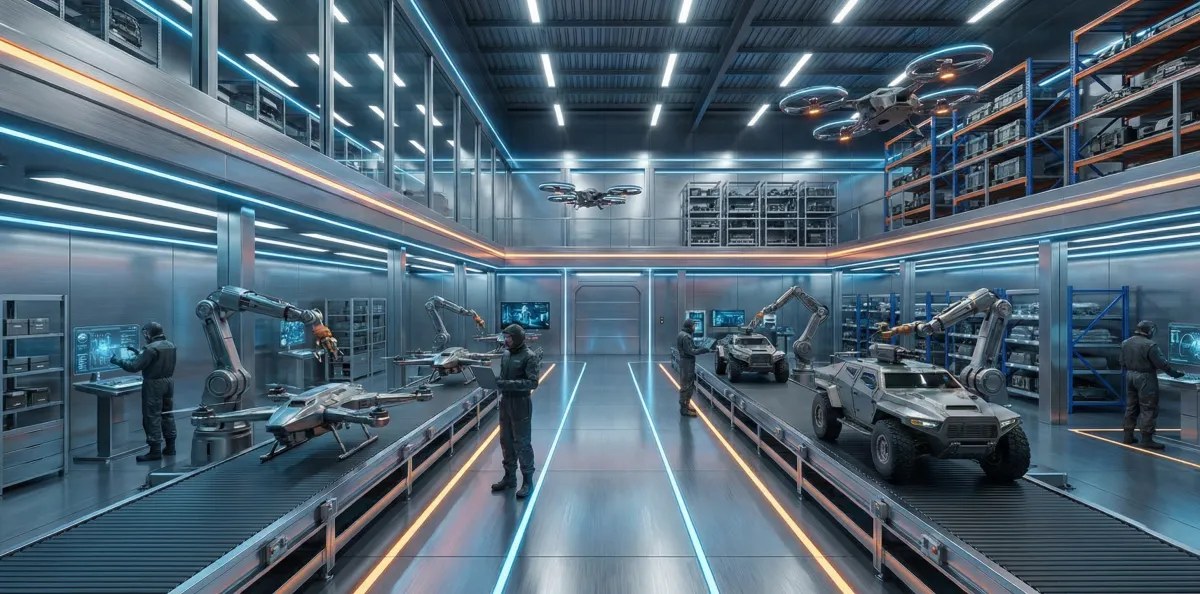
One unexpected development emerging from field tests is the Army's deployment of mobile 3D printing capabilities. During recent exercises, soldiers successfully printed replacement drone components on-site, dramatically reducing downtime and supply chain dependencies.
This capability represents a shift toward expeditionary manufacturing — where forward-deployed units can fabricate mission-critical parts in hours rather than waiting days or weeks for resupply. The technology is being integrated into next-generation autonomous logistics vehicles.
Market Growth and Strategic Competition
The US investment in military AI and robotics is part of a broader global arms race. The AI in defense and aerospace market is projected to grow from $4.2 billion in 2026 to $42.8 billion by 2036, according to industry analysts — a compound annual growth rate of 26.4%.
China, Russia, and other nations are pursuing parallel autonomous warfare programs, creating pressure on the Pentagon to accelerate deployment timelines. Recent Department of Defense strategy documents emphasize speed and scale in AI integration as critical to maintaining technological overmatch.
The Ethical and Legal Landscape
The shift toward autonomous combat systems raises significant ethical and legal questions. International humanitarian law requires human judgment in lethal force decisions, a principle enshrined in the Geneva Conventions and supported by most NATO allies.
The Army maintains that all systems in development preserve meaningful human control — operators can override autonomous actions, and weapons release authority remains with human commanders. However, as autonomy increases and battlefield tempo accelerates, the practical gap between "human-in-the-loop" and "human-on-the-loop" becomes harder to distinguish.
Arms control advocates have called for international treaties limiting autonomous weapons, citing risks of unintended escalation and civilian harm. So far, no binding agreements have emerged, and development continues across major military powers.
Budget and Deployment Timeline
The $9.8 billion allocation will fund prototyping, testing, and initial production runs across multiple autonomous platforms:
- Robotic Combat Vehicles (RCV): Light, medium, and heavy variants for direct combat support
- Autonomous resupply systems: Unmanned ground and aerial logistics platforms
- Counter-UAS systems: AI-powered drone defense networks
- Intelligence and reconnaissance drones: Autonomous aerial surveillance with edge AI processing
Initial operational deployments are expected by late 2027, with full-scale fielding across brigade combat teams by the early 2030s. The Army is also investing in training infrastructure to prepare soldiers for human-machine teaming operations.
What This Means for the Future of Warfare
The Army's autonomous-first strategy represents more than a technological upgrade — it's a reimagining of how wars are fought. If successful, it will shift the calculus of modern conflict, reducing the political and human cost of military operations while raising the stakes in AI and robotics development.
The move also signals to adversaries that the US is committed to maintaining battlefield dominance through technological superiority, even as traditional force structures shrink. Whether other nations follow suit — or pursue asymmetric counters — will shape the character of 21st-century warfare.
For now, the robots are rolling into position. The question is no longer whether autonomous systems will define the future of ground combat, but how quickly they'll become the new normal.