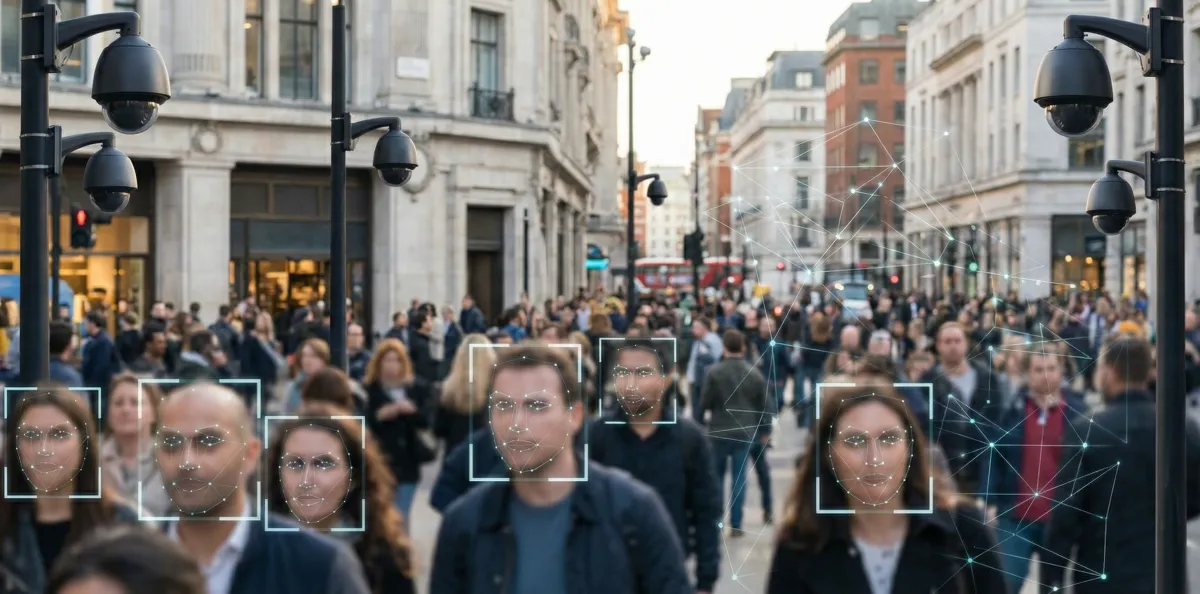
The era of anonymous movement through public space may be ending. A constellation of surveillance technologies — facial recognition, geolocation tracking, social media monitoring — is converging into integrated enforcement platforms that give law enforcement agencies unprecedented visibility into civilian life.
At the center of this shift are companies like Palantir Technologies and Clearview AI, whose systems are being deployed across federal, state, and local agencies. Their tools promise efficiency and security. Critics warn they're building the infrastructure of a surveillance state.
The Clearview Database: 60 Billion Faces and Growing
Clearview AI operates what is likely the world's largest facial recognition database. The company has scraped more than 60 billion images from publicly accessible sources across the internet — social media profiles, news articles, corporate websites, and more. Users upload a photo, and Clearview's algorithm searches this database for matches, returning potential identities in seconds.
The technology works even with low-quality images. A blurry photo from a security camera, a partial face captured at an angle, a years-old social media post — Clearview's system can often find a match. The company claims its accuracy rates exceed those of government-developed facial recognition systems, and it has been validated by the National Institute of Standards and Technology (NIST) in independent testing.
Law enforcement agencies in the United States have used Clearview nearly one million times, according to data disclosed by the company. While initially marketed for serious crimes like child exploitation and assaults on officers, reporting indicates the technology is now used for a much broader range of investigations, including shoplifting and routine identity verification.
ICE's $3.75 Million Investment in Facial Recognition
In early 2026, U.S. Immigration and Customs Enforcement (ICE) signed a $3.75 million contract with Clearview AI — the agency's largest purchase of the technology to date. The contract is part of a broader technology procurement strategy that includes iris-scanning smartphones ($4.6 million from BI2 Technologies) and a $30 million deal with Palantir for its ImmigrationOS platform.
ICE now uses at least two facial recognition programs: Clearview AI and Mobile Fortify, a mobile application that compares biometric information against agency records in the field. Together, these systems enable agents to identify individuals during enforcement operations, cross-reference them against databases, and generate "confidence scores" for deportation targeting.
Palantir's ImmigrationOS: The Integration Layer
Palantir Technologies, the data analytics firm co-founded by Peter Thiel, has become the backbone of ICE's surveillance infrastructure. The company's ImmigrationOS platform integrates data from multiple sources — facial recognition outputs, cellphone geolocation data, social media monitoring, government databases, and third-party data brokers — into a unified interface.
The system allows agents to populate a map with potential enforcement targets, pull up detailed dossiers on each individual, and view address "confidence scores" indicating the likelihood a person will be found at a given location. Palantir also provides generative AI tools for coding assistance, database querying, and metric analysis, though the company maintains these tools are not trained on sensitive agency data.
Palantir has consistently argued that it provides tools, not policy — the company doesn't decide who gets targeted or deported. But design choices shape outcomes. The ease with which an agent can identify, locate, and build a case against an individual determines how enforcement power is exercised on the ground.
The Broader Surveillance Ecosystem
Clearview and Palantir are not operating in isolation. They're part of a growing ecosystem of surveillance vendors whose technologies are being stitched together into comprehensive monitoring platforms:
- Data brokers: Companies that aggregate and sell consumer data, including location histories, purchasing behavior, and associational networks. Some brokers are jointly owned by airline companies and sell travel pattern data to government agencies.
- Social media monitoring tools: Platforms that scrape public posts, analyze networks, and flag individuals based on keywords, affiliations, or behavioral patterns.
- Biometric verification systems: Iris scanners, fingerprint readers, and voice analysis tools that enable identity verification in the field without traditional documentation.
- Geolocation services: Real-time tracking capabilities that fuse cellphone tower data, GPS signals, and Wi-Fi positioning to monitor movement patterns.
What makes this ecosystem particularly powerful is integration. Historically, these capabilities existed in separate systems, managed by different agencies, with limited interoperability. The current generation of platforms — particularly those built by Palantir — breaks down those silos, enabling agencies to query multiple databases, cross-reference findings, and act on combined intelligence in near real-time.
Market Growth and Regulatory Gaps
The facial recognition market is projected to grow at approximately 12% annually over the next several years, driven by demand for contactless authentication, airport security systems, and law enforcement applications. The COVID-19 pandemic accelerated adoption of touchless verification technologies, and those use cases have persisted even as public health concerns have receded.
However, the regulatory landscape remains fragmented. Illinois' Biometric Information Privacy Act (BIPA) and California's Consumer Privacy Rights Act (CPRA) impose restrictions on how biometric data can be collected and used, but many states have no comparable protections. Europe's strict data protection regime has limited real-time surveillance deployments, but has also spurred demand for on-device processing and consent management tools.
At the federal level, oversight remains limited. Congressional scrutiny has increased — particularly around TSA's expansion of facial recognition at airports — but comprehensive legislation has yet to pass. The result is a patchwork system where the same technology may be tightly regulated in one jurisdiction and freely deployed in another.
Privacy Concerns and Civil Liberties
Civil liberties organizations have raised alarms about the scope and scale of surveillance being deployed. Key concerns include:
- Mission creep: Technologies initially justified for narrow use cases (e.g., child exploitation investigations) are being used far more broadly, including for routine immigration enforcement and minor crimes.
- Lack of transparency: Many contracts are awarded through sole-source procurement, limiting public scrutiny. The full capabilities and data sources of platforms like ImmigrationOS are not disclosed.
- Error rates and bias: Facial recognition systems have documented higher error rates for people of color, women, and younger individuals, raising concerns about discriminatory outcomes.
- Data persistence: Images and biometric identifiers are stored indefinitely in most systems, creating permanent records that can be queried and re-analyzed as algorithms improve or use cases expand.
- Chilling effects: The knowledge that one's face, location, and online activity may be monitored can discourage lawful activities like protest, journalism, and political organizing.
Palantir and Clearview have both faced legal challenges. Clearview was fined $33 million by a Dutch data protection authority for maintaining an "illegal database" of facial images scraped without consent. The company has also faced class-action lawsuits in the United States, resulting in a $51.75 million settlement — though the company did not admit wrongdoing.
The Technical Reality: It Works
Whatever the ethical concerns, the technology is effective. Demonstrations by Clearview's CEO have shown the system identifying individuals from grainy, poorly lit photos taken years apart. Law enforcement agencies report that facial recognition has been instrumental in solving cold cases, identifying suspects in violent crimes, and locating missing persons.
Palantir's integration platforms enable workflows that would have been impossible a decade ago. An agent in the field can snap a photo, run it through facial recognition, pull associated social media profiles, map known associates, check border crossing records, and generate an enforcement dossier — all in minutes, from a smartphone.
This capability represents a fundamental shift in the balance of power between individuals and the state. The assumption of anonymity that once governed movement through public space — the ability to walk down a street, attend a protest, or enter a building without generating a persistent, searchable record — is being eroded.
What Happens Next?
The trajectory of surveillance technology is clear: more data, better algorithms, tighter integration. The question is whether regulatory frameworks, oversight mechanisms, and civil liberties protections can evolve quickly enough to impose meaningful constraints.
Some jurisdictions have banned government use of facial recognition. San Francisco, Boston, and Portland have enacted prohibitions, citing privacy and civil rights concerns. But these are outliers. The dominant trend is toward broader adoption, driven by a combination of genuine security needs, vendor lobbying, and the path-of-least-resistance appeal of technological solutions to complex social problems.
For companies like Palantir and Clearview, the business case is straightforward: governments need intelligence capabilities, and they're willing to pay for them. The same forces driving mass production of autonomous weapons systems and autonomous-first military strategies are accelerating surveillance adoption. For civil society, the challenge is more existential: how to preserve privacy, anonymity, and freedom of movement in an era when the infrastructure to eliminate all three already exists.