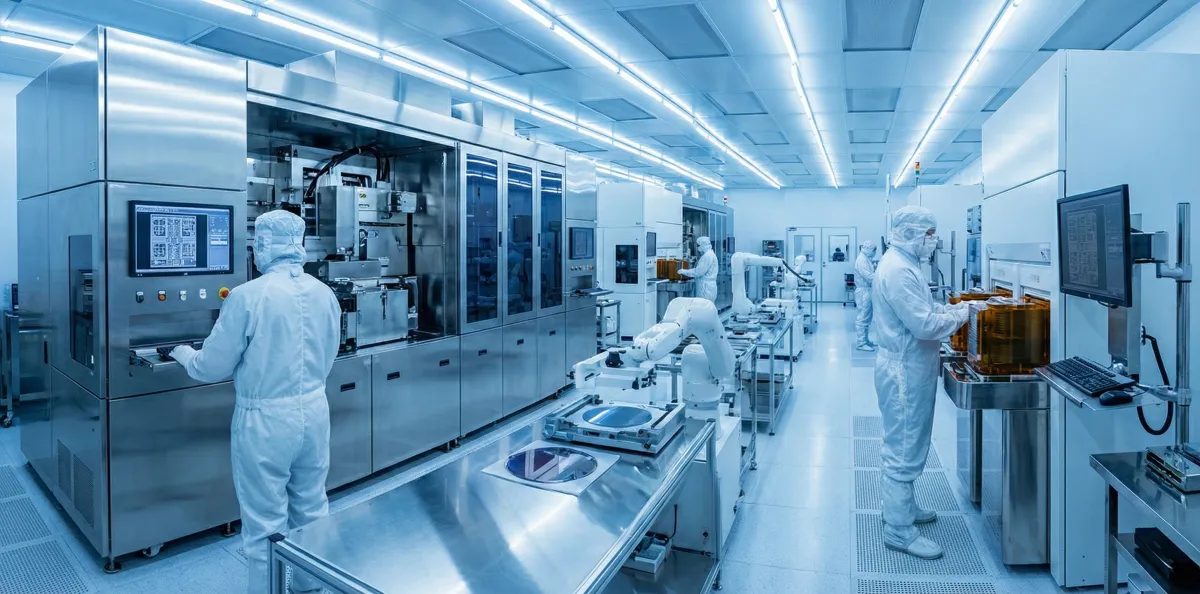
CES 2026 delivered the clearest signal yet that Intel's long-promised foundry revival is real. The company unveiled its Core Ultra Series 3 processors—codenamed Panther Lake—as the first production chips built on Intel 18A, the most advanced process node ever manufactured in the United States. With RibbonFET gate-all-around transistors and PowerVia backside power delivery, 18A represents a fundamental architectural shift. And the competition noticed: NVIDIA and AMD both used CES to unveil their own next-generation platforms, igniting a three-way chip war that will define AI infrastructure through 2027.
18A: Intel's Make-or-Break Node
Intel 18A isn't just an incremental process shrink—it's a wholesale redesign of how chips are built. The node introduces two revolutionary technologies that competitors won't match until 2027 or later:
RibbonFET is Intel's implementation of gate-all-around (GAA) transistors, replacing the FinFET architecture that has dominated since 2011. By wrapping the gate material completely around the channel, RibbonFET delivers better electrostatic control, enabling higher performance at lower power. Intel claims up to 30% improved transistor performance compared to FinFET at equivalent power levels.
PowerVia moves power delivery to the backside of the wafer, separating power and signal routing onto different layers. Traditional chips route both on the front side, creating congestion and limiting optimization. PowerVia reduces voltage drop by up to 6%, improves signal integrity, and enables denser standard cell libraries—critical for AI workloads that demand maximum compute density.
"This is the first time Intel has shipped both technologies together in volume production," notes semiconductor analyst Ben Thompson of Stratechery. "TSMC won't have backside power until N2P in 2026, and Samsung's GAA node is still ramping. If 18A yields hold up, Intel has a genuine process lead for the first time in five years."
Panther Lake: Proof at Scale
Core Ultra Series 3 (Panther Lake) launched at CES 2026 with bold performance claims: 50% faster CPU and GPU performance compared to the previous generation, alongside significant efficiency improvements. The chips target thin-and-light laptops and mini PCs, with configurations ranging from 4 to 16 cores and integrated Xe3 graphics capable of up to 12 TFLOPS.
But the real story is the manufacturing. Panther Lake is being produced at Intel's new Fab 52 in Chandler, Arizona—a $20 billion facility that came online in mid-2025. The successful ramp of 18A production validates Intel's broader foundry strategy and positions the company to compete for external customers.
"We're not just building chips for ourselves anymore," Intel CEO Pat Gelsinger told CES attendees. "18A is open for business. This is proof that Intel Foundry Services can deliver leading-edge nodes at scale."
The timing matters. Intel has committed to reaching "five nodes in four years," a cadence designed to close the gap with TSMC and position IFS as a credible alternative foundry. Panther Lake's successful launch is a critical validation milestone—one that could influence foundry customer decisions worth billions over the next two years.
NVIDIA Strikes Back: Rubin and the Memory Bottleneck
If Intel stole headlines with 18A, NVIDIA reminded everyone who still dominates AI infrastructure. CEO Jensen Huang used his CES keynote to unveil Vera Rubin, the next-generation AI platform set to replace Blackwell in the second half of 2026.
Rubin doubles down on memory bandwidth. Each GPU will feature up to 8 HBM4 memory stacks delivering 1.5TB/s of bandwidth—double Blackwell's capacity. NVIDIA is also introducing a new NVLink fabric capable of 1.8TB/s inter-GPU communication, addressing the scaling bottlenecks that have plagued large language model training.
"AI model sizes are growing faster than Moore's Law," Huang explained. "Memory bandwidth is the new performance limiter. Rubin is purpose-built for trillion-parameter models."
But Rubin faces a supply chain challenge. Samsung and SK Hynix—the only two companies capable of producing HBM4 at scale—are prioritizing data center chips over gaming products. Industry sources suggest HBM4 allocation for AI accelerators generates 12x more revenue per wafer than GDDR memory for gaming GPUs. That's creating an allocation crisis: NVIDIA's GeForce RTX 50-series production could be cut 30-40% in early 2026 as HBM demand surges.
"Memory has become the strategic chokepoint," says memory analyst Mehdi Hosseini at Susquehanna. "Whoever secures HBM allocation wins the AI race. NVIDIA knows this—Rubin's architecture is as much about locking up supply as it is about performance."
AMD's Counter-Move: Ryzen AI 400 and Data Center Push
AMD arrived at CES 2026 with a two-pronged strategy: dominate AI PCs with Ryzen AI 400 "Gorgon Point" processors, and challenge NVIDIA in the data center with MI455 and MI500 accelerators.
Ryzen AI 400 features refined Zen 5 CPU cores alongside a massively upgraded NPU delivering up to 180 platform TOPS (tera operations per second)—triple the AI performance of the previous generation. AMD is positioning these as the chips for on-device AI, targeting Microsoft's Copilot+ PC requirements and local inference workloads.
The flagship Ryzen AI Max+ 395 maintains a competitive 50 TOPS NPU while emphasizing high-bandwidth unified memory—a design choice that benefits integrated graphics and AI workloads equally. AMD claims Ryzen AI 400 offers 40% better AI performance per watt than Intel's competing solutions, though independent benchmarks remain pending.
In the data center, AMD showcased its MI455 and MI500 accelerators designed to compete directly with NVIDIA's H200 and upcoming Rubin platforms. The MI500, expected in Q4 2026, will feature 192GB of HBM3e memory and support for AMD's new Infinity Fabric 5.0 interconnect.
"AMD is betting that open software ecosystems will eventually break NVIDIA's CUDA moat," notes Dylan Patel of SemiAnalysis. "ROCm is improving rapidly, and cloud providers are desperate for competitive alternatives. If AMD can hit performance parity at 70% of NVIDIA's price, hyperscalers will bite."
The Foundry Wild Card
Beyond the headline products, CES 2026 exposed the strategic importance of foundry access. Intel, TSMC, and Samsung are all racing to expand capacity, but allocation is already becoming a weapon.
TSMC's 2nm N2 node entered mass production in late 2025, with Apple and NVIDIA reportedly securing 100% of initial capacity. That leaves AMD, Qualcomm, and others waiting until 2027 for access—a delay that could hand Intel an unexpected window.
Intel is aggressively courting fabless chip designers. The company announced that its 18A-FDK (foundry design kit) is now available to external customers, and rumored early adopters include Qualcomm and Amazon (for custom Graviton CPUs). If Intel can attract even a handful of high-volume customers, it would validate the foundry model and diversify revenue beyond traditional PC and server chips.
"The real question is whether Intel can execute," says Stacy Rasgon, semiconductor analyst at Bernstein. "18A proves they can build competitive nodes. But running a foundry business means hitting customer schedules, managing multi-project wafers, and supporting external design teams—skills Intel hasn't historically demonstrated. Panther Lake is step one. Now comes the hard part."
2026: The Year of Consequences
The chip wars unveiled at CES 2026 will play out across the year in foundry capacity, HBM allocation battles, and software ecosystem development. Intel has proven 18A works in production. NVIDIA has bet its roadmap on memory bandwidth. AMD is pushing multi-die designs and open software.
And beneath it all, geopolitics looms. Intel's Arizona fabs, TSMC's planned U.S. facilities, and the CHIPS Act's $52 billion in subsidies are reshaping where advanced chips are made. Panther Lake isn't just Intel's comeback—it's a proof point for domestic semiconductor manufacturing.
The stakes extend beyond earnings reports. AI infrastructure, autonomous systems, and advanced weapons platforms all depend on leading-edge chips. The company that controls process leadership, memory supply, and foundry capacity will shape the next decade of technology.
CES 2026 made one thing clear: the chip wars are no longer about mobile processors or gaming GPUs. They're about who builds the silicon that powers artificial intelligence. And every major player just showed their hand.