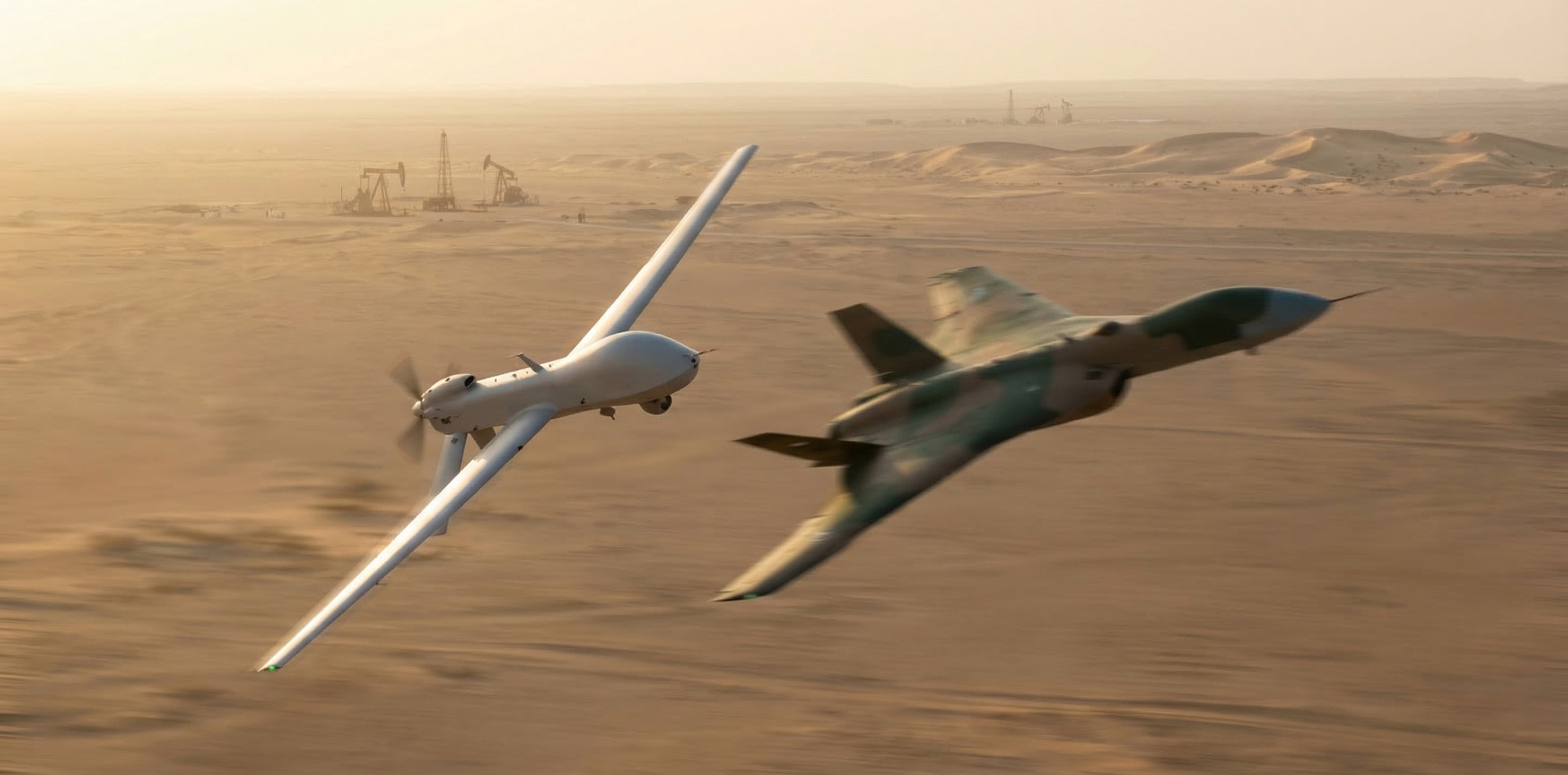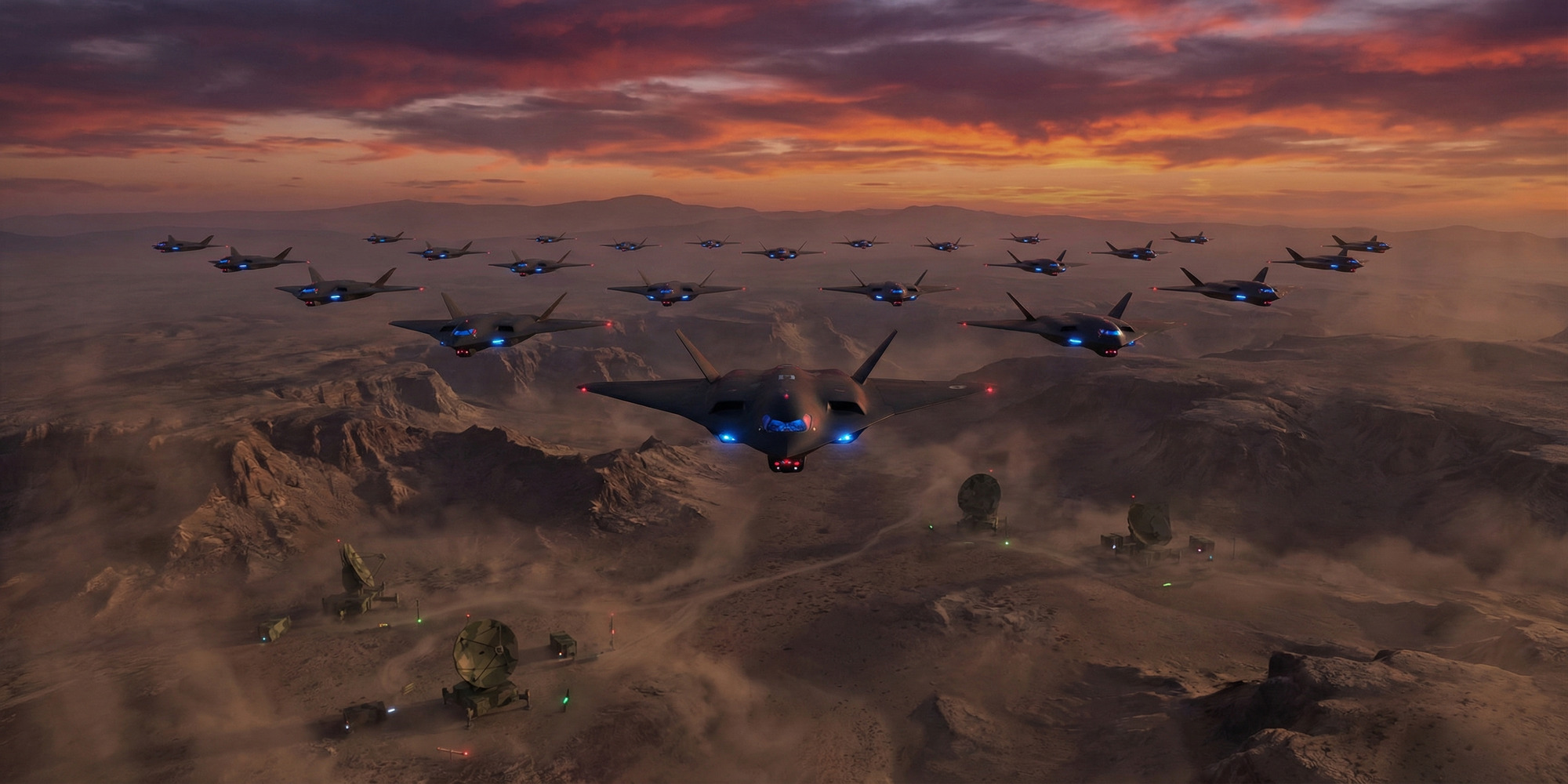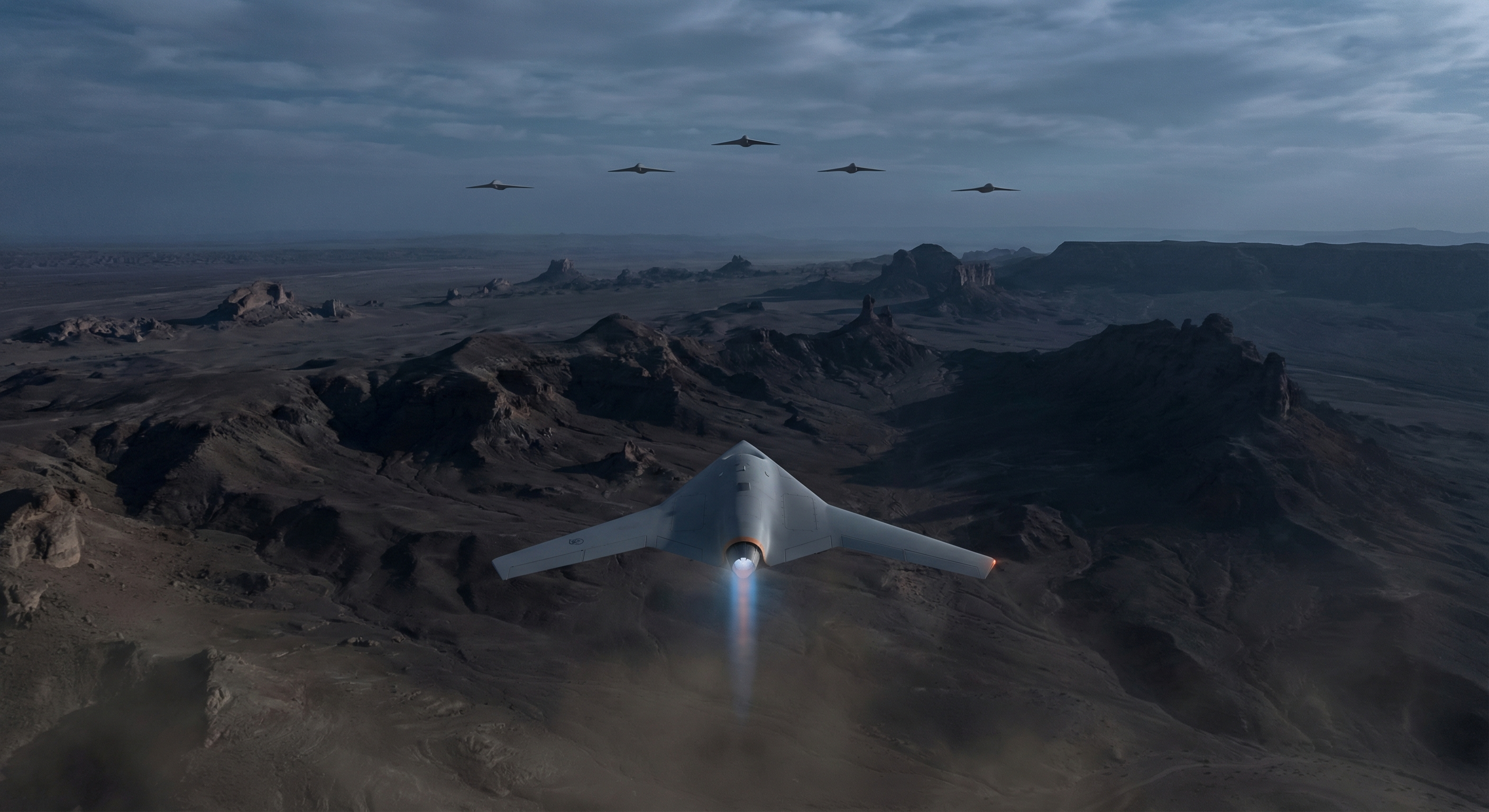
On February 28, as the first wave of Operation Epic Fury strikes tore through Iranian air defense networks, a new weapon entered combat for the first time: the Low-cost Unmanned Combat Attack System, known as LUCAS. Built by an Arizona startup from the reverse-engineered bones of Iran's own Shahed-136, LUCAS is a $35,000 AI-guided kamikaze drone that can be launched from a catapult, a ship, or a truck bed — and it just delivered what U.S. Central Command called "massive effects" on Iranian targets. The story of how it got there is a crash course in how America is rethinking the economics of modern warfare.
The Drone That Humiliated the World's Most Expensive Air Defenses
The Shahed-136 is not a sophisticated weapon. Iran's delta-winged loitering munition uses a modified lawn mower engine, a basic autopilot, and enough explosives to punch through light armor or destroy radar installations. Its maximum range is estimated at around 1,200 miles. Each unit costs approximately $30,000 to produce. And Iran launched more than 2,000 of them in the opening days of Operation Epic Fury.
The result was a brutal exposure of America's air defense cost asymmetry. Intercepting a $30,000 Shahed with an $800,000 AIM-120 AMRAAM — or a $10 million Patriot PAC-3 — is not a sustainable strategy at scale. As TTN reported earlier this week, the U.S. fired more than 800 Patriot interceptors in the conflict's first three days, draining stockpiles built for a different threat environment. The math doesn't work. The Pentagon has known it for years.
What's new is that the U.S. now has an answer with the same basic economics — and the irony is that Iran handed it to them.
From Wreckage to Weapon: The Origins of LUCAS
According to officials who spoke to CNN, the LUCAS program began when U.S. forces recovered a damaged Shahed drone several years ago — likely from the Middle East or Ukraine, where Iran supplied the weapons in large numbers for use against Ukrainian cities. Engineers dissected it. They understood the basic design: a delta-wing fuselage, a piston engine driving a rear-mounted propeller, and a nose packed with explosives.
The engineering task given to SpektreWorks, an Arizona-based defense startup, was not to replicate the Shahed. It was to improve on it. What emerged — the LUCAS platform, derived from SpektreWorks' FLM 136 target drone — retained the Shahed's core design philosophy (cheap, simple, attritable) while upgrading almost everything that mattered.
Where the Shahed-136 carries between 60 to 100 pounds of explosives, LUCAS is optimized differently: it carries approximately 40 pounds of munitions with a maximum takeoff weight of 180 pounds — significantly lighter than the Iranian original. That reduced payload is paired with better accuracy, thanks to modern American guidance systems. The effective yield per strike is higher despite the smaller warhead. According to defense analyst Alex Hollings of Sandboxx News, LUCAS's 40-pound payload delivers "roughly twice the explosive yield of a Hellfire missile" against hardened targets.
Range is approximately 500 miles — shorter than the Shahed-136's 1,200-mile maximum, but considerably more accurate, and sufficient for the strike distances involved in the Iran campaign. Most critically, LUCAS can be launched from catapults, rocket-assisted takeoff systems, and mobile ground and vehicle platforms. In December 2025, the Navy successfully launched a LUCAS from the littoral combat ship USS Santa Barbara in the Arabian Gulf — the first ship-launched LUCAS operation on record.
What Makes LUCAS Different: AI, Swarms, and Anti-Jam
The biggest departure from the Shahed isn't the airframe. It's what's inside. LUCAS incorporates artificial intelligence guidance systems that allow it to "think" autonomously during flight — adjusting course, acquiring updated target data, and maneuvering in coordination with other LUCAS units as part of a swarm. This capability makes the drone substantially harder to defeat using traditional electronic warfare techniques.
During testing, CENTCOM paired LUCAS drones with advanced satellite communications systems, according to Reuters. Strong satellite uplinks protect the guidance system from jamming or GPS spoofing attempts — the two most common countermeasures Iran and its proxies deploy against loitering munitions. The Shahed-136 is vulnerable to both; LUCAS is engineered to resist them.
The swarming capability is particularly significant. Rather than operating as individual weapons that can be intercepted one by one, LUCAS units can operate in coordinated formations that overwhelm air defenses through simultaneous multi-vector attacks. This is the same tactic Iran used to devastating effect in the war's opening salvo — except LUCAS units are smarter, harder to jam, and more precise.
Task Force Scorpion Strike: America's New Drone Army
LUCAS didn't enter combat alone. It was fielded through Task Force Scorpion Strike — the first dedicated one-way-attack drone squadron in U.S. military history, led by U.S. Special Operations Command-Central personnel and formally established in December 2025.
"This new task force sets the conditions for using innovation as a deterrent," Adm. Brad Cooper, commander of U.S. Central Command, said at its launch. "Equipping our skilled warfighters faster with cutting-edge drone capabilities showcases U.S. military innovation and strength, which deters bad actors."
The task force's formation was directly mandated by a July 2025 memo from Defense Secretary Pete Hegseth titled "Unleashing U.S. Military Drone Dominance." Hegseth directed the services to accelerate acquisition and fielding of affordable autonomous systems across every branch, explicitly calling out bureaucratic risk-aversion as the primary obstacle to deployment speed. "To simulate the modern battlefield, senior officers must overcome the bureaucracy's instinctive risk-aversion on everything from budgeting to weaponizing and training," Hegseth wrote.
Task Force Scorpion Strike is the operational output of that directive — a purpose-built unit designed to absorb new drone systems rapidly and integrate them into live combat operations. LUCAS was its first real-world test. By all early accounts, it passed.
The Economics of Attritable Warfare
At $35,000 per unit, LUCAS costs roughly 1.5% of a Tomahawk Land Attack Missile, which carries a unit cost of approximately $2.4 million. That's not a marginal efficiency improvement — it's a category shift. A single Tomahawk buys 68 LUCAS drones. A single Patriot PAC-3 interceptor costs roughly 285 LUCAS rounds.
This arithmetic is reshaping how the Pentagon thinks about munitions procurement and operational planning. Loitering munitions can absorb attrition in ways that cruise missiles and precision-guided bombs cannot. If Iran shoots down 20% of an incoming LUCAS swarm with electronic warfare, the remaining 80% still hit their targets — and the total cost of the operation was a fraction of an equivalent Tomahawk strike.
The Pentagon's One Big Beautiful Bill spending plan reflects this economic logic, allocating billions toward scalable low-cost autonomous systems rather than premium precision munitions. LUCAS is the leading edge of that doctrine playing out in real combat.
LUCAS does have real limitations. Its 500-mile range is substantially shorter than the Tomahawk's 1,000+ mile reach. It cannot penetrate hardened underground facilities the way a bunker-buster can. And unlike sophisticated cruise missiles such as L3Harris's Green Wolf — designed for electromagnetic spectrum warfare — LUCAS is a kinetic weapon only. It hits hard and it hits cheap, but it doesn't collect intelligence or suppress enemy electronics the way more advanced systems can.
The honest assessment, from the Pentagon's own posture: LUCAS is not a Tomahawk replacement. It's a Tomahawk complement — a weapon that can saturate targets at volumes that were previously unaffordable, freeing expensive precision munitions for the hardest targets.
The Lineage Problem: Iran Learned From Israel
There is a deeper irony threaded through the LUCAS story. The drone America reverse-engineered from Iran is itself a reverse-engineered weapon. The Shahed-136's distinctive delta-wing design closely mirrors Israel's IAI Harpy loitering munition, first introduced in 1988. Iran studied the Harpy, copied the airframe concept, built the Shahed, sold it to Russia, and watched Russia deploy it against Ukraine — where U.S. forces observed thousands of combat sorties, documenting performance data.
That data informed LUCAS. Which means the weapon America fired at Iran on February 28 carries, in its engineering DNA, the design legacy of an Israeli weapon that Iran itself copied decades earlier. The drone lineage — Israel to Iran to America and back to Iran — is a remarkable artifact of how military technology diffuses across geopolitical lines.
"We took them back to America, made them better, and fired them right back at Iran," Adm. Cooper said in a March 3 CENTCOM post. It was a pointed line — and an accurate one.
What Comes Next for Loitering Munitions
The combat debut of LUCAS marks a strategic inflection point, not just a tactical one. The U.S. military now has a confirmed doctrine — cheap, attritable, AI-guided, swarm-capable — and a fielded weapon system operating under that doctrine in live combat. What comes next is scaling.
CENTCOM's December statement described LUCAS as compatible with "catapults, rocket-assisted takeoff, and mobile ground and vehicle systems" — meaning it can be deployed from virtually any operational environment without fixed infrastructure. That flexibility is essential in a Pacific context, where contested island chains and dispersed logistics create exactly the conditions where cheap loitering munitions outperform expensive cruise missiles.
The broader implication: every major military operation the U.S. undertakes going forward will likely feature swarms of low-cost AI-guided loitering munitions alongside traditional precision strike packages. LUCAS is the proof of concept. The production ramp is the next test — and at $35,000 a unit, the math supports building them fast and in quantity.
For Iran, the lesson is brutal in its simplicity. The weapons they seeded globally — through Russia in Ukraine, through proxies across the Middle East — have now returned home, improved, and in the hands of the country they were designed to threaten.