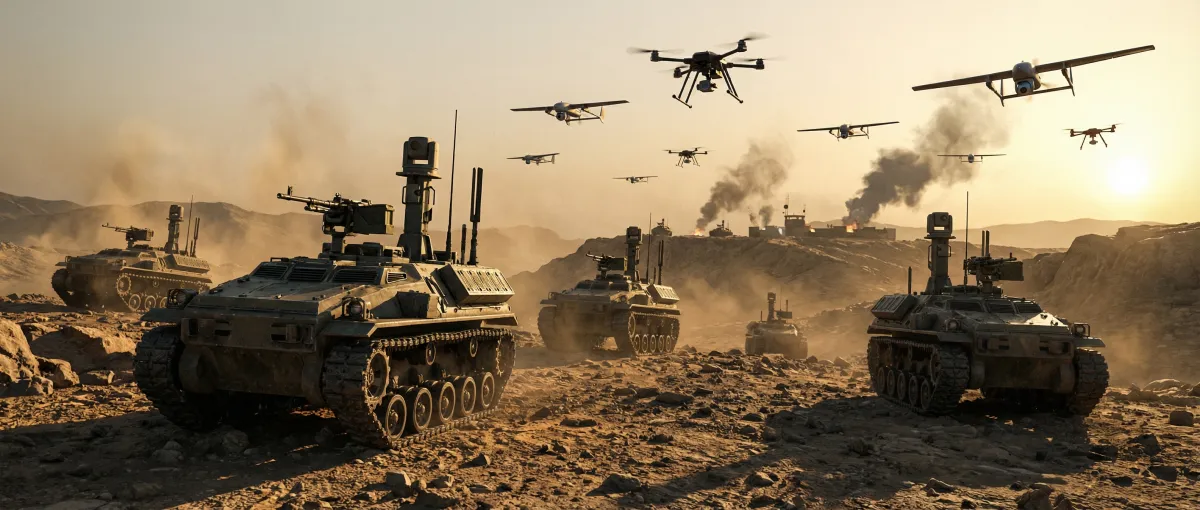
The battlefield of 2026 looks fundamentally different than it did just two years ago. Autonomous drones—once the stuff of science fiction—are now central to military strategy across the globe, with the Pentagon committing $1.1 billion to deploy over 300,000 AI-powered platforms by 2027.
As geopolitical tensions escalate and lessons from Ukraine reshape modern warfare doctrine, nations are racing to develop swarms of intelligent, low-cost drones that can operate independently, communicate with each other, and execute complex missions without human oversight. This transformation represents the most significant shift in military technology since stealth aviation.
The Pentagon's Drone Dominance Program: A $1.1 Billion Bet
In early February 2026, the U.S. Department of Defense announced the first phase of its ambitious "Drone Dominance Program," selecting 25 vendors to compete for initial contracts worth $150 million. The competition, dubbed "the Gauntlet," is taking place at Fort Benning, Georgia, where companies from established defense contractors to scrappy startups are demonstrating their one-way attack drones and autonomous systems.
The program's scope is staggering: four competitive phases designed to rapidly field hundreds of thousands of weaponized drones across all military branches. By 2027, the Pentagon aims to have fundamentally altered the cost-benefit calculus of military engagement, flooding potential adversaries with low-cost, highly capable autonomous platforms.
"The Russians are knocking on the door," says Sven Weizenegger, head of the German military's Cyber Innovation Hub, reflecting the urgency driving European and NATO defense modernization. "AI-enabled intelligence, surveillance, and reconnaissance and mass-deployed drones have become decisive on the battlefield."
From Testing to Combat: The Rapid Evolution
What makes 2026 a watershed moment is that autonomous drone technology has crossed the threshold from experimental to operational. Multiple military branches are now deploying systems that were theoretical concepts just 18 months ago:
- Counter-Drone Systems: The Joint Interagency Autonomous Task Force (JIATF-401) recently contracted for advanced DroneHunter F700 systems—AI-powered drones specifically designed to capture hostile drones mid-flight, neutralizing threats without explosive engagement.
- Drone Wingmen: The Air Force is expected to make critical decisions in 2026 about its Collaborative Combat Aircraft (CCA) program, which will pair autonomous drones with manned fighter jets. These AI wingmen will handle dangerous suppression missions, electronic warfare, and reconnaissance, multiplying the effectiveness of each human pilot.
- Chemical Weapon Response: The U.S. Army is actively seeking autonomous drone systems for chemical weapons decontamination—robots that can operate in contaminated environments too dangerous for human personnel, compatible with various decontaminants including High Test Hypochlorite (HTH) and military-grade foam agents.
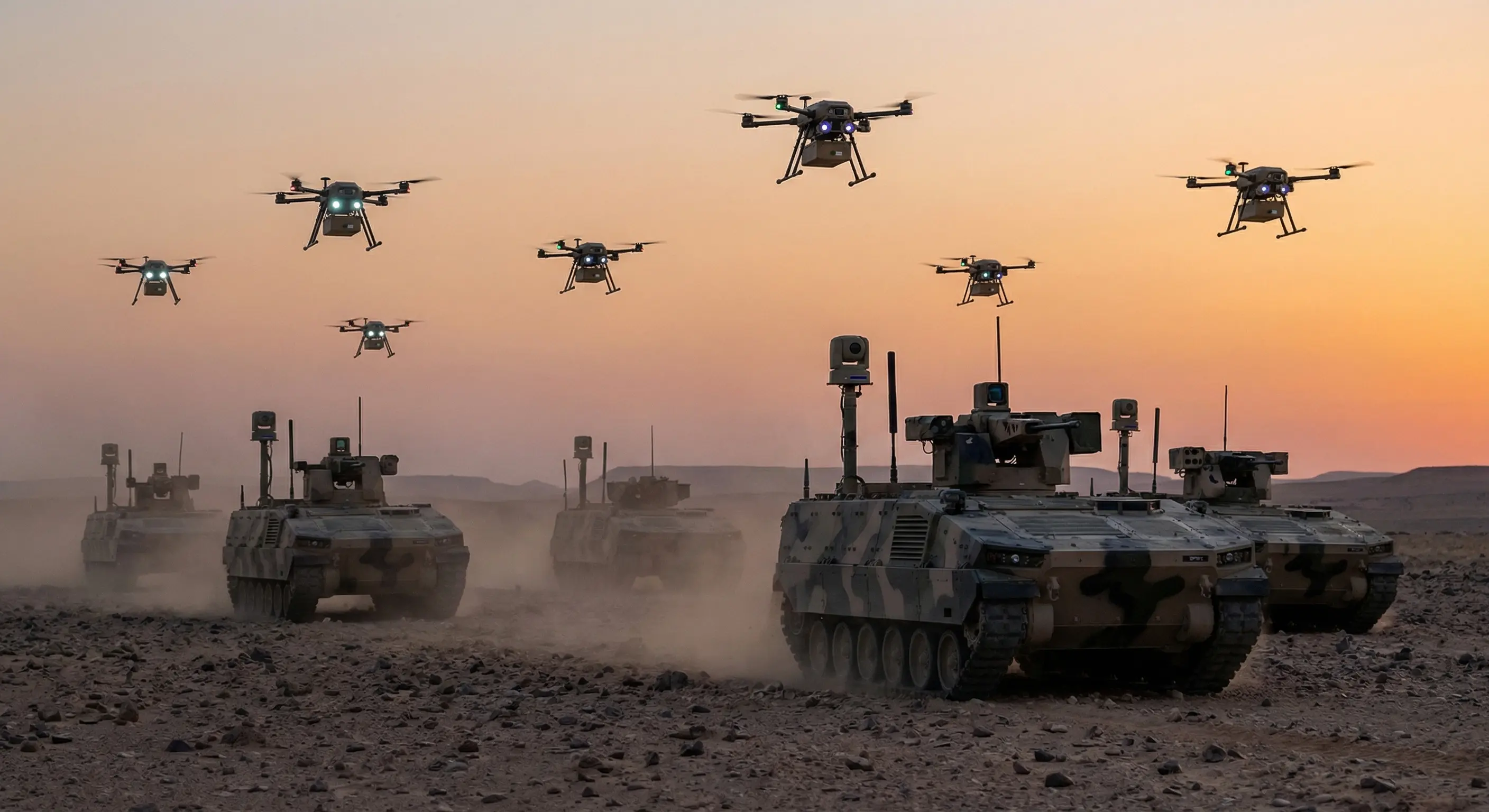
- Swarm Coordination: Industry analysts predict at least two major defense acquisitions before summer 2026 focused on vendor-agnostic swarm coordination—the holy grail technology that allows drones from different manufacturers to work together intelligently in large formations.
The Global Arms Race: China and Urban Warfare AI
While the Pentagon accelerates its programs, China's People's Liberation Army (PLA) is pursuing a parallel but distinct path. Recent research from Chinese universities known to support military R&D—the "Seven Sons of National Defense"—reveals a concerted effort to develop lethal autonomous drone swarms specifically optimized for urban warfare.
These systems, informed by detailed analysis of urban combat in Ukraine, Syria, and Gaza, represent a troubling evolution. Rather than open-field operations, China is developing AI that can navigate complex building environments, distinguish between combatants and civilians in cluttered urban settings, and coordinate attacks through narrow alleyways and multi-story structures.
The legal and ethical framework around these capabilities remains ambiguous at best. International law has not kept pace with technology, creating a dangerous grey zone where autonomous lethal systems operate without clear rules of engagement or accountability mechanisms.
Europe's Strategic Awakening
Eighty years after World War II devastated the continent, European nations are experiencing a strategic awakening. Estonia's Ministry of Defense Innovation Department reports that automated battlefield systems have become "decisive" in modern conflict, driving rapid procurement and development across NATO members.
Germany, Poland, the Baltic states, and Nordic countries are all fast-tracking autonomous defense programs. The "Hedgehog" defensive systems being tested along Europe's eastern frontier represent a new philosophy: create such a dense, intelligent defensive network that conventional military breakthroughs become prohibitively expensive in both blood and treasure.
This shift toward mass-deployed, AI-coordinated systems reflects hard lessons from Ukraine, where cheap Turkish Bayraktar drones and consumer quadcopters modified for military use proved remarkably effective against billion-dollar conventional weapons systems.
The Cost Equation That Changes Everything
At the heart of the autonomous drone revolution is a simple but profound economic reality: these systems fundamentally alter the cost of military power projection.
A Javelin anti-tank missile costs approximately $178,000. An advanced autonomous attack drone with AI targeting can cost as little as $5,000-$15,000 while achieving similar or better effectiveness against certain targets. When deployed in coordinated swarms, these systems can overwhelm traditional defenses through sheer numbers and intelligent coordination.
This cost advantage extends beyond procurement to operations. Autonomous systems don't require sleep, don't suffer from fatigue-induced errors, and can maintain persistent surveillance or combat air patrols far longer than human-operated platforms. The Pentagon's data from early trials suggests operational costs drop by 40-60% for autonomous versus crewed missions of similar duration.
Technical Challenges and Security Concerns
Despite rapid progress, significant technical challenges remain. Autonomous drone systems must solve complex problems:
- GPS Denial: Modern battlefields feature sophisticated electronic warfare. Drones must navigate and coordinate using alternative methods when GPS signals are jammed or spoofed.
- Friend-or-Foe Identification: AI vision systems must reliably distinguish between friendly forces, civilians, and enemy combatants in chaotic, rapidly changing environments—a task that remains imperfect even for trained human observers.
- Cybersecurity: Autonomous swarms connected via wireless networks present tempting targets for cyber attacks. Adversaries with sophisticated capabilities could theoretically hijack or spoof command signals, turning friendly drones into weapons against their operators.
- Counter-Drone Evolution: As offensive drone capabilities advance, defensive systems must keep pace. The arms race between autonomous attack drones and AI-powered counter-drone systems creates a spiraling technology competition.
Ethical and Strategic Implications
The proliferation of autonomous lethal systems raises profound questions that militaries and policymakers are only beginning to grapple with:
Decision Authority: At what point does autonomous operation cross the line from "supervised" to truly independent? When an AI decides to engage a target without real-time human authorization, who bears legal and moral responsibility?
Proliferation Risk: If major powers deploy hundreds of thousands of these systems, what prevents proliferation to non-state actors, terrorist groups, or rogue regimes? The same characteristics that make these drones militarily valuable—low cost, commercial components, AI software—also make them accessible to adversaries of all types.
Strategic Stability: Autonomous swarms could destabilize deterrence frameworks. If nations believe they can conduct "cost-free" military operations using drones, the threshold for conflict might lower dangerously. Conversely, the fear of such attacks might drive pre-emptive actions in crisis situations.
Looking Ahead: The 2027 Battlefield
By late 2027, if current programs proceed on schedule, the U.S. military will field several hundred thousand autonomous drones across its services. China, Russia, and numerous other nations will deploy comparable systems. European NATO members will have established integrated autonomous defensive networks along their eastern borders.
This isn't speculation—it's based on funded programs, signed contracts, and systems already in advanced testing. The autonomous drone revolution isn't coming; it's here, accelerating faster than regulatory frameworks, international law, or public discourse can adapt.
What remains uncertain is how these capabilities will actually perform in high-intensity conflict against peer adversaries with sophisticated electronic warfare and cyber capabilities. The first major confrontation involving mass autonomous drone deployment will reveal whether current assumptions hold or whether the fog of war proves thicker than AI can penetrate.
Conclusion
The autonomous warfare revolution of 2026 represents a technological inflection point comparable to the introduction of gunpowder, aircraft carriers, or nuclear weapons. AI-powered military drones are not simply new tools—they fundamentally change the logic of military engagement, the economics of defense, and the ethics of warfare.
As the Pentagon's Gauntlet competition unfolds at Fort Benning and hundreds of engineers worldwide refine swarm coordination algorithms, we're witnessing the birth of a new era. The decisions made in 2026 about how to deploy, control, and constrain these systems will shape military affairs and international security for decades to come.
The question is no longer whether autonomous drones will transform warfare—they already have. The question is whether humans can maintain meaningful control over the systems we're creating, and whether international frameworks can emerge to prevent this powerful technology from destabilizing global security rather than enhancing it.