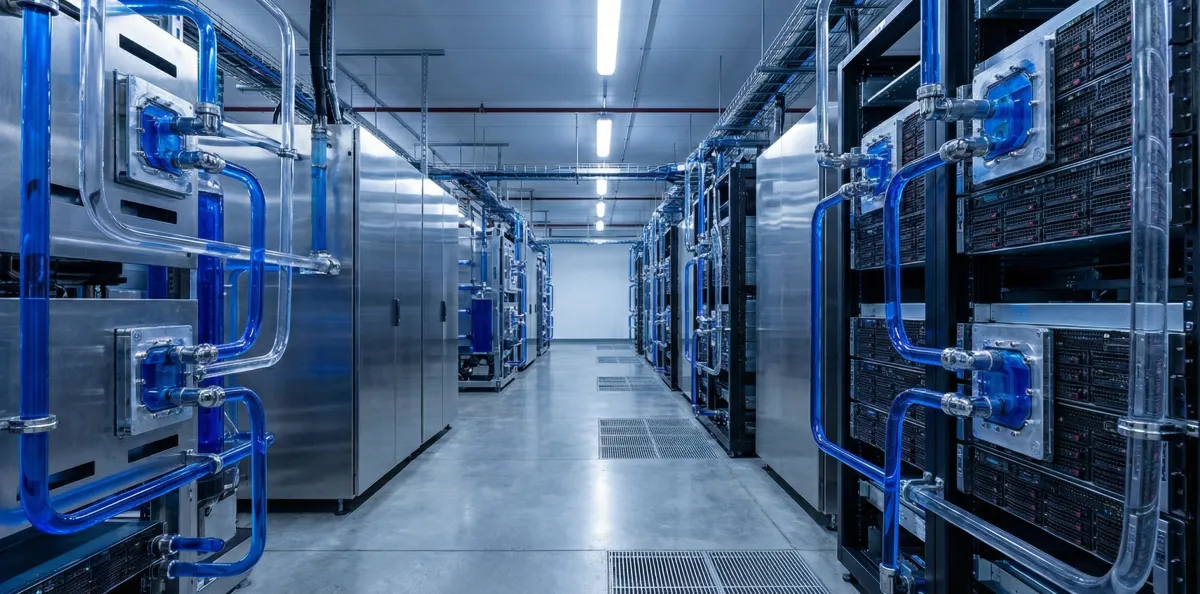
For decades, data centers have relied on the same cooling strategy: blow cold air over hot servers and exhaust the heat. It worked for email, databases, and even the cloud computing boom. But AI training clusters running thousands of GPUs have created thermal densities that air simply cannot handle. The industry is now in the middle of the fastest infrastructure shift in its history—and by the end of 2026, close to 40% of data centers are expected to have deployed some form of liquid cooling.
The transition isn't optional. It's physics.
The Thermal Density Problem
Traditional air-cooled racks typically handle 5-10 kilowatts per rack. Modern AI clusters? 100-200 kW per rack, with some configurations pushing beyond 300 kW. NVIDIA's GB200 NVL72 system—a single rack with 72 Blackwell GPUs—consumes 120 kW and generates enough heat to warm several homes.
Air cooling becomes impractical above 30-40 kW per rack. Beyond that threshold, you need hurricane-force airflow, which creates noise, vibration, and still doesn't remove heat efficiently. Liquid cooling is up to 3,000 times more effective than air at heat transfer, enabling the high-density configurations that AI workloads demand.
Direct-to-Chip Cooling Goes Mainstream
Direct-to-chip (D2C) liquid cooling attaches cold plates directly to processors and memory modules, circulating coolant to absorb heat at the source. By removing 70-80% of heat loads directly at the chip, D2C reduces the burden on facility-level cooling infrastructure.
The technology has matured rapidly. Next-generation cold plates from companies like Accelsius and CoolIT can handle heat flux exceeding 300 watts per square centimeter—densities that would cause air-cooled chips to throttle or fail. Vertiv's Coolant Distribution Units (CDUs) now provide contaminant-free coolant circulation at scale, supporting thousands of servers per facility.
Hyperscalers are deploying D2C aggressively. Microsoft's AI clusters use direct liquid cooling for GPU and CPU thermal management. Meta is retrofitting existing facilities with D2C infrastructure to extend their lifespan and increase compute density without building new structures.
Immersion Cooling: Submerging Servers in Dielectric Fluid
Immersion cooling takes the concept further by submerging entire servers in tanks of thermally conductive dielectric fluid. Single-phase immersion systems circulate fluid that never changes state; two-phase systems allow the fluid to boil and condense, transferring even more heat.
The approach eliminates fans, reduces maintenance (no dust or corrosion), and enables extreme compute density. Some immersion deployments achieve 200+ kW per rack while maintaining safe operating temperatures.
The liquid cooling market is projected to reach $16.16 billion by 2030 at a 26% CAGR, driven by AI's insatiable appetite for compute. Dell'Oro Group forecasts the sector will approach $7 billion by 2029, with direct-to-chip systems dominating initial adoption and two-phase cooling expanding as chip-level thermal design power (TDP) exceeds single-phase limits.
Why Now?
Several forces converged to make liquid cooling the default:
- AI training clusters — Models like GPT-4 and Gemini require thousands of tightly coupled GPUs running at maximum power for weeks
- Power efficiency mandates — Liquid cooling reduces cooling energy by 30-50% compared to air, critical when power costs dominate operating expenses
- Supply chain maturity — CDUs, cold plates, and dielectric fluids are now commoditized and available at scale
- Real estate constraints — Liquid cooling doubles or triples compute density per square foot, maximizing expensive data center space
Challenges and Trade-Offs
Liquid cooling isn't without complexity. Facilities must install CDU infrastructure, train technicians on coolant management, and design for potential leaks (though modern systems use low-conductivity fluids that minimize risk). Retrofitting existing air-cooled facilities is expensive and disruptive.
But the cost of not adopting liquid cooling is higher: stranded assets, underutilized power capacity, and the inability to deploy the latest AI accelerators. Data center operators that stick with air cooling will find themselves with facilities that can't host the workloads customers demand.
The Shift Is Irreversible
By 2026, liquid cooling has moved from niche high-performance computing (HPC) deployments to mainstream hyperscale and colocation infrastructure. Every major data center equipment vendor—Vertiv, Schneider Electric, Stulz—now offers liquid cooling as a standard option, not an exotic upgrade.
The air-cooled era lasted 50 years. The liquid-cooled era is just beginning—and it will define how we build data centers for the next generation of computing.
Related Articles
The AI Power Crisis: Why Data Centers Can't Find Enough Electricity
AI facilities consume 50-100 MW. Microsoft restarted Three Mile Island. The grid can't keep pace with AI's power demands.
TSMC Enters the 2nm Era: Apple and NVIDIA Lock Up All Initial Capacity
TSMC began 2nm mass production with GAAFET technology. Apple and NVIDIA reserved 100% of initial capacity.
The Hyperscaler Data Center Boom: Why Big Tech Is Building Faster Than Ever
Amazon, Microsoft, Google building 50+ facilities per year. AI training clusters drive unprecedented construction pace.