For more than two decades, MediaTek has been the world's most successful chipmaker that most people in the industry never thought about. The Taiwanese fabless giant quietly became the dominant force in smartphone processors — its Dimensity chips give it the largest share of Android handsets globally — while Nvidia, Intel, and AMD fought loudly for the data center and PC segments that get all the press coverage. At MWC 2026 in Barcelona, MediaTek served notice that the quiet era is over.
Under the banner of "AI For Life: From Edge to Cloud," MediaTek unveiled a portfolio of data center technologies that, taken together, represent a credible and technically serious entry into the most lucrative segment of the semiconductor market. The company announced in-house UCIe-Advanced IP for die-to-die chip connectivity, already silicon-validated on TSMC's 2nm and 3nm process nodes, delivering bandwidth densities of up to 10 terabits per second per millimeter of die edge. It also introduced a self-developed co-packaged optics (CPO) solution providing optical transmission bandwidth of up to 400Gbps per fiber — directly targeting the interconnect bottleneck that throttles modern AI server clusters.
These are not roadmap promises. MediaTek's language at MWC was specific: silicon-validated. The chips exist and they work.
Why the Data Center, and Why Now?
MediaTek's timing is deliberate. The AI infrastructure buildout has created an environment where every major hyperscaler — Amazon, Google, Microsoft, Meta — is actively seeking alternatives to a single-vendor dependency on Nvidia. Nvidia's GPU compute dominance is near-total, but the networking and interconnect layers that link those GPUs together represent an open field. Broadcom and Marvell have positioned themselves as the primary alternatives for custom AI ASICs and networking silicon, but neither has MediaTek's manufacturing relationships or its cost-competitive design culture.
The company's president, Joe Chen, framed the strategy clearly in his MWC keynote: MediaTek's role is not to clone what incumbents offer, but to build the plumbing — the die-to-die interconnects, the optical interfaces, the packet-processing logic — that sits between compute chips. This is a strategic positioning play that avoids direct competition with Nvidia's GPU monopoly while targeting the adjacent infrastructure layer that is equally critical and considerably less defended.
UCIe-Advanced: The Die-to-Die Standard That Could Reshape AI Chip Design
To understand why MediaTek's UCIe-Advanced IP is significant, it helps to understand what UCIe (Universal Chiplet Interconnect Express) actually does. As AI chips have grown in complexity, the industry has moved toward "chiplet" designs — instead of cramming every function onto a single monolithic die, designers package multiple specialized dies together in a single module. A modern AI accelerator might pair a compute die with a separate memory controller die, an I/O die, and a networking die, all connected by a high-speed die-to-die interface on the package substrate.
The quality of that die-to-die interface is critical. Bandwidth, latency, and power consumption at the die edge determine whether a chiplet design can outperform a monolithic alternative. UCIe is the industry standard that governs how those connections work, and UCIe-Advanced is the latest, highest-performance generation of that standard.
MediaTek's implementation delivers up to 10 Tb/s per millimeter of die edge — a figure that places it at or above what Intel's Foveros and TSMC's SoIC-X technologies currently offer. More importantly, the fact that it has been silicon-validated on TSMC 2nm means it is ready for production in the same process node that will define the next generation of AI accelerators. Any company designing a 2nm AI chip — and every major player is — can now consider MediaTek's UCIe-Advanced IP as a ready-to-license interconnect component.
This is a licensing model that MediaTek knows well. The company's decades of experience building and licensing IP blocks for mobile chipsets gives it a mature infrastructure for commercializing silicon IP. Applied to the data center, it means MediaTek could become an essential — and invisible — component inside chips branded by AMD, Google, Amazon, or anyone else building custom AI silicon on TSMC 2nm.
Co-Packaged Optics: Solving the Last-Mile Bandwidth Problem
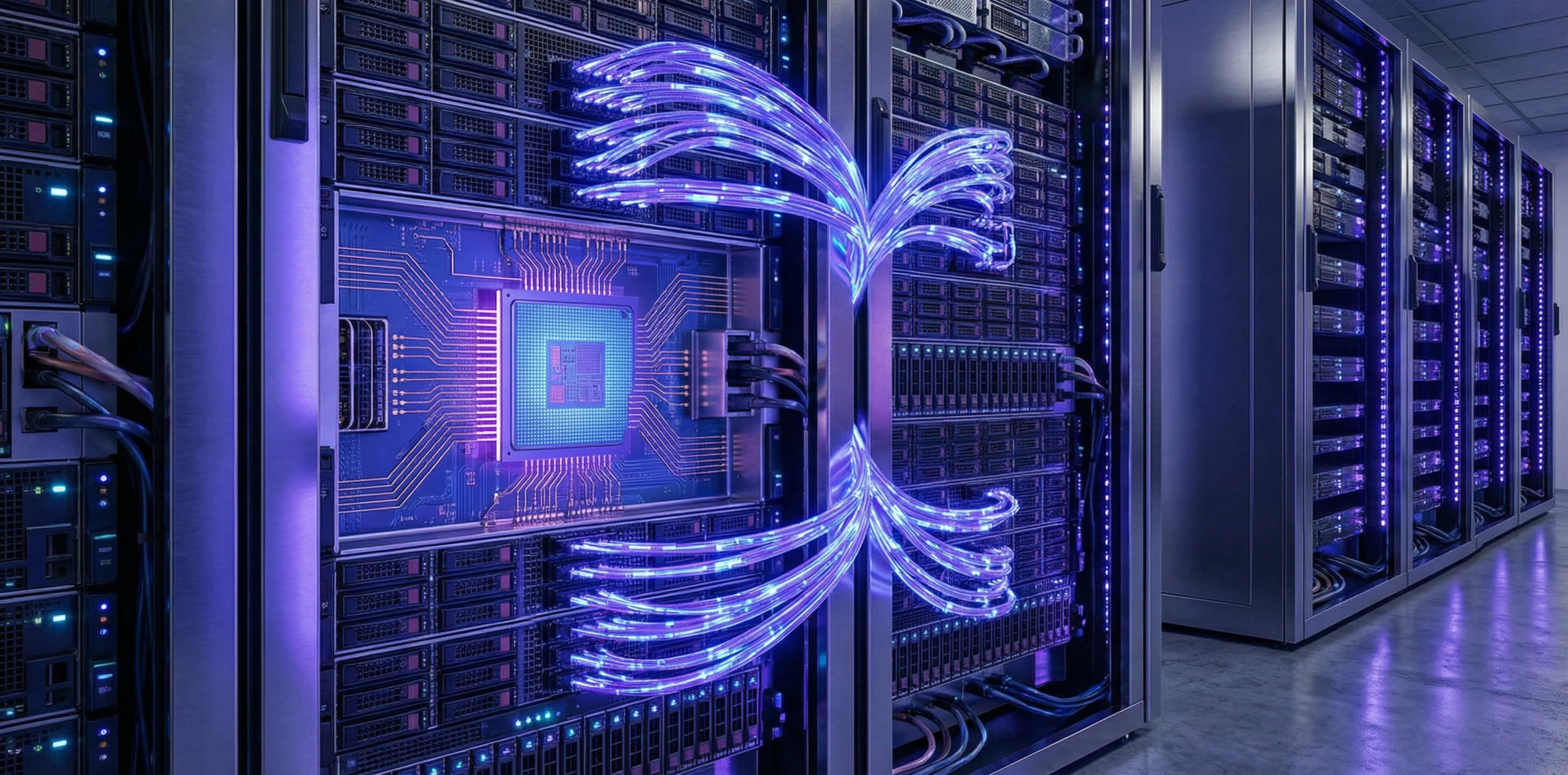
The second major announcement — co-packaged optics at 400Gbps per fiber — targets a different but equally pressing constraint in AI data centers.
Modern AI training and inference workloads require massive data movement between GPU clusters. A single training run for a frontier language model can involve hundreds of thousands of GPUs exchanging gradient updates simultaneously. That traffic must traverse the data center fabric — the switches and cables connecting racks to each other. Today's approach uses pluggable optical transceivers: small modules that clip into network switch ports and convert electrical signals to optical signals for transmission over fiber.
The problem is that at very high port densities — the kind required for petabyte-scale AI training fabrics — pluggable transceivers become a power and latency bottleneck. Each electrical-to-optical conversion burns watts and adds nanoseconds. Co-packaged optics solves this by integrating the optical interface directly on the same package as the switch ASIC, eliminating the pluggable transceiver's conversion penalty and dramatically reducing power consumption per terabit of switching capacity.
MediaTek's CPO solution delivers 400Gbps per fiber — competitive with what Nvidia is offering through its Spectrum-X Ethernet Photonics platform and what Intel has demonstrated in its co-packaged optics research. The key differentiator, if MediaTek can execute on commercial deployment, is cost. MediaTek has built its entire business around manufacturing at competitive price points, and data center operators who have watched networking costs balloon alongside compute costs will pay close attention to any credible alternative that promises equivalent performance at lower system cost.
The MWC Context: Not Just Data Centers
MediaTek's data center announcements were embedded in a broader showcase at MWC that deliberately illustrated the company's edge-to-cloud ambitions. The same event featured the world's first demonstration of 6G radio interoperability, a 5G-Advanced CPE device with Wi-Fi 8 integration, and Dimensity 9500-powered AI glasses capable of running multimodal large models entirely on-device.
This context is not incidental. MediaTek is making a coherent argument: the AI workloads of 2026 and beyond will not live exclusively in data centers or exclusively on edge devices. They will be distributed — with different components of a reasoning pipeline running on whichever hardware tier offers the best latency, cost, and privacy tradeoff for that specific task. MediaTek wants to supply silicon at every tier of that architecture.
The personal device cloud concept that President Chen outlined — where AI agents collaborate across phones, home devices, and cloud endpoints — is not a distant vision. It is the design constraint that is already shaping how MediaTek engineers the interfaces between its mobile, automotive, networking, and now data center silicon divisions. A company that can coherently serve all those markets with compatible silicon and connectivity standards has an integration advantage that neither Nvidia nor Broadcom currently possesses.
What the Incumbents Should Be Watching
Nvidia's response to MediaTek's data center move will likely be a version of "we are not threatened by a mobile chip company." That response would be incomplete. Nvidia's competitive moat in AI compute is real and deep — CUDA, the developer ecosystem, the NVLink interconnect network, and the sheer pace of its roadmap execution all represent genuine barriers. But MediaTek is not attacking Nvidia's GPU compute business. It is attacking the infrastructure layer around it.
Broadcom is a more directly relevant comparison. Broadcom's revenue from custom AI ASICs (built for Google, Meta, and others) and its networking silicon (Tomahawk and Jericho switch families) is growing at a pace that has made AI infrastructure its fastest-growing segment. If MediaTek can capture a meaningful share of the die-to-die IP licensing market and become a credible co-packaged optics supplier, it bites directly into Broadcom's expanding AI infrastructure revenue stream.
Marvell, which has been building AI custom ASIC and networking silicon on similar ground, faces a comparable challenge. MediaTek's manufacturing cost discipline and its existing TSMC relationship — MediaTek is among TSMC's largest customers by volume — give it structural advantages in production ramp speed and per-wafer cost that neither Broadcom nor Marvell can easily replicate.
The Timeline Question
Silicon-validated at MWC does not mean products are shipping. The path from validated IP to integrated commercial silicon to deployed data center infrastructure typically spans 18 to 36 months for a new entrant in a segment this complex. MediaTek has demonstrated the technical capability; the commercial execution challenge is substantial.
Enterprise sales cycles for data center silicon are long and relationship-intensive. Hyperscalers qualify new silicon vendors through multi-year evaluation processes that involve extensive reliability testing, supply chain audits, and architectural co-development. MediaTek has no existing track record in this channel — every hyperscaler relationship will need to be built from scratch.
The company's best near-term path to data center revenue is likely through IP licensing: enabling established AI chip designers to integrate its UCIe-Advanced IP into their own custom silicon, rather than selling complete chips directly. This mirrors the model that ARM used to enter every market it now dominates — provide the foundational IP that others build on, collect royalties at scale, and accumulate the production experience needed to eventually offer complete solutions.
A Landmark Moment in the AI Chip Landscape
MediaTek's MWC 2026 data center announcements represent one of the more significant competitive developments in AI infrastructure this year — not because they immediately change the market structure, but because they signal that the pool of credible data center silicon competitors is expanding faster than the incumbents expected.
Two years ago, the serious contenders for AI data center silicon were Nvidia, AMD, Intel, Broadcom, Marvell, and a handful of startups. Today, that list includes Google (TPUs), Amazon (Trainium/Inferentia), Microsoft (Maia), Meta (MTIA), and now a $30 billion revenue chipmaker with deep TSMC relationships and a validated 2nm interconnect stack.
The data center chip war is not getting quieter. It is getting crowded — and that is ultimately good news for the hyperscalers who have spent years trying to reduce their dependency on any single supplier. For MediaTek, the question is not whether it can build the technology. MWC 2026 answered that. The question is whether it can close the commercial deals that turn silicon validation into revenue at scale.