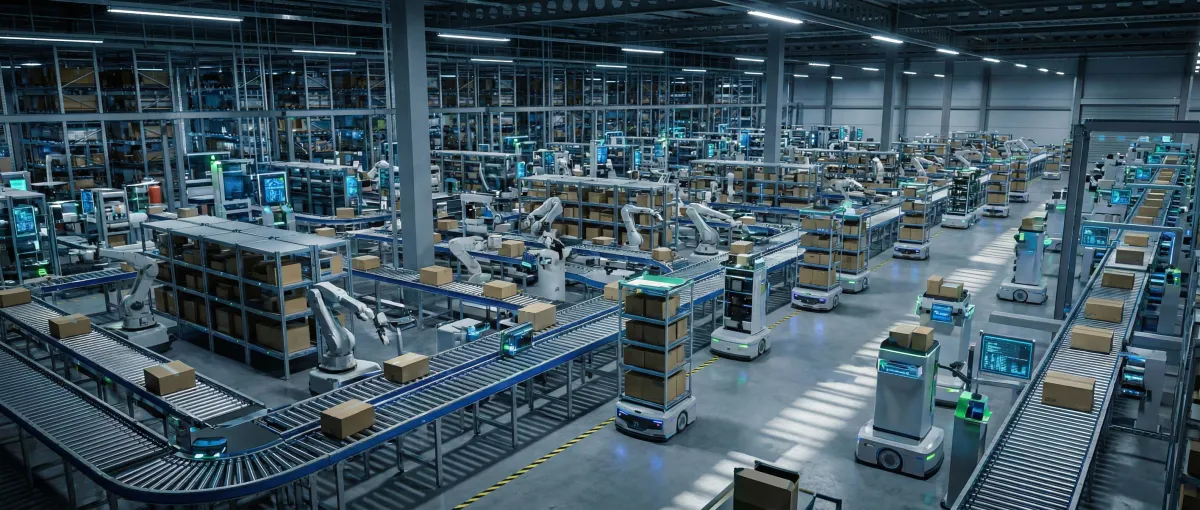
The global logistics industry is undergoing its most dramatic transformation in decades as major carriers race to deploy AI-powered robotics across hundreds of facilities. UPS just ordered 400 autonomous truck-unloading robots. FedEx is launching fully autonomous container systems. And the numbers are staggering: UPS alone is pouring $9 billion into automation infrastructure that's reshaping how millions of packages move daily.
UPS Leads the Pack with 127 Automated Facilities
In a late January earnings call, UPS CEO Carol Tomé revealed the company deployed automation in 57 buildings during Q4 2025, bringing its total to 127 automated facilities. The company plans to add 24 more in 2026, part of a broader $9 billion automation strategy that includes a $120 million investment in 400 Pickle Robots for truck unloading.
"This isn't about experimental deployments anymore," notes industry analyst Sarah Chen at Logistics Tech Insights. "UPS is scaling inbound automation inside existing facilities at unprecedented speed. These aren't greenfield projects—they're retrofitting operational hubs while packages keep moving."
The Pickle Robots, set to deploy across multiple UPS facilities in the latter half of 2026 and into 2027, represent a strategic bet on solving one of logistics' most labor-intensive bottlenecks: unloading trucks. Each robot uses computer vision and AI to identify, grasp, and move packages from trailers to conveyor systems—work that traditionally required teams of workers in physically demanding roles.
The Labor Equation Behind the Automation Push
The timing isn't coincidental. Warehouse and logistics operators face persistent labor shortages, high turnover rates, and rising wage pressures. Automation offers a way to maintain throughput while reducing dependence on hard-to-fill positions.
UPS is simultaneously closing legacy facilities—93 buildings shut down in 2025, with at least 24 more closures planned for the first half of 2026. The pattern is clear: consolidate operations into fewer, highly automated hubs that can handle greater volume with smaller workforces.
"What you're seeing is a cascading effect of legacy conventional facilities being shuttered and replaced by next-generation automated sites," explained Tomé during the earnings call. The company isn't just adding robots—it's fundamentally redesigning its physical network.
FedEx and Competitors Follow Suit
FedEx isn't standing still. The company is launching a fully autonomous robot system designed specifically for unloading containers—a direct counter to UPS's Pickle Robot deployment. While FedEx has released fewer specifics, industry sources indicate the system uses advanced sensor arrays and machine learning models trained on millions of package handling scenarios.
The competitive pressure is driving innovation across the sector. DHL, Amazon Logistics, and regional carriers are all accelerating automation timelines, creating a technology arms race in warehouse operations.
Beyond Unloading: The Full Automation Stack
Truck unloading is just one piece of the puzzle. Modern warehouse automation now spans:
- Autonomous Mobile Robots (AMRs) that navigate facility floors, moving goods between zones without fixed rails or markers
- AI-powered vision systems that inspect packages, identify damage, and verify barcodes in real-time (like Dexory's new Storage Health software)
- Robotic palletizing and depalletizing systems that build and break down pallets with human-level dexterity
- Automated sorting infrastructure that routes packages based on AI-optimized paths, reducing handling steps by 30-40%
- Predictive maintenance systems using IoT sensors to prevent equipment failures before they disrupt operations
The convergence of these technologies is creating "smart warehouses" that operate with minimal human intervention in core material handling tasks. Workers are shifting from physical labor to supervisory roles, system management, and exception handling.
The Economics of the Shift
UPS's $9 billion automation commitment represents roughly 18 months of the company's typical capital expenditure. But the ROI calculus is compelling:
- Labor cost reduction: Automated systems work 24/7 without breaks, benefits, or overtime pay
- Throughput gains: Robotic systems can process 30-50% more packages per hour than manual operations
- Error reduction: AI vision systems achieve 99.9%+ accuracy in barcode scanning and sorting
- Safety improvements: Removing workers from repetitive, injury-prone tasks reduces workers' comp claims and OSHA incidents
- Space efficiency: Automated systems can operate in tighter configurations, increasing usable square footage by 20-30%
Industry analysts estimate the payback period for full warehouse automation ranges from 3-5 years, depending on facility size and throughput volumes. For high-volume hubs processing millions of packages annually, ROI can hit breakeven in under 24 months.
The Technology Behind the Transformation
What's enabling this rapid automation rollout? Three key technology advances:
1. Computer Vision Maturity
Modern warehouse robots use transformer-based vision models (similar to those powering GPT and other AI systems) to understand complex 3D environments. They can identify packages regardless of orientation, lighting conditions, or label placement—capabilities that were unreliable just 24 months ago.
2. Edge AI Processing
Onboard AI chips (from NVIDIA, Intel, and specialized robotics semiconductor firms) allow robots to make millisecond decisions without cloud connectivity. This reduces latency, improves reliability, and enables operations in network-limited environments.
3. Simulation-Trained Systems
Companies like NVIDIA's Omniverse and Unity's industrial simulation platforms let robotics firms train systems in virtual warehouses processing billions of simulated packages before deploying to physical facilities. This "digital twin" approach dramatically shortens development cycles and reduces real-world testing costs.
The Human Impact and Workforce Transition
The elephant in the room: what happens to warehouse workers? UPS employs over 500,000 people worldwide. FedEx has more than 600,000 employees. Automation at this scale will inevitably reduce demand for certain job categories.
However, the companies argue they're creating new roles:
- Robot technicians: Maintaining and troubleshooting automated systems
- Data analysts: Optimizing operations using insights from sensor networks and AI systems
- Systems integrators: Coordinating between legacy and automated infrastructure
- Exception handlers: Dealing with edge cases that robots can't process
The Teamsters union, which represents many UPS workers, has negotiated provisions in recent contracts that include retraining programs and job protection clauses for existing employees. Similar labor agreements are being negotiated across the industry.
"This is a classic technology transition," says labor economist Dr. Marcus Thompson at MIT. "The jobs aren't disappearing—they're changing. The question is whether we invest adequately in workforce development to help people make that transition."
What Comes Next: The 2027-2030 Roadmap
If 2026 is the year of scaled deployment, 2027-2030 will be the era of system integration and optimization. Industry roadmaps point to:
- Multi-vendor orchestration: Facilities running robots from 3-5 different manufacturers, coordinated by AI management layers
- Autonomous last-mile delivery: Extending automation from warehouses to delivery vehicles and final dropoff
- Predictive demand routing: AI systems that pre-position inventory based on forecast models, reducing same-day delivery costs
- Carbon optimization: Routing and operational algorithms that minimize energy consumption and emissions
- Lights-out facilities: Entire warehouses operating unmanned during night shifts
Some facilities are already testing "lights-out" operations during off-peak hours, with only security personnel and remote monitoring teams on-site. These pilots are providing data that will inform the next generation of warehouse design—buildings optimized for robots first, with human work zones as exceptions rather than defaults.
The Broader Implications
Warehouse automation isn't happening in isolation. It's part of a broader industrial transformation touching manufacturing, retail, healthcare logistics, and food distribution. The lessons learned in package handling are being applied to pharmaceutical distribution, grocery cold chains, and even hospital supply management.
As these systems prove their reliability and economics, expect automation to cascade through every sector that moves physical goods. The $9 billion UPS is spending represents just a fraction of the hundreds of billions that will flow into logistics automation over the next decade.
The revolution is here. The question isn't whether warehouses will automate—it's how quickly, and whether the workforce and policymakers can keep pace with the technology.
Related Articles
The Humanoid Robot Race Heats Up: Tesla, Apptronik, and China Battle for Market Dominance
Tesla Optimus Gen 3 mass production, Apptronik's $5B valuation, China's 90% market share. Inside the 100K+ unit humanoid robot market.
The AI Power Crisis: Why Data Centers Can't Find Enough Electricity
Microsoft restarts Three Mile Island. Google partners with Kairos for 50 MW reactor. Inside the race to power AI.

The Rise of Agentic AI: Why Every Enterprise Will Run Autonomous AI Systems by 2027
From chatbots to autonomous agents: How AI systems are moving from answering questions to taking action.