CES 2026 has once again set the stage for groundbreaking technological announcements, and AMD has emerged as a frontrunner in the race for AI supremacy. The semiconductor giant unveiled its highly anticipated Ryzen AI 400 series processors, poised to redefine the capabilities of AI-powered laptops, alongside providing crucial new details on its next-generation "Turin" data center chips. These revelations, coupled with recent breakthroughs in 3D chip stacking technology, signify a pivotal moment in the evolution of AI hardware, promising unprecedented performance and efficiency.
Ryzen AI 400: Intelligent Power for Laptops
The Ryzen AI 400 series is designed to bring robust AI processing capabilities directly to the edge, enabling laptops to handle complex AI tasks locally with greater speed and responsiveness. This move is critical as more applications, from advanced video conferencing to creative content generation and personal AI assistants, demand dedicated AI acceleration. These new processors are expected to feature significantly enhanced Neural Processing Units (NPUs), offering a substantial leap in AI inference performance per watt compared to previous generations.
Integrating AI directly into client devices reduces reliance on cloud-based AI, addressing concerns about data privacy, latency, and continuous internet connectivity. For consumers, this translates to faster AI-driven features, longer battery life, and a more seamless user experience.
Turin: Powering the Hyperscale AI Era
While the Ryzen AI 400 targets personal computing, AMD's "Turin" chips are set to become the backbone of future hyperscale data centers. Details emerging from CES 2026 indicate that Turin processors will offer a formidable combination of high core counts, increased memory bandwidth, and specialized AI accelerators, all meticulously engineered to meet the insatiable demands of large language models and complex AI training workloads.
The emphasis on power efficiency within the Turin architecture is particularly noteworthy. As AI data centers continue to expand, their energy consumption has become a significant concern. AMD's focus on optimizing performance per watt aims to provide powerful solutions without exponentially increasing operational costs and environmental impact, a critical factor for cloud providers and enterprises deploying vast AI infrastructures.
The 3D Stacking Revolution: Beyond Flat Architectures
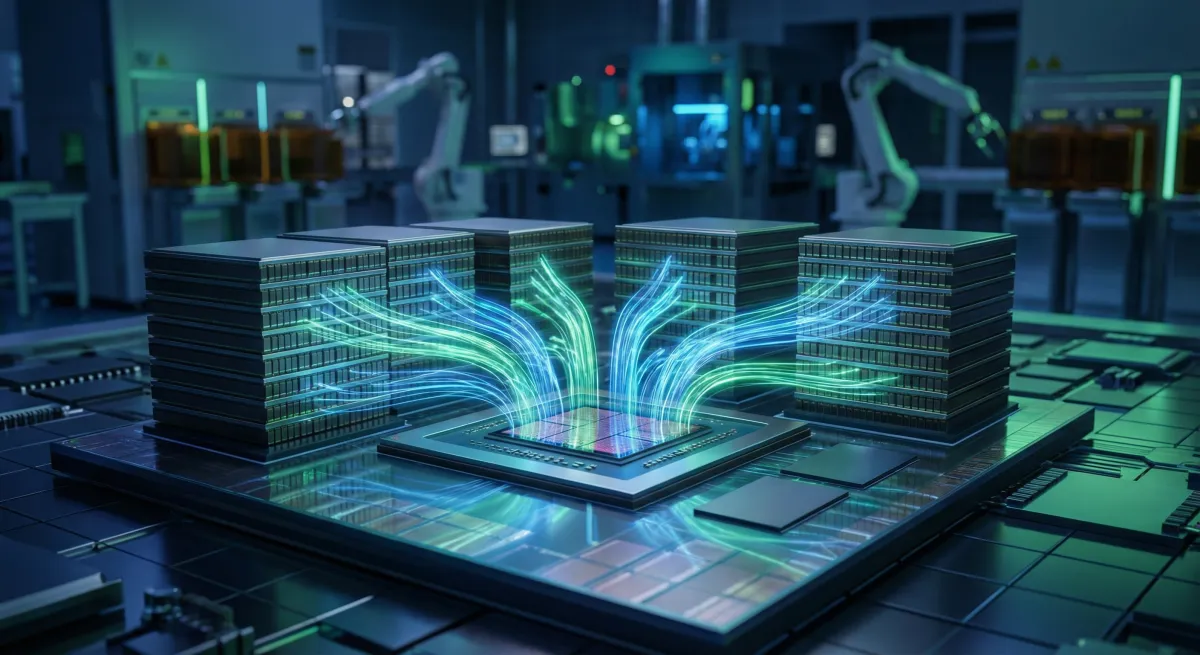
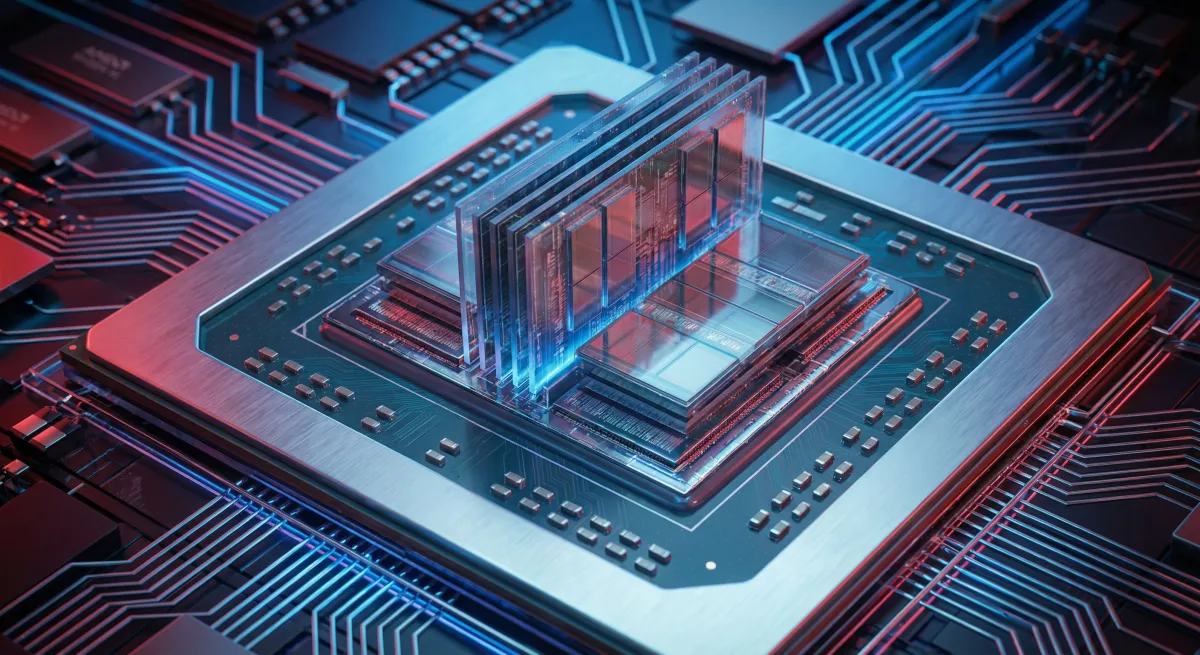
Beyond AMD's specific product announcements, the broader AI hardware landscape is being reshaped by a revolutionary approach to chip design: 3D stacking. Recent research breakthroughs, highlighted by a ScienceDaily report, reveal the creation of novel 3D computer chips that vertically integrate memory and computing elements. This innovative architecture dramatically accelerates data movement within the chip by circumventing the "traffic jams" inherent in traditional flat, 2D designs.
In conventional chips, data often travels considerable distances between processing units and memory, leading to bottlenecks that limit overall performance and energy efficiency. By stacking these components vertically, researchers have drastically reduced communication pathways, enabling data to be accessed and processed almost instantaneously. This "local" data access is particularly advantageous for AI workloads, which are highly data-intensive and often constrained by memory bandwidth.
The implications for AI are profound. Faster data access means more efficient training of neural networks, quicker inference times, and the ability to process larger, more complex datasets on-chip. This technology holds the promise of unlocking new levels of AI performance, enabling even more sophisticated algorithms and applications across various domains, from scientific computing to advanced robotics.
The Future of AI Hardware: A Converging Path
The announcements from AMD at CES 2026, coupled with the rapid advancements in 3D chip stacking, paint a clear picture of the future of AI hardware: one characterized by intelligent, highly integrated, and incredibly efficient processing solutions. As AI continues to permeate every aspect of technology, the demand for specialized and powerful hardware will only intensify.
Companies like AMD are not just building faster chips; they are architecting entirely new paradigms for computing, where AI is not an afterthought but a fundamental design principle. The convergence of powerful NPUs, optimized data center processors, and revolutionary 3D chip architectures will be instrumental in pushing the boundaries of what AI can achieve, ushering in an era of truly transformative artificial intelligence.