Nvidia's "Surprise the World" Moment: Rubin Chips, HBM4, and the Memory Bottleneck Reshaping AI
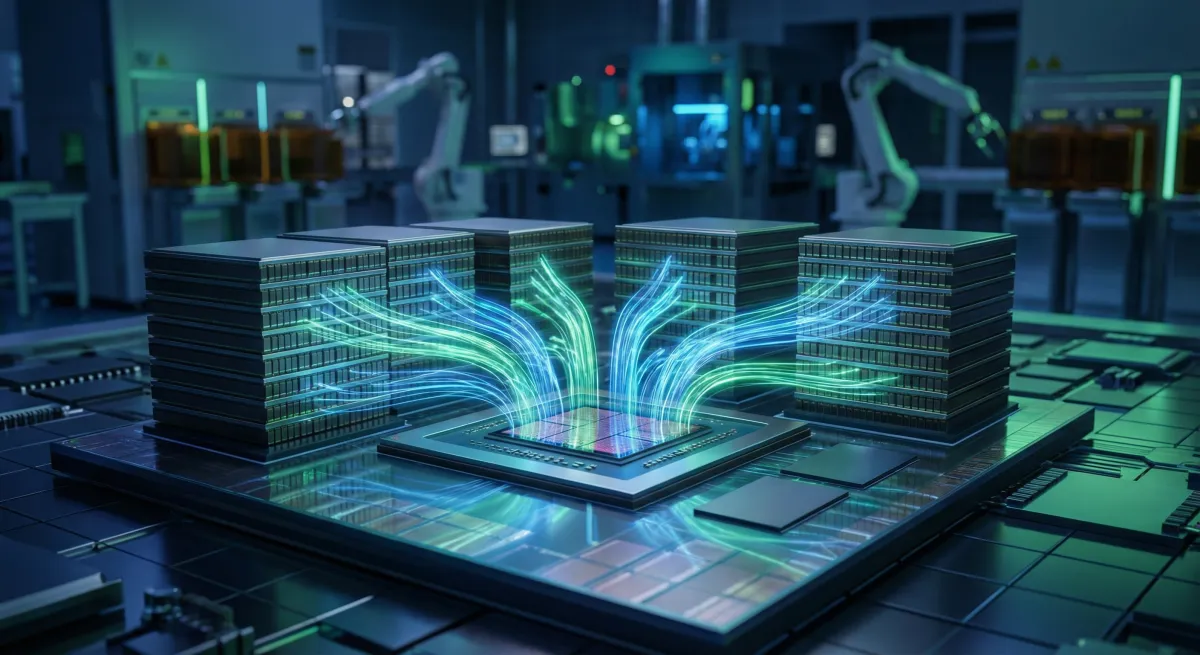
Nvidia CEO Jensen Huang just dropped a bombshell that has the semiconductor industry buzzing: at the upcoming GPU Technology Conference (GTC) in March 2026, the company will unveil chips that will "surprise the world." But the real story isn't just about Nvidia's next-generation Rubin architecture—it's about a fundamental shift in AI hardware where memory, not processing power, has become the critical bottleneck threatening to slow down the entire AI revolution.
The GTC 2026 Reveal: What We Know So Far
In a strategic interview with the Korea Economic Daily, Huang confirmed that Nvidia's March 16-19 GTC conference in San José would showcase revolutionary new processors. While the CEO remained cryptically tight-lipped about specifics, industry analysts are converging on a consensus: the Vera Rubin generation of AI accelerators, paired with next-generation HBM4 (High Bandwidth Memory) and advanced system-level integration, is the most likely candidate for the grand reveal.
The timing is deliberate. Just before his interview, Huang held what he described as a "celebratory dinner with the world's leading memory semiconductor team"—executives from SK Hynix, one of only three manufacturers capable of producing HBM4 at scale. This dinner was not merely ceremonial. SK Hynix has been racing to meet Nvidia's specifications for HBM4, which promises bandwidth improvements of 50% over the current HBM3e standard and latency reductions critical for training models with trillions of parameters.
What makes the Rubin generation particularly significant is not just the raw compute power—though estimates suggest a 3x improvement in AI inference throughput over the current Blackwell (B200) generation—but the architectural integration. Nvidia has reportedly cracked advanced Co-Packaged Optics (CPO), a technology that uses light instead of electrical signals to move data between the processor and memory stacks. This eliminates one of the most stubborn power consumption and heat dissipation problems plaguing current data center designs.
The Memory Crisis: From GPU Shortage to RAM Shortage
While the tech world has obsessed over GPU availability for the past three years, a quieter but more structurally significant crisis has been building: memory is now the primary constraint in AI system design. According to recent industry analyses, memory chips have displaced processors as the key driver of semiconductor revenue growth, marking what experts are calling an unprecedented "memory supercycle."
The numbers tell the story. Training a single frontier AI model like OpenAI's GPT-5 or Anthropic's Claude Opus 4 requires not just thousands of GPUs, but petabytes of high-bandwidth memory that can feed data to those processors fast enough to prevent compute stalls. Current HBM3e production cannot keep up with demand, and lead times have stretched to 52 weeks—longer than for the GPUs themselves.
"Memory chips are now the chokepoint," explains John Furrier, industry analyst at SiliconANGLE. "You can have all the GPUs in the world, but if you can't get data in and out of them fast enough, you're essentially running a Ferrari with bicycle tires."
This bottleneck has triggered a massive revaluation of memory manufacturers. Samsung, Micron, and SK Hynix have seen their market capitalizations surge as they race to convert older DRAM fabrication facilities to HBM4 production lines. Samsung recently announced it had shipped what it described as the "priciest AI memory Nvidia has ever ordered"—HBM4 modules exceeding key thermal and bandwidth specifications that had previously been considered theoretical limits.
The Technical Challenge: Why HBM4 Matters
To understand the significance, you need to grasp the engineering challenge. HBM4 stacks multiple memory dies vertically using Through-Silicon Vias (TSVs), creating a "memory tower" that sits directly adjacent to the GPU die. This proximity reduces the distance data must travel, cutting latency from nanoseconds to picoseconds. But manufacturing these stacks with 16 or 24 layers while maintaining thermal stability and yield rates above 70% has proven extraordinarily difficult.
HBM4's target specifications are staggering:
- Bandwidth: 2TB/s per stack (up from 1.2TB/s in HBM3e)
- Capacity: 48GB per stack (doubling HBM3e's 24GB)
- Power efficiency: 30% reduction in watts per gigabyte
- Operating temperature: Sustained performance at 95°C+ without throttling
Achieving these targets requires not just better memory chips, but revolutionary packaging. This is where Nvidia's partnership with TSMC and SK Hynix becomes critical. The Rubin chips are expected to use TSMC's 3nm process node combined with Chip-on-Wafer-on-Substrate (CoWoS-L) packaging—a mouthful of a technology that essentially creates a miniature supercomputer in a single module.
The Custom Silicon Rebellion: Broadcom vs. Nvidia
While Nvidia prepares its next-generation offering, a parallel revolution is quietly undermining the GPU giant's dominance: the rise of custom silicon. Companies like Google, Meta, Amazon, and OpenAI are increasingly designing their own Application-Specific Integrated Circuits (ASICs) for AI workloads, bypassing Nvidia entirely. And the company enabling this shift? Broadcom.
Broadcom's Q1 2026 earnings (scheduled for March 4) are expected to validate a seismic industry shift. The company is sitting on a $73 billion hardware backlog, with its custom silicon division reportedly booked solid through 2027. Broadcom's value proposition is simple but compelling: by designing chips tailored to specific AI models, hyperscalers can achieve 3-5x better performance-per-watt compared to general-purpose GPUs, while cutting their per-inference costs by 60-80%.
The Economics of "Escaping the Nvidia Tax"
Let's run the numbers. A single Nvidia B200 GPU retails for approximately $35,000-$40,000, with enterprise customers often waiting 9-12 months for delivery. Meta's custom MTIA v4 chip, co-designed with Broadcom, reportedly costs $12,000-$15,000 per unit to manufacture and is optimized specifically for running Llama 4 inference workloads. Over a five-year data center lifecycle, that cost differential compounds dramatically.
Google's latest Tensor Processing Unit (TPU), the 3nm "Sunfish" developed with Broadcom, has become the compute backbone for Gemini 3.0. According to leaked internal documents, running Gemini inference on Sunfish TPUs costs Google one-fifth what it would cost on equivalent Nvidia hardware. When you're running hundreds of millions of inference queries per day, those savings translate to billions of dollars annually.
This trend has forced Nvidia to adapt. The company is reportedly developing "semi-custom" variants of Rubin that will allow hyperscaler customers to specify certain architectural features—a middle ground between fully custom ASICs and off-the-shelf GPUs. But this concession reveals the pressure Nvidia faces as its customers increasingly view standard GPUs as overpriced commodities.
The Networking Revolution: 1.6T Ethernet and the Death of InfiniBand
There's another dimension to this hardware transformation that often gets overlooked: networking. For years, Nvidia's proprietary InfiniBand technology was the gold standard for connecting AI accelerators in training clusters. But in 2026, Ethernet is making a stunning comeback, and it's rewriting the economics of data center construction.
Broadcom's Tomahawk 6 switching ASIC, the world's first 102.4 Tbps chip supporting 1.6T Ethernet ports, has become the backbone of what the industry calls "Ultra Ethernet" clusters. This technology allows data centers to network up to 1 million AI accelerators in a single coherent fabric—a scale that was science fiction just 18 months ago.
Why does this matter? InfiniBand is proprietary, expensive, and locks customers into Nvidia's ecosystem. Ethernet is an open standard, costs 40-60% less per port, and integrates seamlessly with existing data center infrastructure. As AI training clusters scale from tens of thousands to millions of accelerators, the networking cost differential becomes a decisive factor. Meta's recently announced "Grand Teton 2" AI supercomputer uses 100% Ethernet connectivity—a deliberate snub of InfiniBand.
The Geopolitical Dimension: Memory as National Security
The memory bottleneck has caught the attention of governments worldwide, transforming HBM production capacity into a matter of national security. The United States CHIPS Act has earmarked $6.2 billion specifically for advanced packaging and memory manufacturing, with the explicit goal of reducing dependence on South Korean and Taiwanese suppliers.
Micron's planned $20 billion facility in Upstate New York, scheduled to begin HBM4 production in late 2027, is part of this strategic repositioning. Similarly, the European Union's "Chips for Europe" initiative has designated €2.8 billion for a joint Samsung-Infineon memory fabrication facility in Dresden, Germany.
China, meanwhile, has ramped up investment in domestic memory champions like ChangXin Memory Technologies (CXMT) and Yangtze Memory Technologies (YMTC), despite being multiple generations behind in HBM technology. The gap is closing: CXMT recently demonstrated HBM3-equivalent modules, and insiders suggest HBM4-class production could begin by 2028, albeit at lower yields.
What This Means for the AI Industry
The convergence of Nvidia's Rubin reveal, the memory supercycle, and the custom silicon boom creates three distinct scenarios for the next 18 months:
Scenario 1: The Nvidia Moat Holds
If Rubin delivers on its promise and Nvidia secures sufficient HBM4 supply through its partnerships with Samsung and SK Hynix, the company could maintain its 80%+ market share in AI training hardware. The key will be whether Nvidia can offer compelling "semi-custom" options that give hyperscalers enough flexibility to feel they're not overpaying for unused capabilities.
Scenario 2: The Custom Silicon Fracture
If Broadcom's earnings confirm that custom ASICs are achieving significant cost and performance advantages, we could see accelerated defection from Nvidia. In this scenario, Nvidia becomes primarily a vendor for smaller companies and research institutions, while the hyperscalers that drive 70% of AI chip demand build their own hardware. Nvidia's data center revenue growth would stall, and its stock multiple would compress significantly.
Scenario 3: The Memory-Constrained Stalemate
The most likely outcome: everyone is constrained by memory supply. Neither Nvidia nor its competitors can scale as fast as AI model development demands because HBM4 production simply cannot ramp quickly enough. In this scenario, the real winners are the memory manufacturers—Samsung, SK Hynix, and Micron—whose pricing power and margins expand dramatically. We're already seeing signs of this: HBM4 pricing is reportedly 3-4x higher per gigabyte than traditional DRAM, with no discounting in sight.
The Long View: From Compute-First to Memory-First Design
What we're witnessing is a fundamental architectural shift in computing. For 60 years, processor speed was the primary constraint—Moore's Law drove the entire industry. But in the AI era, memory bandwidth and capacity have become the binding constraints. This is forcing a complete rethinking of system design.
Future AI accelerators will likely look radically different from today's discrete GPU cards. Instead of a chip with memory attached, we'll see memory-centric architectures where processing elements are embedded directly into or adjacent to memory arrays. Technologies like Processing-in-Memory (PIM) and Compute-in-Memory (CIM) are moving from research labs to commercial production.
Samsung has already demonstrated a prototype "HBM-PIM" module that can perform matrix multiplications—the core operation in neural networks—directly within the memory stack, reducing data movement by 90%. If this technology reaches commercial viability by 2027-2028, it could render both traditional GPUs and ASICs partially obsolete, triggering yet another wave of architectural disruption.
Conclusion: Surprise or Validation?
When Jensen Huang promises chips that will "surprise the world" at GTC 2026, the real surprise may not be the Rubin chips themselves, but the broader ecosystem transformation they represent. We're entering an era where:
- Memory is more valuable than compute
- Custom silicon challenges one-size-fits-all GPUs
- Open networking standards break proprietary lock-in
- Geopolitics shapes semiconductor roadmaps
For investors, engineers, and industry observers, the next six months will be pivotal. Nvidia's GTC reveal on March 16, followed by Broadcom's earnings on March 4, will provide critical data points. But the longer-term trend is clear: the AI hardware landscape is fragmenting from a Nvidia-centric monopoly into a more diverse, specialized, and memory-constrained ecosystem.
The question isn't whether Nvidia will "surprise the world"—it's whether any single company can dominate in this new paradigm. The memory bottleneck suggests that even the most revolutionary chip won't matter if you can't feed it data fast enough. And that's the real surprise the industry is slowly waking up to.