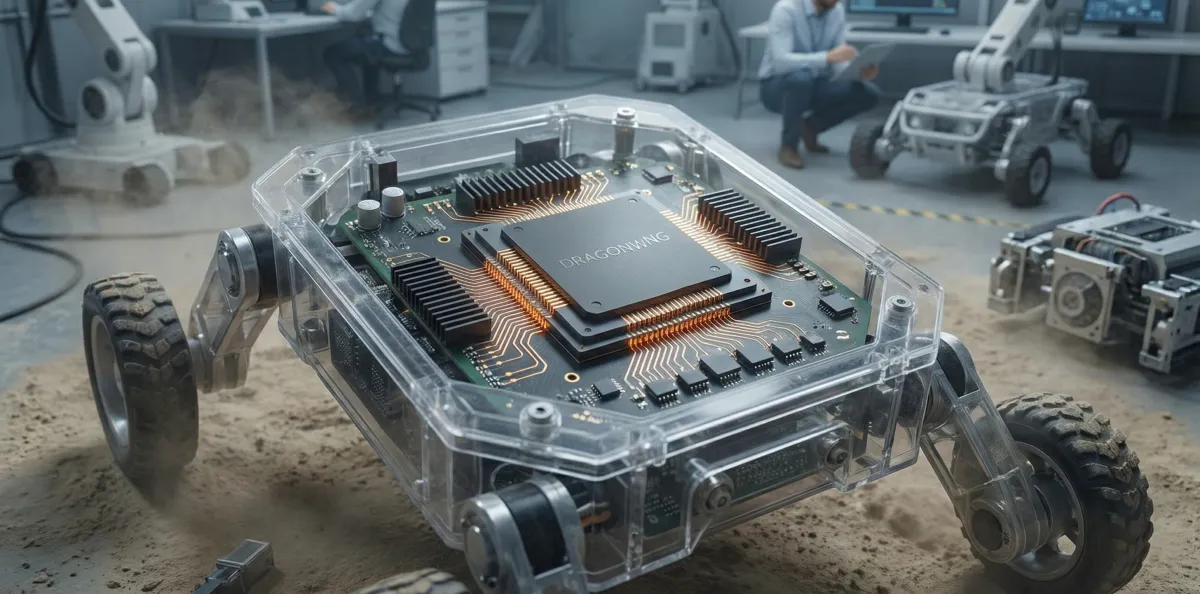
The mobile chip giant has made its move. At the India AI Impact Summit 2026 in New Delhi this week, Qualcomm unveiled the Dragonwing IQ-10—its first processor purpose-built for robotics—alongside a complete end-to-end robotics platform targeting humanoids, autonomous mobile robots (AMRs), and the burgeoning "physical AI" market. The announcement signals Qualcomm's serious entry into premium robotics silicon, putting it on a collision course with NVIDIA's Jetson ecosystem and positioning the Snapdragon maker as a key enabler of the humanoid robot wave sweeping factories, warehouses, and eventually homes.
Dragonwing IQ-10: Purpose-Built for Physical AI
Unlike Qualcomm's previous forays into robotics using adapted mobile SoCs, the Dragonwing IQ-10 represents a from-scratch design optimized for the unique demands of robotic systems. The chip targets full-size humanoids and high-end AMRs—machines that must continuously process multi-modal sensor data (vision, audio, lidar, IMU), run real-time motion control loops, execute AI inference models for perception and planning, and coordinate actuators—all within strict power and thermal envelopes.
Shrestha Jain, Qualcomm's Marketing Lead for Robots and Automotive, emphasized the processor's energy efficiency as a critical differentiator. "Robots aren't plugged into walls," she explained at the summit. "Whether it's a warehouse AMR running 12-hour shifts or a humanoid performing factory tasks, battery life directly limits operational utility. Dragonwing IQ-10 is engineered to deliver the compute density these machines need without thermal throttling or requiring massive battery packs."
While Qualcomm hasn't disclosed full specifications, the company confirmed the processor integrates:
- Heterogeneous compute architecture combining AI accelerators, CPU cores, GPU, and specialized DSPs for sensor fusion and motor control
- Multi-criticality support derived from Qualcomm's automotive ADAS experience, allowing safety-critical control loops and non-critical AI workloads to coexist on a single chip
- Hardware-accelerated perception for real-time SLAM (Simultaneous Localization and Mapping), object detection, and scene understanding
- On-device AI inference capable of running transformer-based vision-language models and motion planning networks without cloud dependency
The emphasis on edge processing is deliberate. Real-world robots can't afford latency or rely on consistent connectivity—decisions must happen locally, in milliseconds.
The Broader Robotics System: Hardware Meets Software
The Dragonwing IQ-10 sits at the center of what Qualcomm calls its "Robotics System"—a modular, scalable platform that extends beyond silicon to encompass software frameworks, developer tools, and an "AI data flywheel" for continuous learning.
The architecture includes:
Vision, Audio, and Motion Integration: Pre-validated sensor stacks that work out-of-the-box with the processor, reducing months of integration work for robot manufacturers.
Edge AI Frameworks: Support for TensorFlow Lite, PyTorch Mobile, ONNX Runtime, and Qualcomm's own Neural Processing SDK, enabling developers to deploy models trained in standard ML pipelines directly to robots.
Data Flywheel: A telemetry and model improvement loop where robots in the field collect edge cases, upload anonymized data during charging/downtime, and receive updated models—similar to Tesla's approach with FSD but applied to manipulators and humanoids instead of vehicles.
Modular Compute Scaling: The platform supports tiered implementations, from entry-level AMRs using lower-power variants to premium humanoids pairing multiple Dragonwing chips for advanced reasoning and dexterous manipulation.
"We're not building robots," Jain clarified. "We're building the nervous system that robot makers can plug into. The goal is to collapse development time from years to months by providing validated compute, proven software, and ecosystem support."
10 Priority Tasks: Pragmatic Focus Over Hype
Rather than chasing the sci-fi vision of general-purpose androids, Qualcomm is initially targeting ten specific, high-ROI tasks in logistics, manufacturing, and retail:
- Item picking (e.g., order fulfillment in warehouses)
- Case stacking (palletizing and depalletizing)
- Line sequencing (assembly line material handling)
- Inventory scanning (stockroom audits)
- Mobile manipulation (moving objects between stations)
- Quality inspection (visual defect detection)
- Cart transport (moving racks and bins)
- Package sorting (last-mile logistics hubs)
- Shelf restocking (retail back-of-house)
- Collaborative assembly (human-robot teaming)
This pragmatic roadmap mirrors the strategy that made Qualcomm dominant in mobile: identify high-volume use cases with clear economic justification, optimize the silicon for those workloads, and let the ecosystem expand from there.
"Every one of these tasks has a measurable payback period for adopters," notes industry analyst Patrick Moorhead. "Qualcomm isn't selling a platform for research labs—they're selling ROI to CFOs. That's how you actually scale robotics beyond pilot programs."
The Competitive Landscape: NVIDIA, Tesla, and Emerging Players
Qualcomm's timing is strategic. NVIDIA CEO Jensen Huang declared February's unveiling of Project GR00T and the Isaac Robotics Platform the "ChatGPT moment for robotics"—a claim that immediately drew skepticism but underscored the market's explosive growth trajectory. NVIDIA's Jetson ecosystem dominates today's robotics developer community, particularly for perception-heavy applications, but Jetson chips weren't designed for the real-time control and power constraints of untethered humanoids.
Tesla, meanwhile, continues refining its custom FSD silicon for Optimus, giving it a fully vertical stack but limited third-party applicability. Figure AI, Agility Robotics, and Apptronik are building custom compute solutions, fragmenting the market.
Qualcomm's edge: ecosystem leverage. With decades of relationships across manufacturing (from automotive to consumer electronics), proven supply chain scale, and a developer community that already knows its tools, Qualcomm can offer robot makers a turnkey solution with known economics and established support—critical for companies navigating their first hardware product.
"NVIDIA has mindshare among researchers. Tesla has vertical integration. Qualcomm has operational maturity and manufacturing partnerships," explains robotics investor James Brehm. "For the hundreds of robotics startups trying to go from prototype to production, that last point matters enormously."
India AI Summit: Strategic Timing and Market Signaling
Qualcomm's decision to showcase Dragonwing IQ-10 at India's flagship AI event—following a quieter CES debut—wasn't accidental. India represents one of the world's fastest-growing automation markets, with surging demand in logistics (fueled by e-commerce), manufacturing (electronics assembly, textiles), and agriculture.
The summit, inaugurated by Prime Minister Narendra Modi and held at Bharat Mandapam in New Delhi, emphasized themes of "People, Planet, and Progress"—framing AI and robotics as tools for inclusive growth rather than job displacement. Qualcomm's demo featured a full-scale humanoid performing industrial tasks, directly addressing concerns about accessibility and local innovation.
"India isn't just a market for Qualcomm—it's a design and manufacturing hub," notes tech policy analyst Amber Sinha. "Announcing here signals that Qualcomm sees Indian robotics companies and system integrators as first-tier partners, not just customers. That's a meaningful shift."
Qualcomm also highlighted its existing footprint in India's semiconductor ecosystem, including collaborations with IIT labs and involvement in the country's $10 billion chip incentive program. The subtext: Dragonwing-powered robots could be designed, built, and deployed entirely within India's emerging tech supply chain.
From ADAS to AMRs: Leveraging Automotive DNA
One of Qualcomm's underappreciated advantages is its deep experience in automotive ADAS systems—arguably the closest analog to robotics in terms of technical requirements. Both domains demand:
- Real-time sensor fusion (cameras, radar/lidar, ultrasonics)
- Safety-critical compute with deterministic latency
- Functional safety certification (ISO 26262 for automotive, emerging standards for robotics)
- Thermal management in harsh environments
- Years-long product lifecycles with software update support
Qualcomm's Snapdragon Ride platform already powers ADAS systems in production vehicles from BMW, GM, and others. Dragonwing IQ-10 adapts this architecture for different form factors and actuation requirements.
"Automotive taught us how to build chips that never fail and systems that improve over time," Jain noted. "That's exactly what industrial robots need. A warehouse AMR that crashes once a week isn't commercially viable, just like an ADAS system that misses pedestrians isn't."
This experience also informs Qualcomm's business model: long-term partnerships with OEMs, ongoing software support, and a roadmap that assumes robots will receive feature updates and capability enhancements for 5-7 years after initial deployment.
Market Outlook: The Robotics Gold Rush Begins
The physical AI market is at an inflection point. Goldman Sachs projects the humanoid robot market alone will reach $38 billion by 2035, driven by labor shortages, rising wages in developed economies, and improving AI capabilities. ABI Research forecasts 1.8 million industrial AMRs will be deployed globally by 2030, up from 230,000 in 2024.
Qualcomm is positioning Dragonwing as the "Snapdragon of robotics"—a reference architecture that becomes the default choice for the majority of the market, much as its mobile chips power 40% of smartphones. If successful, the strategy could generate billions in annual revenue from a sector that barely existed five years ago.
But challenges remain. Robot economics still hinge on narrow use cases with clear ROI. General-purpose humanoids remain years away from consumer viability. And competitors aren't standing still—NVIDIA will likely counter with a robotics-specific Jetson variant, while Chinese chip makers like Horizon Robotics are aggressively targeting the Asia-Pacific market.
What's clear: the race to power the next generation of physical AI has begun in earnest. And Qualcomm, leveraging decades of mobile and automotive silicon expertise, is making its claim as a foundational player. The Dragonwing IQ-10 isn't just a chip—it's Qualcomm's bet that robots, like smartphones before them, will run on standardized compute platforms built at scale.
For robotics startups, system integrators, and enterprises evaluating automation, the takeaway is simple: the silicon layer is maturing rapidly. The bottleneck to widespread robot deployment is shifting from hardware availability to software maturity, business model innovation, and workforce adaptation.
The robots are coming. Qualcomm just made sure they'll have brains.