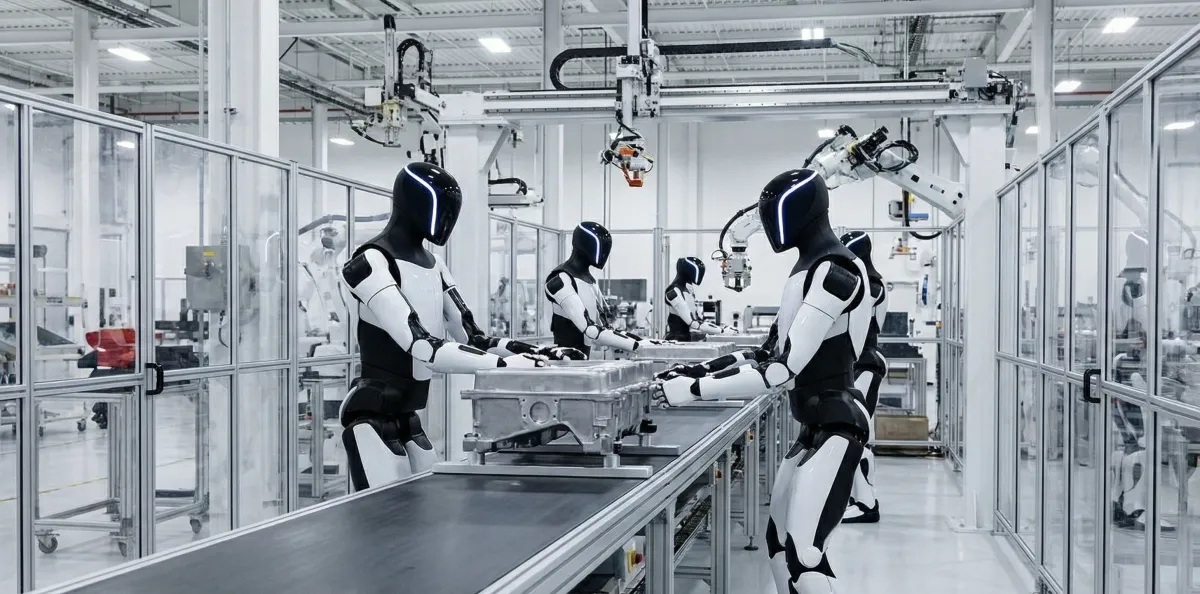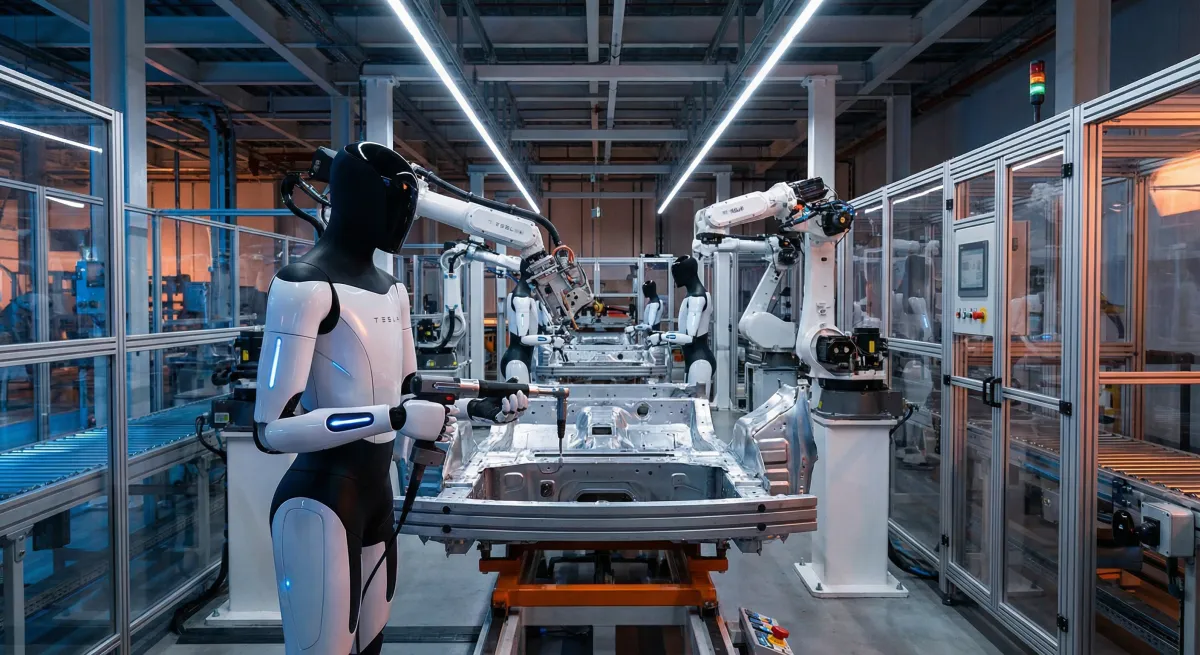
For decades, humanoid robots belonged in research labs and viral videos—impressive demonstrations of what was theoretically possible, but commercially impractical. In 2026, that era is definitively over. Boston Dynamics' Atlas is entering production. China has shipped over 10,000 humanoid robots in the past year. Tesla's Optimus Gen 3 is weeks away from its public reveal. And the first consumer humanoid—1X's NEO—is being delivered to actual homes.
The inflection point has arrived. Humanoid robotics is transitioning from R&D curiosity to deployed reality, driven by converging advances in AI, actuator technology, battery systems, and manufacturing scale. The question is no longer "will humanoid robots work?" but "who will dominate the market as it scales into the millions?"
Boston Dynamics Atlas: From Backflips to Production Lines
Boston Dynamics made its name with viral videos of Atlas performing parkour, backflips, and human-like balance recovery after being pushed. Those demos showcased what hydraulic actuators and advanced control systems could achieve—but they also reinforced Atlas's reputation as a research platform rather than a product.
That changed in January 2026 when Boston Dynamics announced Atlas had entered production. The electric version of Atlas—unveiled in 2024 and refined throughout 2025—is now being manufactured for deployment to Hyundai's Robotic Manufacturing Automation Center (RMAC) and Google DeepMind's AI research labs.
The Hyundai partnership is particularly significant. As Boston Dynamics' parent company, Hyundai is integrating Atlas into its factories for tasks requiring dexterity and dynamic movement: installing complex wiring harnesses, positioning heavy components, and performing quality inspections in tight spaces. The goal: prove that humanoid robots can handle tasks that currently require expensive custom automation or flexible human labor.
Google DeepMind's involvement points to another strategic direction: using Atlas as a physical AI training platform. DeepMind's robotics team is focused on developing foundation models for manipulation—AI systems that can learn to interact with the physical world through experience rather than explicit programming. Atlas provides the hardware capable of executing complex, dynamic tasks that simpler robots can't handle.
What Makes Electric Atlas Different
The shift from hydraulics to electric actuators was essential for commercialization. Hydraulic systems offer incredible power-to-weight ratios and enable Atlas's signature dynamic movements, but they're loud, require regular maintenance, leak fluid, and aren't practical for indoor or food-safe environments.
Electric Atlas trades some raw power for reliability, quieter operation, and easier maintenance. It retains Atlas's core capabilities—dynamic balance, whole-body manipulation, navigation of unstructured environments—while becoming viable for real-world deployments beyond research labs.
Boston Dynamics hasn't disclosed pricing, but industry analysts estimate Atlas will cost $150,000-$200,000 per unit initially, positioning it as a premium option for specialized applications rather than mass-market automation.
China's Humanoid Robot Surge: 10,000+ Units and Counting
While Western companies focused on perfecting individual platforms, China pursued volume. In 2025 alone, Chinese manufacturers shipped over 10,000 humanoid robots—more than the rest of the world combined. The leaders: Unitree Robotics and Agibot, each shipping approximately 5,000 units.
Unitree: The "$16,000 Humanoid" Strategy
Unitree Robotics made headlines by pricing its G1 humanoid at approximately $16,000—dramatically undercutting Western competitors. The strategy mirrors China's approach to electric vehicles and solar panels: achieve scale through aggressive pricing, iterate rapidly, and dominate through volume.
The G1 isn't as capable as Atlas or Optimus in raw specs. It's slower, less dexterous, and has shorter battery life. But it's good enough for many industrial tasks: moving materials, simple assembly, basic inspection. And at $16,000, the ROI calculation becomes attractive even for mid-sized manufacturers.
Unitree is also pursuing the research market aggressively, positioning G1 as an affordable platform for universities and AI labs that can't justify six-figure robots. This creates a pipeline: researchers who train models on Unitree platforms in academic settings are more likely to recommend them for industrial deployment.
Agibot and the Industrial Focus
Agibot takes a different approach: higher-quality robots ($30,000-$50,000) optimized for specific industrial workflows. The company partners with manufacturers to customize robots for particular tasks—automotive assembly, electronics manufacturing, food processing—and provides ongoing software updates and operational support.
The model is working. Agibot has secured multi-year contracts with several major Chinese manufacturers and is expanding into Southeast Asia, where labor costs are rising but wages remain below the breakeven point for Western-priced automation.
UBTECH Walker S2: Border Patrol Robots
In February 2026, UBTECH announced a $37 million contract to deploy Walker S2 humanoid robots for border patrol applications. The robots will patrol designated areas, monitor for unauthorized crossings, and relay real-time video to human operators.
It's a controversial application—raising questions about surveillance, use of force, and the militarization of robotics. But it demonstrates that governments are willing to deploy humanoids for security tasks, opening a market beyond industrial automation.
Tesla Optimus Gen 3: The Q1 2026 Reveal
Tesla has been promising "general-purpose humanoid robots" since 2021. The timeline has slipped repeatedly, but Q1 2026 marks a critical milestone: the public reveal of Optimus Gen 3 and the start of internal factory deployments.
Elon Musk's latest claims: Optimus Gen 3 will cost $20,000-$30,000 at scale, perform useful work in Tesla factories by mid-2026, and be available for external sale in 2027. The skepticism is warranted—Musk's timelines are famously optimistic—but Tesla has advantages that can't be dismissed.
The Tesla Manufacturing Advantage
Tesla is the only humanoid robot maker that's also a mass-market manufacturer. The company produces millions of vehicles annually, each containing complex electronics, actuators, sensors, and AI systems. Optimus leverages this supply chain and manufacturing expertise in ways competitors can't replicate.
The actuators are adapted from Tesla's vehicle motors. The vision system uses the same cameras and neural networks as Full Self-Driving. The battery tech comes from Tesla's EV platform. Even the manufacturing processes—stamping, casting, assembly line integration—are borrowed from automotive production.
If Tesla can achieve anything close to its target cost, it will fundamentally reshape the market. A $25,000 humanoid capable of useful work would undercut competitors by 3-5x and make automation economically viable for applications that currently can't justify the investment.
The AI Integration Story
Tesla's other advantage: end-to-end AI development. The company has spent years training neural networks to perceive and navigate the real world using vehicle data. Optimus inherits this foundation, potentially accelerating its learning curve compared to robots starting from scratch.
Musk has claimed Optimus will eventually be "more valuable than Tesla's car business." That's hyperbole—but if humanoid robots scale to millions of units at healthy margins, it's not entirely absurd. The total addressable market for general-purpose robots dwarfs automotive.
Figure AI, Agility Robotics, and the Deployment Race
While Tesla generates headlines, Figure AI and Agility Robotics are quietly scaling deployments:
Figure 02: BMW Partnership
Figure AI's Figure 02 robot is operating in BMW's Spartanburg, South Carolina plant, performing tasks like parts sorting, kitting, and quality inspection. The deployment is a pilot—fewer than 50 robots—but it's real production work, not a controlled demo.
Figure's strategy: prove value in high-end manufacturing, establish operational expertise, then scale to other verticals. The company raised $675 million in 2024 at a $2.6 billion valuation, backed by investors including OpenAI, NVIDIA, and Jeff Bezos. That capital provides runway to iterate and scale without pressure to achieve profitability immediately.
Figure 02 costs over $100,000 and isn't designed for mass-market applications. But for BMW—where downtime costs thousands per minute and labor shortages constrain production—the economics work. If Figure can demonstrate 90%+ uptime and meaningful productivity gains, automotive manufacturers will line up.
Agility Digit: Warehouse Automation
Agility Robotics' Digit is designed for logistics: moving totes, loading delivery vans, navigating warehouses. The robot's legs enable it to handle stairs, curbs, and uneven surfaces that wheeled robots can't traverse, while its torso-mounted arms manipulate packages.
Amazon, GXO Logistics, and Spanx have all piloted Digit. The value proposition: deploy humanoids in existing facilities without expensive retrofits. Traditional AMRs require flat floors and wide aisles. Digit navigates human-designed spaces as-is.
Agility is building a 70,000-square-foot factory in Salem, Oregon—the first facility in the world dedicated to mass-producing humanoid robots. The target: 10,000+ Digits annually by 2027. At an estimated $100,000-$150,000 per unit, that's a billion-dollar revenue run rate if they hit the target.
1X NEO: The First Consumer Humanoid
While industrial robots dominate headlines, 1X Technologies is pursuing a different market: homes. The company's NEO humanoid is being delivered to select customers in Norway as part of a limited pilot program—the first time a general-purpose humanoid has entered private residences.
NEO is designed for household tasks: loading dishwashers, folding laundry, organizing clutter, assisting elderly or disabled individuals. It's slow, deliberate, and non-threatening by design—1X intentionally avoided the "uncanny valley" by giving NEO a friendly, approachable appearance.
The price hasn't been disclosed, but industry estimates suggest $50,000-$75,000—far beyond most consumers but affordable for early adopters and assisted living facilities. The pilot program is collecting real-world usage data to refine NEO's capabilities before broader commercialization.
1X's long-term vision: robotics-as-a-service for households. Rather than buying a robot outright, consumers would pay a monthly subscription ($500-$1,000) that includes the hardware, maintenance, and continuous software upgrades. The economics mirror car subscriptions and equipment leasing—lower upfront cost, recurring revenue for 1X.
The Technical Challenges That Remain
Despite rapid progress, humanoid robotics still faces fundamental limitations:
Battery Life
Most humanoids operate for 2-4 hours per charge under real working conditions. That's sufficient for structured shifts with charging breaks, but it limits applications requiring continuous operation. Electric actuators are power-hungry, and battery energy density hasn't improved as fast as compute or sensors.
The industry is betting on three solutions: faster charging (15-minute "pit stops"), hot-swappable battery packs, and more efficient actuators. Tesla claims Optimus Gen 3 will achieve 8-hour runtime—if true, it would be a significant competitive advantage.
Dexterity and Manipulation
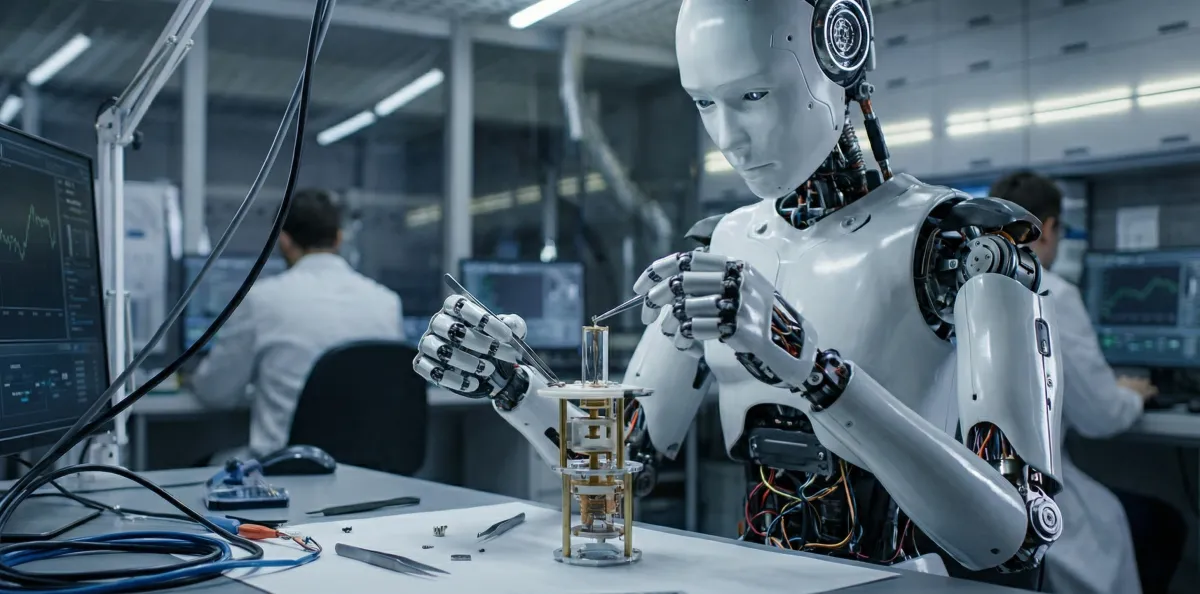
Humanoid hands remain far less capable than human hands. Picking up a box or moving a pallet is achievable. Tying shoelaces, handling delicate electronics, or assembling complex mechanisms is still beyond current systems.
The limiting factor isn't hardware—it's AI. Teaching robots to manipulate objects with human-like dexterity requires massive amounts of training data and compute. Companies like Google DeepMind, OpenAI, and Figure AI are racing to develop foundation models for manipulation, but we're still in the early innings.
Cost vs. Human Labor
The brutal economic reality: in much of the world, human labor is cheaper than robots. A $100,000 humanoid with a 5-year lifespan costs $20,000 per year (amortized), plus maintenance, software, and infrastructure. In the US or Europe, where average manufacturing wages exceed $40,000 annually, robots can be competitive. In China, Southeast Asia, or India, the math doesn't work yet.
This creates a split market: robots for high-wage regions, humans for low-wage regions. But as wages rise globally and robot costs fall, the crossover point approaches rapidly.
The 2026-2030 Outlook: Millions of Humanoids
Market forecasts predict the humanoid robot population will grow from approximately 25,000 units globally in early 2026 to 1-2 million by 2030. Goldman Sachs projects the market will reach $38 billion by 2035, driven by:
- Labor shortages: Aging populations in developed economies create structural demand for automation
- Declining costs: Economies of scale and commoditized components will drive prices below $20,000 for basic models
- AI improvements: Foundation models for manipulation will unlock new capabilities annually
- Regulatory acceptance: As safety records improve, regulations will enable broader deployment
The winners will be companies that achieve three things simultaneously: competitive hardware costs, AI capabilities that enable useful work, and manufacturing scale to meet demand. As of early 2026, no single company has all three—but several are close.
The Likely Market Structure
The humanoid robot industry will likely mirror automotive: a tiered market with premium, mid-market, and budget segments.
Premium ($100K+): Boston Dynamics Atlas, Figure 02, custom platforms for specialized applications. High performance, low volume.
Mid-market ($30K-$60K): Tesla Optimus (if targets are met), Agibot, Agility Digit. Capable enough for most industrial tasks, priced for ROI in developed markets.
Budget ($15K-$25K): Unitree G1, Chinese competitors. "Good enough" for basic automation, volume-focused.
Tesla has the potential to disrupt this structure if Optimus achieves both low cost and high capability—the "affordable luxury" positioning that made Tesla successful in automotive. But delivering on that promise requires overcoming the skepticism earned by years of missed timelines.
Societal and Economic Implications
The deployment of millions of humanoid robots will reshape labor markets, supply chains, and economic development:
Job Displacement and Creation
Humanoid robots will displace jobs in manufacturing, logistics, retail, and hospitality—roles involving repetitive physical tasks in structured environments. The typical estimate: 10-20 million jobs globally at risk by 2035.
Simultaneously, robotics will create new roles: robot technicians, AI trainers, fleet managers, human-robot coordination specialists. History suggests technological transitions create more jobs than they destroy—but the transition period is painful for displaced workers.
The political response is already forming. Labor unions are pushing for "robot taxes" to fund retraining programs. Some jurisdictions are proposing quotas limiting automation adoption. Others are embracing robotics as essential for economic competitiveness.
Reshoring Manufacturing
If robots become cost-competitive with offshore labor, they enable reshoring—bringing manufacturing back to high-wage countries. A lights-out factory staffed entirely by robots can locate near end markets, reducing logistics costs and lead times.
This could reverse decades of globalization, particularly in industries like apparel, electronics assembly, and consumer goods. But it also means manufacturing employment won't return at historical levels—the jobs move back, but robots do the work.
The Humanoid "iPhone Moment"
NVIDIA CEO Jensen Huang has called humanoid robotics the "ChatGPT moment for physical AI." The analogy is imperfect—humanoid adoption will be far more gradual than generative AI—but the underlying point holds: we're at the inflection point where technology becomes viable enough to scale rapidly.
The next five years will determine which companies become the "Apples and Samsungs" of humanoid robotics. The contenders are placing their bets. The race is on.
Conclusion: From Lab to Factory Floor to Living Room
2026 marks the year humanoid robotics transitioned from impressive demos to deployed products. Boston Dynamics is shipping Atlas to real customers. China is producing thousands of units monthly. Tesla is weeks away from revealing Optimus Gen 3. And the first consumer humanoid is operating in private homes.
The technology still has significant limitations. Battery life, dexterity, and cost remain barriers to mass adoption. But the trajectory is clear: humanoid robots are becoming practical, scalable, and economically viable.
Within a decade, millions of humanoids will work in factories, warehouses, hospitals, and homes. The companies that master the combination of AI, manufacturing scale, and cost efficiency will define the next chapter of automation.
The age of the humanoid workforce has begun.