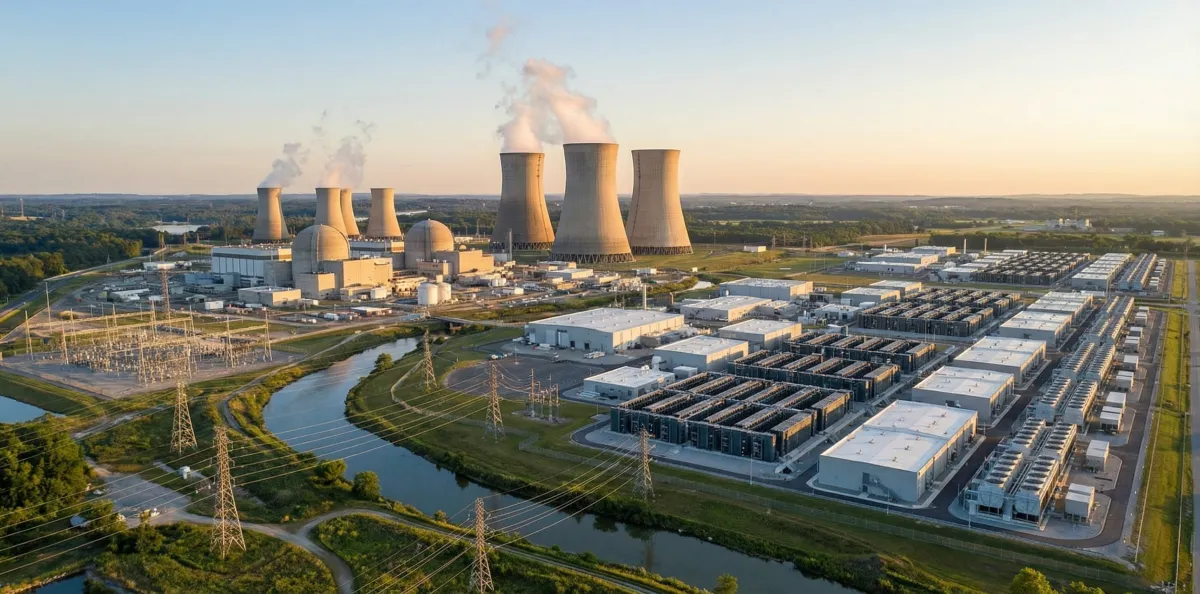
In September 2024, Microsoft announced a deal that startled the energy industry: a 20-year power purchase agreement to restart Unit 1 at Three Mile Island, the infamous Pennsylvania nuclear plant that has been offline since 2019. The reactor will deliver 835 megawatts of carbon-free electricity exclusively to Microsoft's data centers—enough to power hundreds of thousands of AI training servers.
Within weeks, Google and Amazon followed with their own nuclear commitments. By early 2026, the tech giants had collectively signed contracts for more than 10 gigawatts of new nuclear capacity in the United States—the largest private-sector bet on atomic energy in decades.
The nuclear pivot isn't about environmentalism or PR. It's about survival. AI workloads are consuming electricity at rates the grid can't support, and hyperscalers need baseload power that runs 24/7 without interruption. Solar and wind are intermittent. Natural gas emits carbon. Nuclear is the only scalable, zero-emission energy source that can meet AI's relentless demand.
Microsoft Bets Big on Three Mile Island
Microsoft's Three Mile Island deal is the most high-profile nuclear revival in the U.S. Constellation Energy will invest $1.6 billion to refurbish and restart the plant's Unit 1 reactor (Unit 2, site of the 1979 partial meltdown, remains permanently shuttered). Once operational in 2028, the plant will provide 835 MW of continuous power under a 20-year contract.
Why Three Mile Island? The plant already has grid interconnection, cooling infrastructure, and regulatory approval—assets that take years and billions to secure for greenfield projects. Restarting an existing reactor is faster and cheaper than building new capacity.
Microsoft needs the power for its Azure cloud AI clusters, which are being deployed across the Mid-Atlantic region. The company projects its data center electricity consumption will exceed 15 terawatt-hours per year by 2030—equivalent to the entire output of a dozen large power plants.
Google's Small Modular Reactor Bet
Google took a different approach, partnering with Kairos Power, a California-based startup developing small modular reactors (SMRs). In October 2024, Google signed an agreement to purchase power from Kairos' first commercial reactors, with the first 50 MW unit expected online by 2030 and additional units to follow.
Kairos' SMRs use molten fluoride salt as both coolant and fuel carrier, operating at lower pressure than traditional light-water reactors and offering improved safety. The modular design allows reactors to be factory-built and deployed incrementally—critical for matching power supply to data center construction timelines.
Google also contracted with an undisclosed "stealthy nuclear development company" in Greer, South Carolina, to prepare at least three sites for advanced nuclear installations. The exact reactor technology hasn't been disclosed, but industry sources suggest it involves TRISO particle fuel—golf ball-size graphite spheres packed with uranium—used in high-temperature gas reactors.
Amazon Invests in X-energy SMRs
Amazon Web Services announced its nuclear strategy in October 2024, investing more than $500 million in X-energy, a developer of advanced SMRs. AWS signed agreements to explore deployment of X-energy's Xe-100 reactors near its data centers, with a target of bringing 5 gigawatts of capacity online by 2039.
X-energy's Xe-100 is an 80 MW high-temperature gas reactor using the same TRISO fuel as Google's partners. Four Xe-100 units can be clustered into a 320 MW power plant—enough to support a large hyperscale data center campus.
Amazon is also exploring nuclear deployments in the Pacific Northwest and Virginia, two of its largest data center markets. The company has committed to matching 100% of its electricity consumption with carbon-free energy by 2030—a goal that requires baseload power, not just renewables.
Why Nuclear? Why Now?
The shift to nuclear is driven by three converging realities:
1. AI's Electricity Appetite Is Unsustainable
Data centers are projected to consume 325-580 terawatt-hours annually by 2028—up to 12% of U.S. electricity generation. AI training clusters can consume 100+ megawatts per facility, equivalent to a small city. Solar and wind can't provide that much power reliably.
2. Grid Capacity Is Tapped Out
Transmission constraints and permitting delays mean hyperscalers can't simply plug into the grid and draw gigawatts. PJM Interconnection, which manages the grid for 13 states, saw capacity auction prices spike 10x in a single year due to AI-driven demand. Tech companies need dedicated power sources to avoid competition with residential and industrial users.
3. Carbon Commitments Require Baseload Clean Energy
Microsoft, Google, and Amazon have all pledged net-zero carbon by 2030-2040. Renewables help, but batteries can't store weeks of electricity for cloudy, windless periods. Nuclear provides 24/7 carbon-free power without the land footprint of massive solar farms or the intermittency of wind.
The SMR Promise and Reality Check
Small modular reactors are the tech industry's preferred solution because they're scalable, factory-built, and (theoretically) faster to deploy than gigawatt-scale traditional reactors. But SMRs face real challenges:
- None are commercially operational yet — The first U.S. SMRs aren't expected online until 2028-2030
- Regulatory approval is slow — NRC licensing takes years, even for advanced designs
- Cost overruns are common — NuScale, an SMR pioneer, canceled its first project in 2023 after costs ballooned
- Fuel supply is uncertain — TRISO fuel production doesn't yet exist at commercial scale in the U.S.
But the tech giants have deep pockets and long time horizons. They're betting that by the time their 2030-2035 AI infrastructure is fully built out, SMRs will be proven and deployable.
Meta Stays on the Sidelines (For Now)
Meta has not announced nuclear partnerships, instead doubling down on solar, wind, and battery storage. The company argues that renewables plus storage can meet its needs—and that nuclear's capital costs and regulatory complexity don't justify the investment.
But Meta's AI ambitions are smaller than Microsoft's Azure, Google's cloud, and Amazon's AWS. If Meta scales up AI training to compete with frontier models, it may face the same power constraints and reconsider nuclear.
The Broader Energy Shift
Tech's nuclear pivot is accelerating a broader renaissance in atomic energy. Utilities are reconsidering reactor retirements. Startups are raising billions for advanced designs. The U.S. Department of Energy is fast-tracking SMR licensing.
If Big Tech succeeds, it will prove that private capital can revive nuclear power—and that AI's electricity demands are forcing a fundamental rethinking of how we generate and consume energy.
The AI boom didn't just disrupt software. It's disrupting the power grid.
Related Articles
The AI Power Crisis: Why Data Centers Can't Find Enough Electricity
AI facilities consume 50-100 MW. Data center pipeline adding 140 GW to grid. Power prices spiking nationwide.
The Liquid Cooling Revolution: Why Air-Cooled Data Centers Can't Keep Up with AI
40% of data centers adopting liquid cooling by 2026. Direct-to-chip systems handle 300W/cm² heat flux.
The Hyperscaler Data Center Boom: Why Big Tech Is Building Faster Than Ever
Amazon, Microsoft, Google building 50+ facilities per year. $400B capex in 2026 for AI infrastructure.