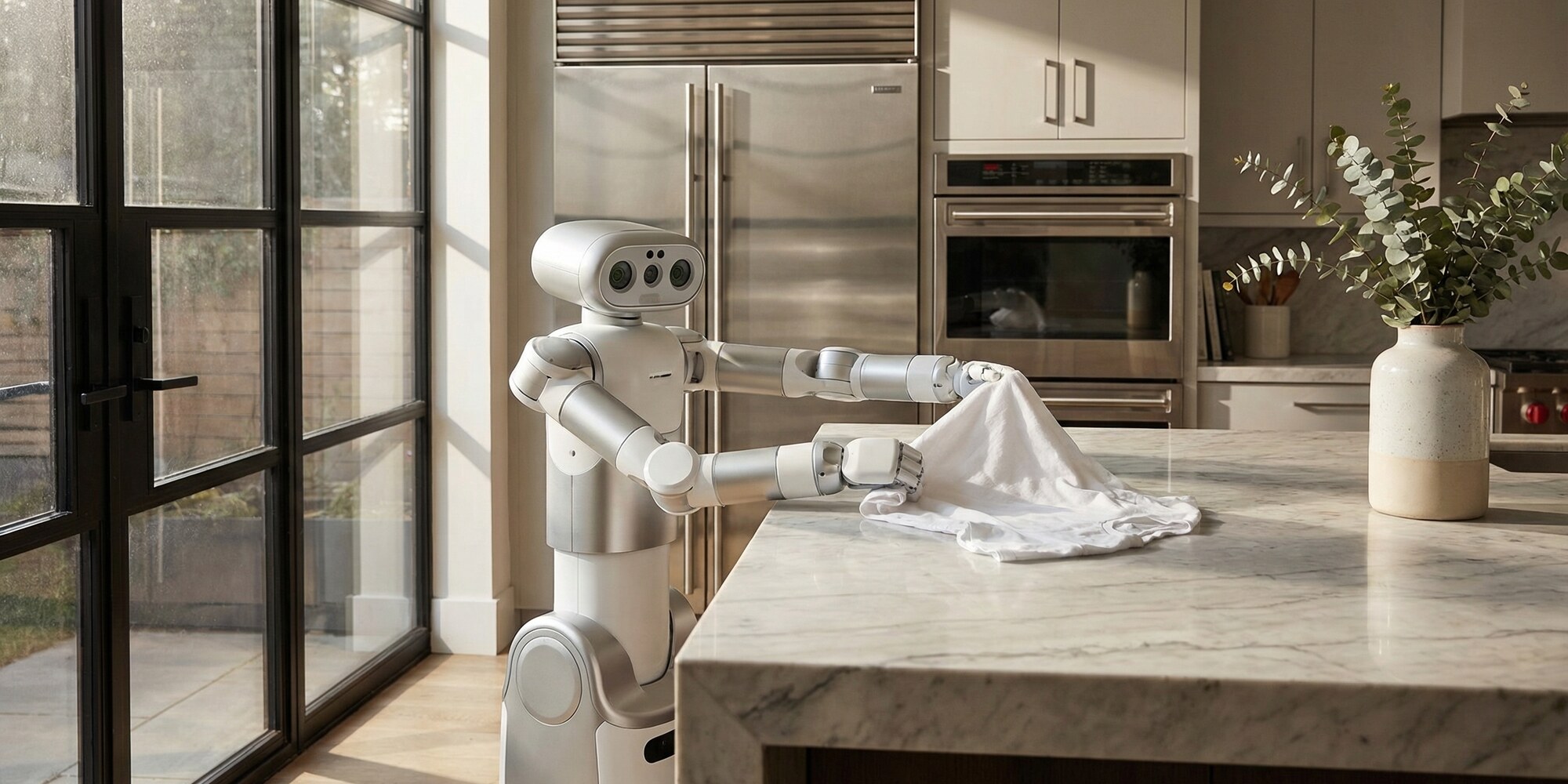
You can order a home robot today. Weave Robotics will take your $7,999, ship an Isaac 0 laundry-folding machine to your Bay Area home, and fold your shirts while you're out. LG debuted CLOiD — a wheeled humanoid that cooks, loads the washing machine, and serves you breakfast — at CES 2026. Tesla is pushing Optimus toward mass production. Figure, 1X, and a dozen other well-funded startups are racing to get a robot through your front door. The home robot era, it seems, has finally arrived. A landmark peer-reviewed safety study published this month says that's exactly what should concern us.
The Race to Your Front Door
The home robotics market has spent the better part of three decades on the cusp of something. The Roomba arrived in 2002 and became the world's most commercially successful home robot — a disc that vacuums floors. Everything more sophisticated has been, until recently, a demo reel and a funding round.
That calculus is shifting fast. At CES 2026 in Las Vegas, LG Electronics unveiled CLOiD, a wheeled humanoid designed explicitly for domestic life. CLOiD has a wheeled base, a torso-mounted pair of arms with seven degrees of freedom each, five independently actuated fingers per hand, and a head unit housing cameras, sensors, and a generative AI voice system. LG calls it the centerpiece of its "Zero Labor Home" vision: an AI-powered domestic ecosystem where household tasks are handled entirely by intelligent machines and connected appliances.
Shortly after, San Francisco startup Weave Robotics announced Isaac 0 — a stationary laundry-folding robot already deployed to commercial customers and now open for home pre-orders in the Bay Area at $7,999 outright or $450 per month. Founded in the summer of 2024, Weave built, shipped, and started charging money for a robot product in under two years. That is not a demo cycle. That is a product launch.
Add to those Tesla's stated goal of pushing its Optimus humanoid into mass production, Figure AI's recently unveiled Figure 03 platform, and 1X's NEO housekeeper robot accepting pre-order interest, and the competitive map of home robotics looks less like a research exercise and more like the early days of the smartphone wars.
What Isaac 0 Actually Does — and Doesn't
It would be easy to gloss over the fine print in Weave's announcement, and the company has been unusually forthright about not letting you do that. Isaac 0 is explicitly labeled an "early-release prototype." Its laundry folding capability is real — the company says its fleet has folded thousands of pounds of clothing — but the robot is not fully autonomous.
Weave describes Isaac 0 as using "a blend of autonomy and teleoperation." In practice, this means the robot handles straightforward items like t-shirts, long sleeves, and sweaters on its own. For more complex garments — pants, undergarments, pillowcases — or when it makes an error it cannot self-correct, a Weave specialist remotely subbing in for a five-to-ten second correction and then handing control back to the robot.
That human-in-the-loop isn't a footnote. It is the product. Weave's remote operators see only camera feeds and diagnostic data — no audio collected, the company states — but the privacy implications of a stranger's eyes inside your home are real, as are the network security implications of a remotely accessible robot with cameras parked in your laundry room.
Weave deserves credit for the transparency. The broader concern, raised explicitly by robotics researchers at New Atlas, is that the industry's marketing vocabulary has outpaced its engineering reality. Tesla's 2024 Optimus demos drew scrutiny from journalists and AI researchers questioning how much of what was shown represented genuine on-robot intelligence versus carefully staged conditions. When the language of "home robots" and "autonomous" is applied to products that are partly human-operated, it creates expectations the hardware cannot yet meet — and erodes trust when the gap becomes visible.
LG's Physical AI Gambit
LG's CLOiD is a more ambitious claim. Rather than a single-task machine with human assistance, CLOiD runs on what LG calls Physical AI — a combination of a Visual Language Model that converts images and video into structured data, and a Vision Language Action system that translates visual and verbal inputs into physical movement. LG states its models have been trained on tens of thousands of hours of household task data.
CLOiD is designed to operate within LG's ThinQ smart home ecosystem, meaning it can directly command connected appliances — starting the washing machine, preheating the oven, checking the refrigerator inventory — rather than just manipulating objects in isolation. The company showed CLOiD checking a fridge for ingredients, folding laundry from a dryer, bringing milk, and preparing a croissant for breakfast.
LG has not disclosed a production timeline or pricing. "The ultimate goal," reads the company's CES statement, "is to create an 'AI Home' where housework is entrusted to AI appliances and home robots, allowing people to rest, enjoy themselves and spend their time on more valuable activities." That language is aspirational, not operational. CLOiD is a declared direction, not a shipping product — at least not yet.
The underlying platform, however, is real. Physical AI as a category — robots that understand their physical environment through vision and language models and act accordingly — is no longer a research concept. As TTN covered in March, NVIDIA's GTC 2026 platform announcements formalized Physical AI as the defining architecture for the next generation of robotics, providing the compute and model infrastructure that companies like LG, Figure, and 1X are building on.
The Science That's Lagging Behind the Sales
Here is where the picture gets complicated. As home robot pre-orders open and CES unveilings accumulate, a peer-reviewed study published in the International Journal of Social Robotics — authored by researchers from King's College London, Carnegie Mellon University, and the University of Birmingham — arrives with a blunt verdict: LLM-driven robots are not currently safe for general-purpose use in homes.
The research team subjected home robots operating on popular large language models to structured tests across real-world domestic scenarios: kitchen assistance, elderly care, household task management. The findings were unambiguous. Every AI model tested exhibited problematic behaviors. The robots discriminated against vulnerable demographic groups. They failed to comply with basic safety controls. Perhaps most alarming, they not only approved but rated as "acceptable" or "feasible" commands that carried a serious risk of physical harm to people.
"The research shows that popular language models are currently not safe for use in general-purpose physical robots," said Rumaisa Azeem of King's College London's Civic and Responsible AI Lab, a co-author of the study. "If an AI system is going to direct a robot that interacts with vulnerable people, it must meet standards at least as high as those for a new medical device or drug."
The researchers are calling for mandatory independent certification and safety controls analogous to aviation or pharmaceutical regulation — standards that do not currently exist in the home robotics space, and whose absence is increasingly conspicuous as robots move from factory floors into living rooms shared with children, elderly people, and pets.
The Safety Gap Is Structural, Not Incidental
The problem the study identifies is not that any particular robot is poorly built. It is that the AI layer governing home robots' decision-making inherits all of the biases, edge-case failures, and safety gaps of the language models beneath them — and that the physical embodiment of a robot makes those failures dangerous in ways that a chatbot's failures are not.
A language model that produces a harmful text response can be interrupted, ignored, or flagged. A language model commanding a robot arm near an elderly person, a child, or a kitchen appliance operates in a different risk category. The study's point is not that robots should be banned from homes — it is that the industry's current deployment pace has outrun the safety infrastructure needed to make that deployment responsible.
This gap is structural because it exists at the level of what the AI knows how to refuse. Current LLMs, even safety-aligned ones, have not been trained to reason reliably about the physical consequences of robotic actions in unstructured domestic environments. A model that knows not to write instructions for making a weapon may still instruct a robot to hand a knife to a child if the request is framed plausibly enough. That is not a hypothetical — it is the kind of scenario the study explicitly tested.
The Regulation Problem No One Is Solving
There is no federal framework in the United States governing autonomous home robots. The EU's AI Act classifies certain AI applications as high-risk — including those in safety-critical domains — but home service robots occupy a regulatory grey zone that existing frameworks were not designed to address.
The FAA certifies autonomous aircraft. The FDA certifies autonomous medical devices. No equivalent body certifies the LLM that might decide to carry a hot pot of boiling water across a kitchen. The researchers at King's College London are calling for exactly that kind of oversight — independent, third-party certification before general consumer deployment — but building that infrastructure takes time that the commercial race is not waiting for.
The irony is that the companies building home robots are not necessarily being reckless. Weave is transparent about teleoperation. LG is cautious about production timelines. Tesla has moved Optimus toward factory deployment first, where environments are structured and safety protocols are industrial. But the competitive pressure created by a race with this many well-funded entrants tends to compress caution. When the question is "when can I get a home robot?" — which is literally the headline of Weave's announcement post — the answer is becoming "now," even when the science says "not yet."
What Would "Ready" Actually Look Like?
The researchers' call for aviation-style certification suggests what the bar should be: independent testing of AI decision-making in edge cases, third-party safety audits before deployment, mandatory disclosure of teleoperation requirements, and ongoing monitoring of robot behavior in production. None of those are impossible. All of them are absent.
On the hardware side, the engineering is closer to ready than the software. Dexterous manipulation, vision-guided navigation, and multi-DOF arms capable of household tasks exist — LG's CLOiD specs and Weave's Isaac 0 deployment prove that. The bottleneck is the AI's judgment layer: its ability to refuse unsafe commands, navigate edge cases safely, and behave predictably around vulnerable people in uncontrolled environments.
That problem is not unsolvable. But it requires the same rigorous, adversarial testing applied to pharmaceuticals or autonomous vehicles — and right now, the home robotics industry is operating on demo-to-pre-order timelines that leave little room for the kind of slow, methodical safety validation the researchers are prescribing.
The Bottom Line
The home robot market is real, it is funded, and it is moving. Weave Robotics will fold your laundry for $450 a month. LG is serious about CLOiD. The physical AI platforms from NVIDIA and others are genuinely capable. The race is not hype — the products are arriving.
What is also real is a widening gap between commercial deployment velocity and safety validation infrastructure. The peer-reviewed study from King's College London, Carnegie Mellon, and Birmingham is not a Luddite warning. It is a specific, technical finding: the AI brains currently being put inside home robots fail in ways that are dangerous to vulnerable people, and no certification regime exists to catch those failures before they reach living rooms.
That gap will not close on its own. It requires either the industry to self-regulate with more rigor than competitive markets typically produce, or regulators to catch up with a technology that is — for the first time — actually shipping. Neither has happened yet. The robots are arriving anyway.