Xiaomi's humanoid robot just completed its first real factory shift — three consecutive hours of fully autonomous operation at a self-tapping nut assembly station inside the company's EV die-casting workshop in Beijing. No remote pilot. No human override. The robot met the production line's fastest cycle time of 76 seconds and hit a 90.2% success rate on bilateral nut installation. For a technology that just a year ago was confined to demos and controlled trials, the numbers are jarring — and they signal a genuine inflection point in the race to put humanoid robots on factory floors at scale.
What Actually Happened on the Floor
The deployment, confirmed by Xiaomi CEO Lei Jun in a Weibo post on March 2nd, is notable for what it didn't involve. Most prior factory demonstrations of humanoid robots have required continuous teleoperation — a human operator remotely guiding the robot through unfamiliar motions — or have been staged in controlled environments that don't reflect real production conditions. Xiaomi's Beijing test was neither.
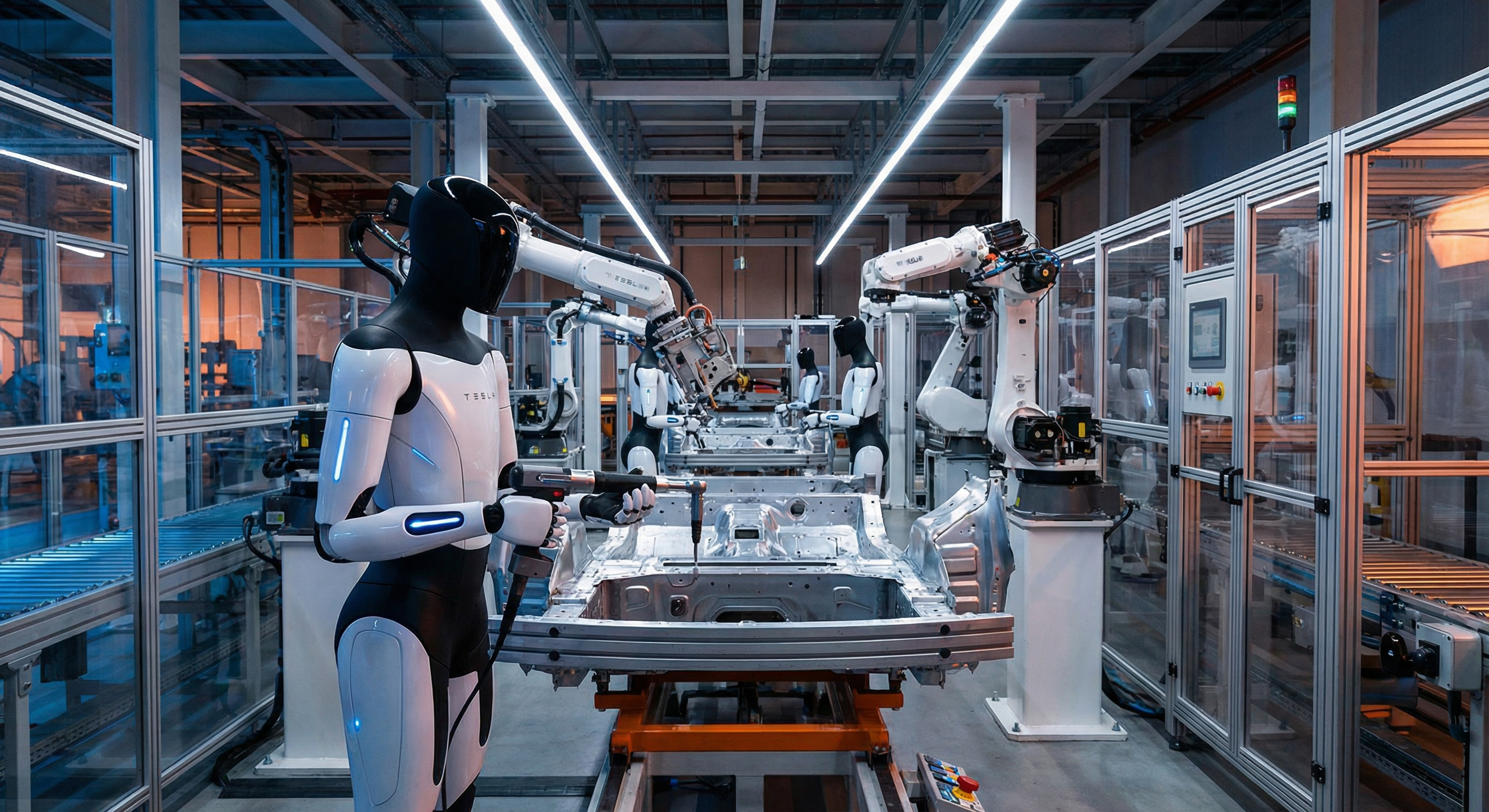
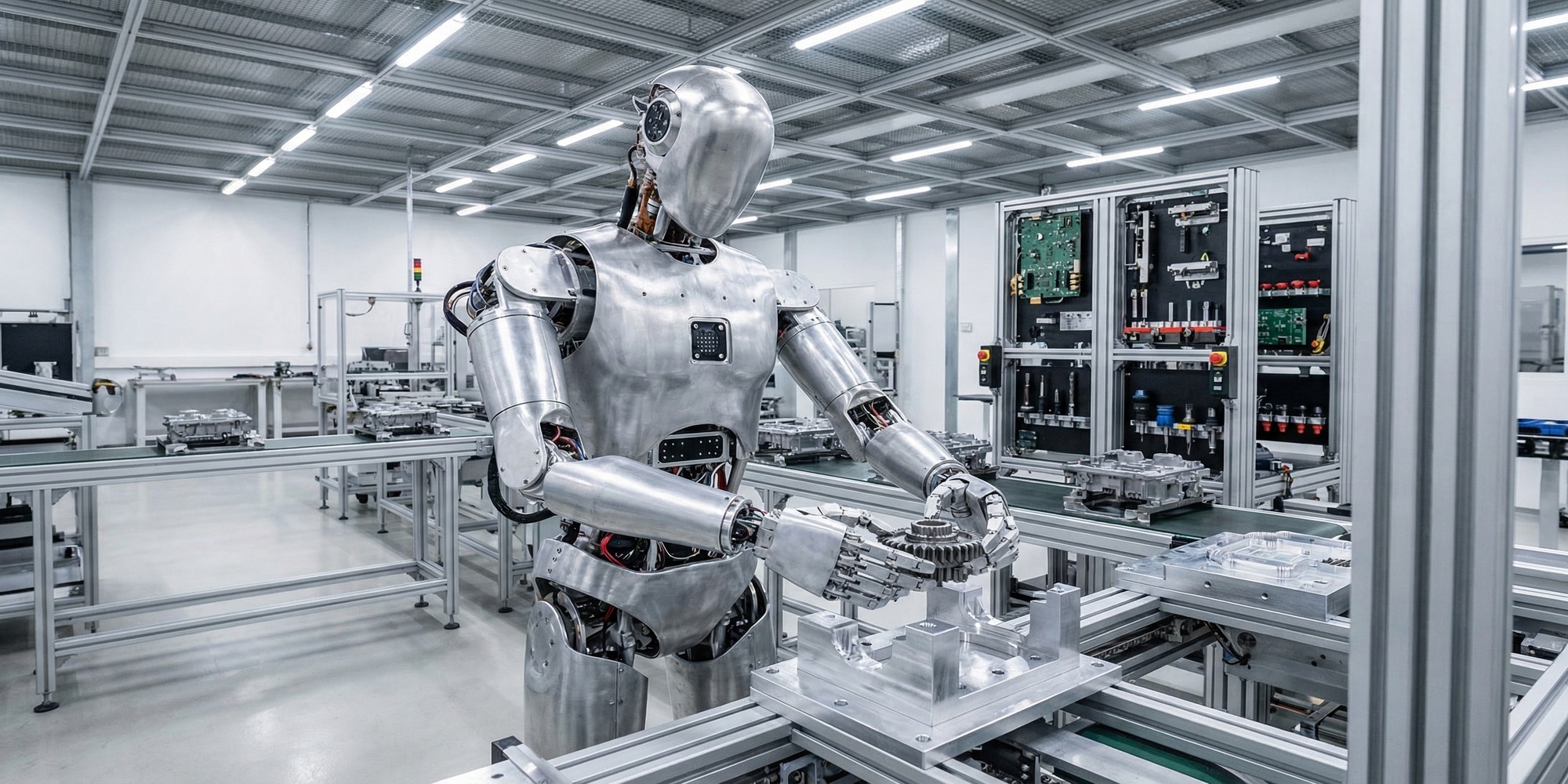
The task assigned to the robot was legitimate production work: picking self-tapping nuts from an automatic feeding device, placing them onto positioning fixtures, and coordinating with slide conveyors and automatic positioning systems to complete the automated tightening of floor components after integrated die-casting. The station operates at a pace that human workers can barely sustain — the fastest cycle time is 76 seconds per part — and the robot matched it.
The technical challenge was more nuanced than it looks. According to Xiaomi's engineering team, the primary difficulty was achieving precise alignment of self-tapping nuts with the spline structures inside the fixtures. The non-fixed gripping posture, combined with magnetic interference during assembly, significantly increased complexity. These aren't conditions that can be engineered away — they're intrinsic to the task.
The Technology Stack Behind the Results
What makes Xiaomi's approach distinctive is its reliance on a proprietary Vision-Language-Action (VLA) foundation model it calls Xiaomi-Robotics-0 — a 4.7-billion-parameter system that fuses visual perception, language-grounded task understanding, and physical action generation into a single end-to-end pipeline. The model was trained almost entirely in simulation, using reinforcement learning rather than large volumes of real-world teleoperation data.
This matters enormously for scalability. The dominant paradigm for training manipulation skills in humanoid robots has been demonstration learning — recording thousands of hours of human operators guiding robots through tasks and using that data to train imitation models. The approach works, but it's expensive, slow to generalize, and collapses when conditions shift even slightly. Xiaomi's simulation-first methodology is a deliberate bet against that paradigm.
For full-body motion control, Xiaomi uses a hybrid architecture that pairs a classical optimization controller — which solves for stable locomotion in under one millisecond per iteration — with a reinforcement learning controller trained through hundreds of millions of simulated random perturbations. The goal is a robot that can maintain balance under conditions that would destabilize a purely learned or purely classical system: sudden vibration from factory machinery, unexpected contact, uneven floor surfaces.
The RL controller achieves what Xiaomi describes as "zero-shot transfer" — meaning skills learned in simulation transfer to physical hardware without additional tuning. The company also integrates multimodal sensor fusion: vision, tactile feedback from fingertip sensors, and joint proprioception, combining all three to reduce the probability of state misjudgment in complex assembly scenarios. A robot that can feel whether a nut has seated properly, not just see it, is a materially different machine than one relying on camera alone.
Why This Milestone Is Different
It's worth being precise about what was demonstrated and what wasn't. Xiaomi hit 90.2% accuracy on a single station over a three-hour window. That's a strong result by any measure, but it's a single workstation with a specific task profile — not a general-purpose robot operating freely across a production floor. The company has been transparent about this: CEO Lei Jun described the Beijing deployment as "the first step," with ongoing work to extend validation across additional workstations including bin-picking and front badge installation.
What matters is the framing. Prior humanoid robot factory tests — by Tesla with Optimus, by Figure, by 1X — have largely been proof-of-concept demonstrations: the robot performed a task, but production-readiness was not the claim. Xiaomi is making an explicit production-readiness argument. Meeting a 76-second cycle time, sustaining that rate for three hours, and doing so without a human in the loop is language borrowed from operations engineering, not press release writing.
The difference is significant because cycle time and yield rate — the metrics Xiaomi explicitly cites as its "core bottleneck" to address — are exactly what industrial engineers use to evaluate whether a technology belongs on a production floor or in a lab. By framing its results in those terms, Xiaomi is inviting scrutiny from a more rigorous audience than the robotics demo circuit typically attracts.
China's Structural Advantage in Physical AI
To understand why Xiaomi is positioned to make this kind of claim, it helps to understand the structural context. China currently accounts for roughly 90% of global humanoid robot production, and the country's hardware supply chain — developed over decades of consumer electronics and EV manufacturing — gives its robotics sector advantages that Western competitors cannot quickly replicate.
Xiaomi's position is particularly unusual. The company is simultaneously a smartphone manufacturer, an EV producer, and now a humanoid robotics developer. Its Beijing EV factory is not a third-party test site — it's Xiaomi's own production environment, where the company has direct control over workstation design, tooling, and operational parameters. That in-house vertical integration is a genuine advantage: Xiaomi can co-design the robot and the workstation together in ways that a third-party deployer cannot.
That advantage cuts both ways. A robot optimized for Xiaomi's own factory may not generalize easily to other production environments. But Xiaomi's stated roadmap — "large-scale deployment within five years across its production facilities" — suggests the near-term goal is internal automation, not external commercialization. Once the internal case is proven, the external market follows naturally.
Other Chinese EV makers are moving on the same timeline. XPeng announced in February 2026 that it would break ground on a dedicated humanoid robot factory in Q1, with a commercial launch targeted for later this year. BYD has been quietly investing in humanoid research through subsidiary channels. The competitive dynamic within China is itself a forcing function on development pace.
How This Fits the Global Race
The global humanoid robot race is accelerating from multiple directions simultaneously. In the United States, Tesla began mass production of Optimus Gen 3 in January 2026, with production targets between 100,000 and 300,000 units and a retail price point of $20,000–$30,000. The Optimus program is the most ambitious attempt to drive humanoid robots to consumer-scale manufacturing volumes, but it's operating on a different axis than Xiaomi's factory deployment: Tesla is building robots to sell. Xiaomi is building robots to deploy in its own facilities, with commercial sales as a downstream consideration.
In Europe, Mobileye — best known for its autonomous driving perception stack — announced in January 2026 a $900 million acquisition of Mentee Robotics, an Israeli humanoid startup with a third-generation platform designed for real-world deployment without teleoperation. The deal, expected to close in Q1 2026, signals that automotive AI companies see physical AI as a natural extension of their core perception and reasoning stacks.
What connects these moves — Xiaomi's factory deployment, Tesla's mass production ramp, Mobileye's acquisition — is a shared bet that the technical barriers to autonomous humanoid robot operation are falling faster than the market anticipated. Two years ago, the consensus view was that meaningful factory deployment was a 2028–2030 story. The Xiaomi results suggest that timeline has compressed by at least two years.
The Key Metrics Still to Watch
Three hours of autonomous operation at 90.2% accuracy is a meaningful data point, but it's one session at one station. The industry metrics that will determine whether humanoid robots genuinely enter mainstream manufacturing are more demanding: mean time between failures (MTBF) sustained over weeks, not hours; yield rates held steady across multiple task types and shift changes; and total cost of deployment benchmarked against the human or traditional automation alternative.
Xiaomi has acknowledged MTBF and single-task success rates as the key performance indicators it's tracking. CEO Lei Jun said both metrics are "steadily improving" as deployment and validation expand across additional stations. That phrasing — steadily, not dramatically — is calibrated language from an engineer, not a marketer. It suggests the company has a realistic view of how far it still has to go.
The economic math also matters. Humanoid robots are expensive to manufacture and maintain. Unless the per-unit cost comes down significantly — and the industry is betting that scale will drive it down — the business case for factory deployment will depend heavily on which tasks are being automated and how high the human labor costs are at those stations. In China's EV factories, where production volumes are massive and labor costs are rising, the calculus is increasingly favorable.
What Comes Next
Xiaomi's near-term roadmap focuses on extending validation to more workstations — bin-picking and front badge installation are specifically called out — while addressing the cycle time and yield rate challenges that remain. The company's five-year deployment target for "large numbers" of humanoid robots across its own facilities implies a gradual scaling curve, not an overnight transformation.
For the broader industry, the Xiaomi deployment is a proof point that will accelerate investment and benchmarking across the sector. Every major robotics program — Tesla, Figure, 1X, Agility, Boston Dynamics, and the expanding roster of Chinese competitors — now has a new reference point against which to measure its own factory readiness claims. The bar has moved, and it moved faster than most people expected.
The race to put humanoid robots on factory floors has been running for years. For the first time, one of the competitors has posted a production-relevant lap time.