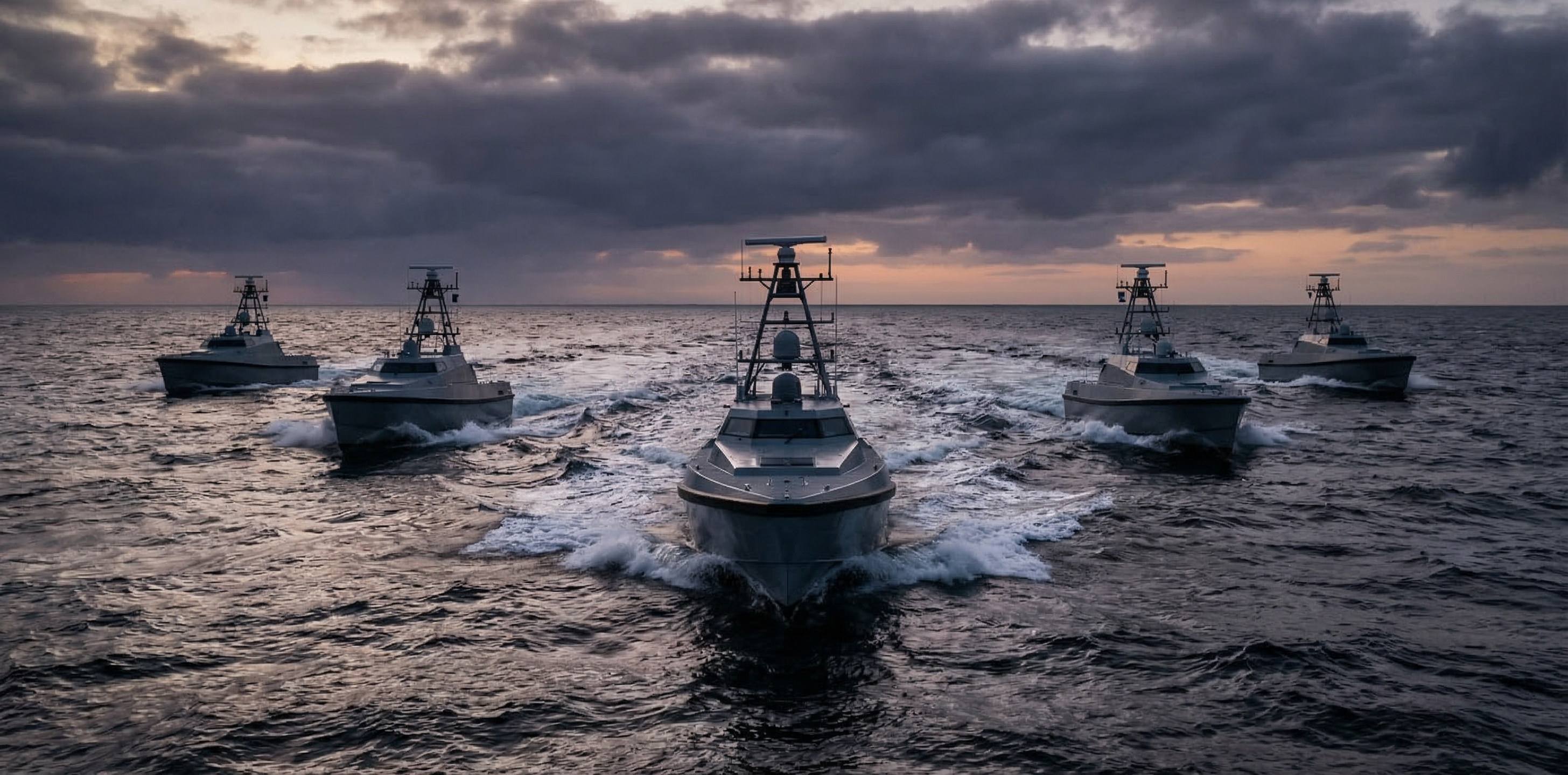
On Monday, Secretary of the Navy John Phelan stood up five new Portfolio Acquisition Executive organizations — formalizing the most sweeping restructuring of naval procurement in decades. Behind the bureaucratic language is a structural bet: that the way America builds autonomous weapons systems is as broken as the weapons themselves used to be, and that fixing procurement might determine who wins the next war at sea.
What Just Happened
The announcement, confirmed Monday by Defense Daily, establishes five new PAE organizations alongside the existing Robotics and Autonomous Systems office that Phelan first stood up in December. The Navy is calling the PAE model its "new operational standard for the acquisition exercise," a phrase that understates the scope of what it is actually doing: dismantling the traditional Program Executive Officer (PEO) structure that has governed defense procurement for generations and replacing it with a leaner, more accountable model built for speed.
The five new offices, and the senior officials tapped to lead them on an interim basis, are:
- PAE Maritime — Christopher Miller
- PAE Marine Corps — Lt. Gen. Eric Austin
- PAE Industrial Operations — Vice Adm. James Downey
- PAE Strategic Systems Programs — Vice Adm. Johnny Wolfe
- PAE Undersea / DRPM Submarines — Vice Adm. Robert Gaucher
Each PAE is designated the single accountable official for their portfolio — with authority over program execution, schedule, cost, and associated acquisition functions. "Every acquisition decision ties directly to deterrence, and if deterrence fails, decisive victory," Phelan said in a statement obtained by ExecutiveGov. "With the establishment of PAEs, we are instilling a war-fighting mindset to accelerate delivery to the fight."
The PAE RAS: Robotics and Autonomous Systems Takes the Lead
The most consequential of the six PAEs isn't one of the new ones. It's the office that was first — the Portfolio Acquisition Executive for Robotic and Autonomous Systems (PAE RAS), established by Phelan's directive in September 2025 and formally stood up in December with the appointment of Rebecca Gassler as its first executive director.
The numbers alone tell you what the Navy prioritized first. According to reporting by USV Hub, PAE RAS manages roughly $19 billion in acquisitions over five years. It is consolidating approximately 47 to 66 distinct programs — previously scattered across more than a dozen Navy and Marine Corps program offices — under a single chain of command. Gassler reports directly to the Assistant Secretary of the Navy for Research, Development, and Acquisition.
The programs now flowing through PAE RAS represent the Navy's entire unmanned future: the Orca Extra Large Unmanned Underwater Vehicle (XLUUV), built by Boeing, designed to conduct long-duration autonomous undersea missions ranging from intelligence gathering to mine warfare; the Modular Attack Surface Craft (MASC), a medium unmanned surface vessel intended to carry offensive payloads; and a portfolio of swarming small unmanned surface systems designed to overwhelm adversary defenses through mass. According to USNI News, the office also oversees small UAV programs for guided-missile destroyers and new command-and-control software to coordinate the whole fleet.
Before PAE RAS existed, all of those programs had different managers, different budgets, different reporting chains, and different relationships with the vendor community. Coordination was a matter of email chains, inter-office meetings, and luck. The PAE model eliminates that by design.
The Bigger Picture: Hegseth's Warfighting Acquisition System
Monday's Navy announcement doesn't exist in a vacuum. It is the latest chapter in Defense Secretary Pete Hegseth's sweeping overhaul of the entire Pentagon procurement apparatus — what he has formally branded the Warfighting Acquisition System (WAS).
In a landmark speech at the National War College in November, Hegseth announced the replacement of the Defense Acquisition System with the WAS framework, built around four structural changes. First, PEOs were replaced by PAEs with sole accountability for cost, schedule, and performance — with four-year tenures extended by two-year options to give leaders enough time to actually move programs. Second, the Pentagon eliminated the Joint Capabilities Integration and Development System (JCIDS), a decades-old requirements process Hegseth described bluntly as "slow, bloated, and disconnected from reality," replacing it with a Requirements and Resourcing Alignment Board and a new Mission Engineering and Integration Activity. Third, contracting reform moved toward fixed-price contracts and a "commercial technology first" philosophy, expanding the use of Other Transaction Authorities to reach non-traditional vendors. Fourth, the Pentagon established a Joint Acceleration Reserve — a discretionary pool of funding specifically for moving promising solutions from concept to fielded capability at a pace that previous rules made nearly impossible.
The Navy was first off the mark. While the Army initiated its own PAE transformation in November and the Air and Space Forces followed in January, per DefenseScoop, it was the Department of the Navy that chose to lead with robotics and autonomous systems — a deliberate signal about where naval warfighting is heading.
Why Procurement Reform Is a Warfighting Imperative
The impetus is not abstract. The operational lessons from the past two years — from drone warfare over Ukraine to Operation Epic Fury's exposure of cost-asymmetry vulnerabilities in air defense — have forced a reckoning with how slowly the military can field new capabilities compared to how quickly adversaries can adapt. An adversary that can field a $30,000 Shahed-136 kamikaze drone in mass production faster than the United States can procure a counter-drone system is exploiting a procurement gap, not just a technology gap.
The old acquisition system's failure modes are well-documented. Under the previous structure, the Navy was managing drone and autonomous systems development across 18 separate program offices. A single program like the Orca XLUUV could have its requirements set by one office, its engineering managed by another, its testing evaluated by a third, and its production planned by a fourth — each with its own budget cycle and timeline. The result, as the Naval Submarine League noted in its December analysis, was a system structurally incapable of the speed modern warfare demands.
PAE RAS is the Navy's answer: one executive, one budget authority, one chain of accountability. Gassler's office is also empowered to make trade-offs that previously required ascending through multiple layers of approval — swapping out a vendor, adjusting requirements based on operational feedback, or accelerating a promising prototype without waiting for the next budget cycle.
The early signals suggest the office is already moving. According to USNI News' December reporting, one of PAE RAS's first operational decisions was to reassess Boeing's position on the Orca XLUUV program and evaluate alternatives for the Navy's small USV effort — decisions that under the previous structure would have required months of inter-agency deliberation. Whether those shifts represent genuine agility or early turbulence in a large organizational transition remains to be seen.
What the Skeptics Are Watching
Not everyone is convinced that reorganization solves what is fundamentally a resourcing and political problem. Jerry McGinn, director of the Center for Government Contracting at George Mason University and a former Pentagon official, told The Defense Watch that transformation "means the department must take more risk — emphasizing a focus on speed and scale" — but warned that "implementation and resourcing" would determine whether the reforms deliver or simply shift accountability without changing outcomes.
The structural challenge is real. PAE RAS is inheriting a portfolio with some genuinely difficult programs. The Orca XLUUV, for example, has been in development since 2017 and has experienced significant delays. Absorbing it into a faster organizational framework doesn't automatically resolve the engineering and supply chain challenges that drove those delays. A new executive with consolidated authority can make decisions faster — but faster decisions aren't always better decisions, particularly in high-stakes, technically complex weapons programs.
There are also congressional dynamics to navigate. PAE tenures of four years don't align neatly with the annual appropriations cycle or the multi-year authorization rhythms of major defense programs. PAEs who want to cancel or redirect programs that already have congressional champions and industrial base support in key districts will find that reorganization doesn't insulate them from political reality.
Still, the 2026 National Defense Authorization Act is expected to provide legislative backing for significant elements of Hegseth's reform agenda, which would give the PAE model a firmer statutory foundation than executive directive alone. If that backing materializes, Monday's announcement may look in retrospect like the moment the Navy permanently changed how it builds its autonomous fleet.
The Strategic Calculation
Step back from the organizational charts and what the Navy is doing becomes clearer. The service is betting that the next major naval conflict — almost certainly involving China in the Pacific — will be decided in significant part by autonomous systems operating at scale: unmanned surface vessels conducting ISR and mine-clearing operations, extra-large UUVs conducting sustained undersea missions beyond the endurance of crewed submarines, swarms of small USVs providing persistent maritime domain awareness at a fraction of the cost of manned patrol vessels.
If that bet is correct, then the $19 billion flowing through PAE RAS isn't just a procurement budget — it's the blueprint for American naval power projection in the 2030s. And the organizational question Monday's announcement poses is whether a single accountable executive with unified authority over 47-plus programs can actually move faster than the fragmented bureaucracy it replaced.
Secretary Phelan's framing left little room for ambiguity about the stakes. "In a time where our warfighters are on the frontline and the nature of warfare is changing at a rapid pace," he said, "the Department of the Navy needs a warfighting acquisition system that better responds to those at the tip of the spear." That sentence could have been written at any point in the last twenty years. The difference now is that the organizational architecture to act on it may finally be in place.