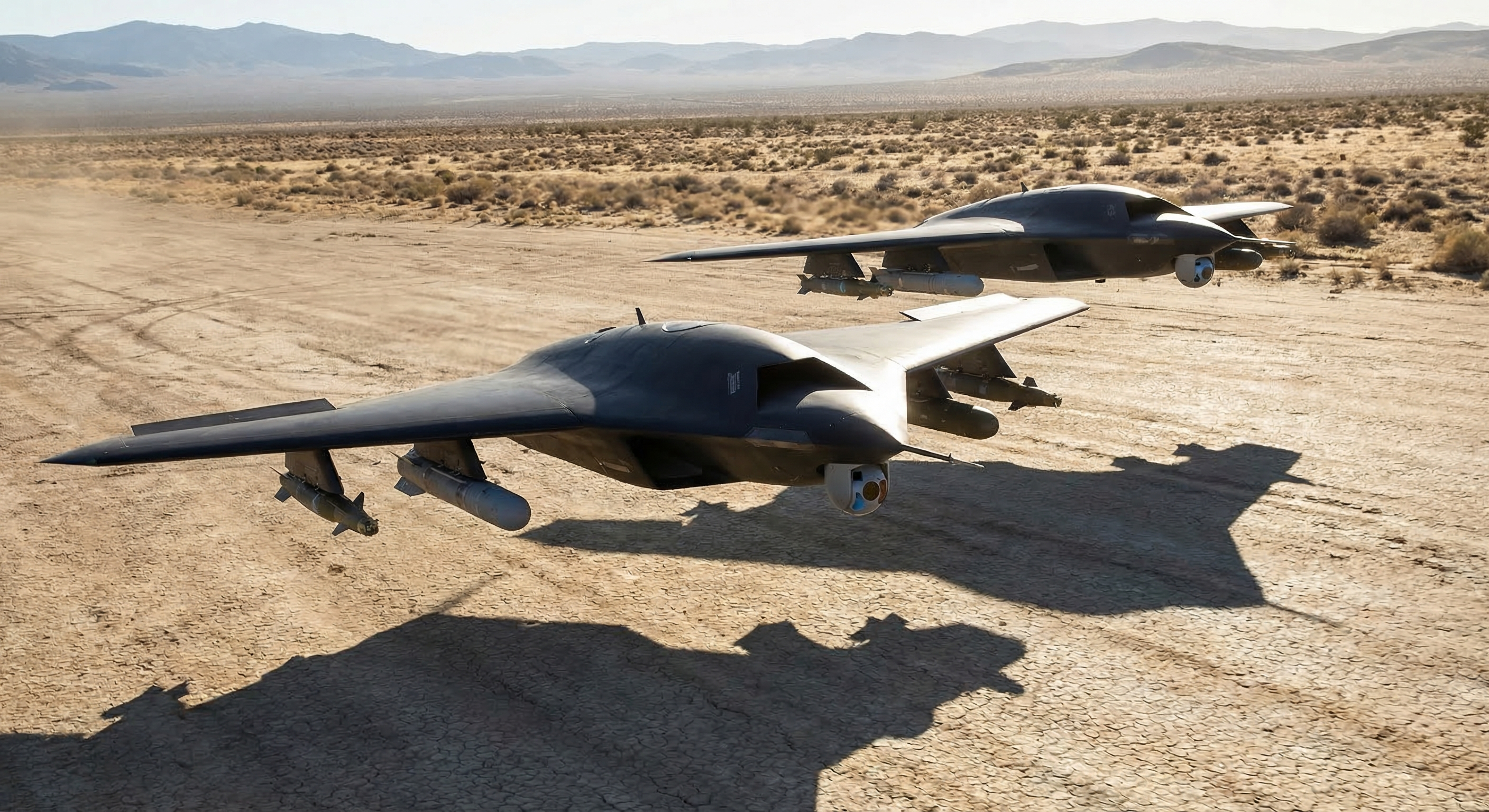
On February 26, 2026, a matte-black autonomous drone called "Fury" lifted off over the Mojave Desert without a human pilot at the controls. Partway through the flight, it handed authority from one AI brain to another — seamlessly, mid-mission — and completed a full sequence of combat test points under both. That single sortie marked the most consequential moment yet in the U.S. Air Force's Collaborative Combat Aircraft program: the day two competing autonomy platforms proved they could occupy the same airframe at software speed.
What the CCA Program Actually Is
The Collaborative Combat Aircraft program is the Air Force's plan to field approximately 1,000 autonomous "loyal wingman" drones by 2030 — uncrewed aircraft designed to fly alongside F-35s and F-22s, extending sensor range, carrying munitions, absorbing missile fire, and executing missions that would be suicidal for a crewed aircraft. The concept has been studied since at least 2019, but the CCA program put a contract, a timeline, and a production decision behind it.
In April 2024, the Air Force downselected Anduril Industries and General Atomics Aeronautical Systems to build "production representative CCA vehicles" — prototypes close enough to the real thing to drive a competitive production decision. Both companies made their first flights within 18 months: General Atomics' YFQ-42A in August 2025, Anduril's YFQ-44A in October 2025.
A third entrant, Northrop Grumman, was not selected in the 2024 downselect but continued development on its own dime and had its YFQ-48A "Talon Blue" formally designated by the Air Force in December 2025. That move surprised many observers — it signals Northrop remains a credible contender in a field the Air Force has described as "more than 20 companies" for future CCA increments.
Three Drones, Three Different Bets
Anduril's YFQ-44A "Fury" — the name inherited from Blue Force Technologies, which Anduril acquired in 2023 — features external hardpoints for air-to-air weapons carriage. That design choice prioritizes simplicity, cost-effectiveness, and faster loading over stealth; external pylons create radar cross-section and drag that an internal bay avoids. On February 24, 2026, the Air Force confirmed Fury had completed its first flight carrying an inert AIM-120 Captive Air Training Missile, a critical step toward live-fire certification.
General Atomics' YFQ-42A "Dark Merlin" takes the opposite approach: an internal weapons bay that preserves stealth and aerodynamic performance at the cost of added mechanical complexity. GA-ASI indicated it would begin captive carry flights in the "very near future," suggesting it is running slightly behind Fury on the weapons integration timeline.
Neither design is inherently superior — the Air Force is likely watching both to see how they trade off in contested environments. A drone that carries four missiles externally and can be rearmed on a forward strip in minutes may be more operationally valuable than one with perfect stealth that requires depot-level maintenance between sorties. The production contract, expected in fiscal year 2026, will force that judgment.
Northrop Grumman's Talon Blue (YFQ-48A) is the wildcard. A self-funded program with a formal Air Force designation signals genuine institutional interest rather than just corporate ambition. The Defense Department has consistently said it wants competition in every tier of CCA development, which means even if Anduril and GA-ASI win the Increment 1 production contract, future increments are wide open.
The Software-First Doctrine
The February 26 flight was not just a milestone for Anduril and Shield AI — it was the first operational proof of the Autonomy Government Reference Architecture (A-GRA), the Air Force's most important architectural decision in the entire CCA program.
A-GRA is a modular, government-owned open-systems framework that decouples mission autonomy software from the airframe. Instead of each aircraft manufacturer bundling its own proprietary AI pilot — which would lock the Air Force into a single vendor per platform indefinitely — A-GRA creates a standardized interface layer where mission autonomy stacks can be plugged in, evaluated, upgraded, and competed independently of the vehicle. The government owns the spec. The companies compete above it.
The implications are significant. In a traditional defense acquisition model, the company that wins the airframe contract also controls the software that makes the aircraft do its job. The Air Force just spent a decade dealing with the consequences of that model in the F-35 program. With A-GRA, a future version of Fury could run a completely different autonomy stack than the one it ships with — if a competitor develops better threat-response algorithms next year, the Air Force can swap it in without replacing the aircraft.
"The integration of mission autonomy software unlocks the next critical phase of testing, including detailed mission CONOPs, weapons integration, multi-ship flights, integration with crewed fighters, and more," said Jason Levin, Anduril's senior vice president of engineering, in a statement following the February 26 flight. The phrase "multi-ship flights, integration with crewed fighters" is the operational end state — not just a drone flying alone, but a heterogeneous team of manned and unmanned aircraft executing coordinated missions.
Shield AI's Hivemind and the Autonomy Competition
Shield AI was selected by the Air Force as one of the mission autonomy providers for CCA's Technology Maturity and Risk Reduction (TMRR) phase after a competitive evaluation. Its Hivemind software is what flew the YFQ-44A Fury on February 26 — completing a series of combat-representative test points including handling mid-mission updates and demonstrating initial operational behaviors.
Hivemind is not an autopilot in the traditional sense. Shield AI describes it as software that "assumes the role of a human pilot or operator, enabling unmanned systems to sense, decide, and act" — capable of rerouting around obstacles, executing collaborative tactics with peer aircraft, responding to unexpected conditions, and completing missions without continuous human oversight. That last phrase is deliberate and consequential: "without continuous human oversight" is distinct from "fully autonomous." A human still authorizes the mission and its parameters; Hivemind executes within them.
The February 26 sortie demonstrated something Hivemind had not previously done: fly a next-generation combat aircraft through a full sequence of Air Force test points, then yield control to a competing autonomy stack — Anduril's Lattice — on the same flight. Anduril's Levin described Fury "autonomously approaching a designated point where Shield AI's mission autonomy software stack, Hivemind, was activated," then following with "a seamless switch to Anduril's Lattice for Mission Autonomy stack to complete the same test points."
That seamlessness is the whole point of A-GRA. Shield AI's Hivemind and Anduril's engineers validated the autonomy stack's performance through "countless software-in-the-loop simulations and milestone hardware-in-the-loop test events" before the flight. Collins Aerospace's Sidekick autonomy software is playing a parallel role on the YFQ-42A Dark Merlin platform, with Sidekick integrated in mid-February 2026 under the same A-GRA framework. GA-ASI's MQ-20 Avenger has reportedly also participated in A-GRA compatibility tests, providing additional validation of the cross-platform framework.
The Production Decision and What Comes Next
The Air Force's stated timeline calls for a production contract award in fiscal year 2026, which runs through September 30, 2026. A competitive Increment 1 production decision will likely force a choice between the YFQ-44A and YFQ-42A — or possibly split the buy — for an initial fleet that could number in the hundreds before scaling toward the thousand-unit goal.
The evaluation criteria will be watching performance that goes beyond flight test checkboxes. Operational sustainability matters: how quickly can a forward maintenance crew service the aircraft between sorties? How does weapons loading differ for external pylons versus an internal bay in a combat environment? How does each airframe perform at low altitude in a contested electronic warfare environment? These are questions that preflight simulations can approximate but only actual testing and operational evaluation can answer definitively.
Meanwhile, the software competition is ongoing. The A-GRA framework means the production decision on airframes and the evaluation of autonomy software are deliberately separated — the Air Force can award the airframe contract while continuing to compete and update the autonomy stack. Christian Gutierrez, Shield AI's VP of Hivemind Solutions, stated after the February 26 flight that "software is central to the future of airpower" — a framing the Air Force has itself adopted. The program's official posture is that "the best algorithms can be deployed rapidly on any compliant platform rather than being trapped inside proprietary architectures."
The Geopolitical Stakes
The CCA program doesn't exist in isolation. China's People's Liberation Army Air Force has been developing its own loyal wingman concepts, including the GJ-11 sharp sword stealth UCAV, with comparable timelines. The ability to deploy 1,000 autonomous wingmen by 2030 — at a projected per-unit cost significantly lower than crewed fighters — is explicitly intended to create asymmetric mass: more aircraft than adversaries can reasonably track and engage simultaneously.
The operational concept driving CCA isn't simply replacing crewed aircraft. It's changing the math of air warfare. A single F-35 pilot commanding a four-drone CCA package can cover more airspace, carry more munitions, and absorb more attrition than the same pilot flying alone — while keeping human judgment in the loop for weapons employment decisions. That architecture directly addresses the threat environment exposed by the Pentagon's broader autonomous systems investment blitz: cheap adversary drones forcing expensive countermeasures, and the need to generate combat mass at scale without generating proportional casualty risk.
The February 26 Mojave test flight was, by any measure, a technical demonstration. But it demonstrated something operationally important: two competing AI platforms, working on the same government-owned architecture, executing the same mission profile on the same airframe. The loyal wingman concept just got measurably more real.
The Road to 2030
Between now and the Air Force's target entry-to-service date, the CCA program faces a demanding testing gauntlet. The next phase involves expanded CONOPS testing — detailed mission scenarios involving multi-ship formations, electronic warfare, sensor fusion, and eventually live weapons employment. Integration with crewed F-35s and F-22s remains the central operational challenge: not just keeping the drones in formation, but having them make real-time tactical decisions in coordination with human pilots who may be managing their own high-workload combat tasks.
The arms race dimension is also intensifying. Boeing and the Royal Australian Air Force completed an autonomous AIM-120 live-fire from an MQ-28 Ghost Bat in December 2025 — demonstrating that allied CCA programs are already at the live-fire stage. The gap between prototype flight and combat-credible deployment is closing faster than most outside observers expected.
What the Air Force is building with the CCA program is not simply a new platform. It's a new acquisition philosophy: government-owned open architecture, competing software vendors, hardware separated from brains. If A-GRA works — if the February 26 Mojave flight proves to be the first of many seamless autonomy transitions — the template will propagate across the entire joint force. The Army's $20 billion Anduril Lattice contract is already a parallel example of the same logic applied to ground-based sensor fusion.
The loyal wingman race isn't just about who builds the best drone. It's about who builds the architecture that governs all the drones that come after.