OpenAI is in talks to purchase electricity from Helion Energy — the fusion startup that Sam Altman has backed financially and previously chaired. The negotiations, first reported by Axios and subsequently covered by The Verge and other outlets, mark a potentially historic moment: AI's most powerful company exploring a power source that doesn't yet commercially exist, from a company with direct financial ties to its CEO. Altman has since stepped down as Helion's board chair and recused himself from discussions — a disclosure that highlights just how tangled the AI industry's desperate search for energy is becoming.
The Energy Crisis Underneath AI's Ambitions
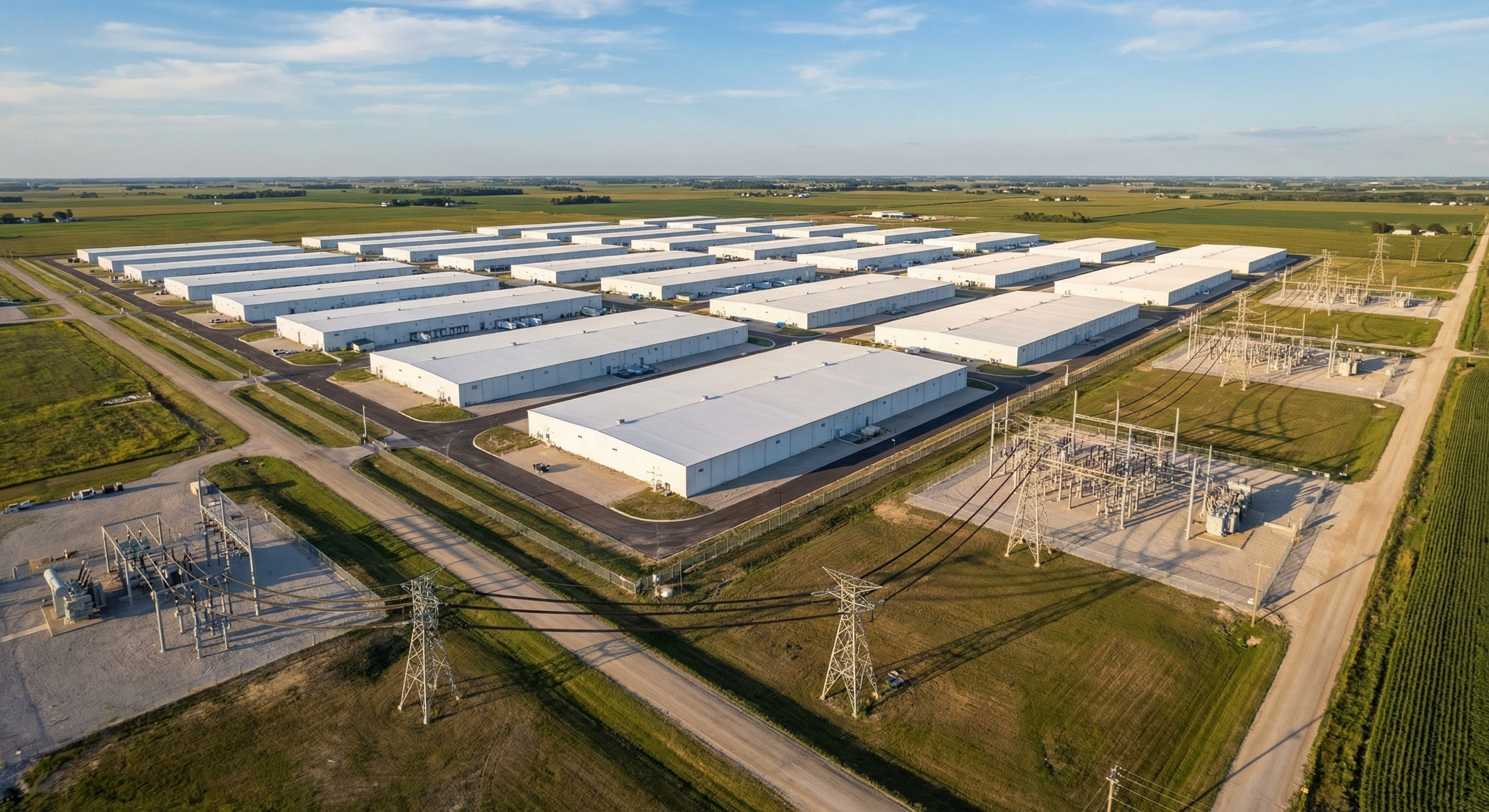
To understand why OpenAI is even having this conversation, you need to understand the scale of the power problem confronting AI infrastructure in 2026. The five largest hyperscalers — Microsoft, Google, Amazon, Meta, and Oracle — have committed between $660 billion and $690 billion in capital expenditure this year, much of it directed at AI data center buildout. But as TTN reported in March, that spending is colliding with a fundamental physical constraint: there isn't enough electricity available on the grid to run the facilities being built.
Microsoft currently holds an estimated $80 billion in unfulfilled Azure AI capacity orders. GPUs are sitting idle in warehouses because data centers are built but not yet powered. The PJM Interconnection — the grid covering 65 million people across 13 states — is projecting 40 GW of unmet AI infrastructure demand through 2030. Electricity prices in key markets have risen more than 36% since 2020.
OpenAI's Stargate project — the $500 billion AI infrastructure initiative announced with SoftBank, Oracle, and others — requires a staggering amount of power. Training frontier models at the scale OpenAI is targeting demands tens of gigawatts over the course of a decade. Nuclear fission, natural gas, solar, and geothermal have all been explored. Now fusion is on the table.
That's not as crazy as it sounds — though the timeline makes it a genuine gamble.
What Is Helion, and Why Is OpenAI Interested?
Helion Energy is a privately held fusion company based in Everett, Washington, founded in 2013. It has raised approximately $2.2 billion in funding, including a landmark $500 million Series E in 2021 led by Dustin Moskovitz, with significant participation from Sam Altman, Peter Thiel, and others. Altman has described fusion as among the most important investments he has ever made.
Helion's approach to fusion is technically distinct from the more commonly known magnetic confinement designs like tokamaks (used by ITER and Commonwealth Fusion Systems). Helion uses what it calls magneto-inertial fusion, which combines elements of both magnetic and inertial confinement. Two plasma formations — Field Reversed Configurations (FRCs) — are accelerated from opposite ends of the device, collided in the center at approximately one million miles per hour, and compressed by powerful magnetic fields until they reach fusion temperatures exceeding 100 million degrees Celsius.
The key engineering insight is what Helion calls direct electricity recapture. Rather than using the heat from fusion reactions to boil water and spin a turbine — the method used by every commercial fission reactor today — Helion's system directly captures the electricity generated as the expanding plasma pushes back against the magnetic field. By Faraday's Law, this changing magnetic field induces a current that can be captured directly. No steam cycle. No turbine. The claimed efficiency gains are substantial.
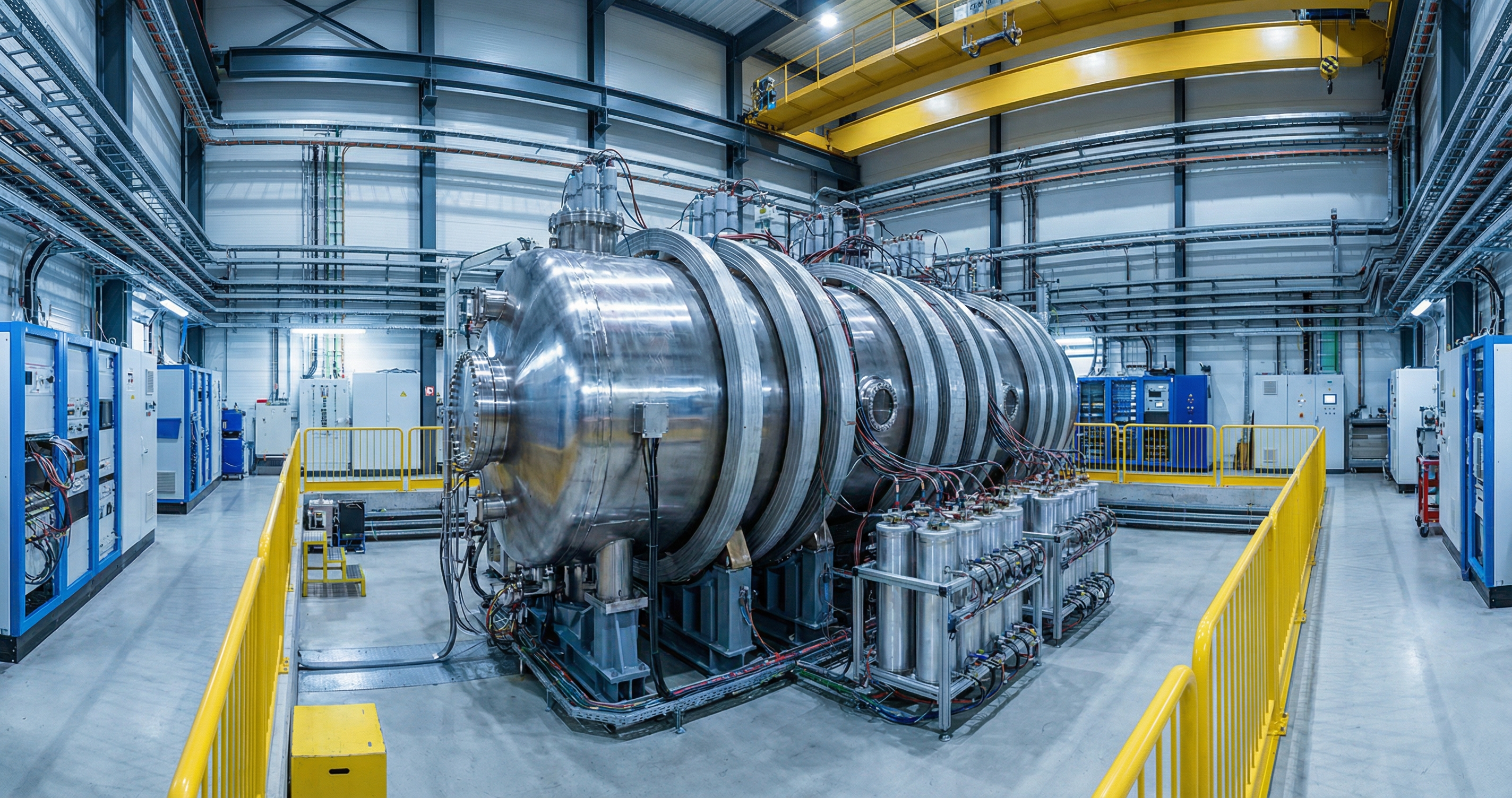
Helion's current machine, Trenta, has demonstrated the plasma physics underlying this approach at laboratory scale. Polaris, the company's next-generation device now in development at its Antares facility, is designed to be the first fusion machine ever to produce net electricity from fusion reactions. Polaris is 19 meters long, uses deuterium and helium-3 fuel, has a peak magnetic field of 15 Tesla, and carries more than 3,800 onboard diagnostics. Its design explicitly targets direct electricity recapture at commercial scale.
The Microsoft Precedent: Fusion's First Power Purchase Agreement
OpenAI is not the first hyperscaler to sign (or attempt to sign) a power purchase agreement with a fusion company. In May 2021, Microsoft and Helion announced a landmark deal: Microsoft would purchase electricity from Helion starting in 2028, making it the world's first commercial power purchase agreement for fusion energy. The deal included financial penalties if Helion failed to deliver power by 2028.
That 2028 target is now under pressure. Fusion timelines have a long history of optimistic projections, and while Helion has made measurable progress — its plasma conditions have improved through seven successive machines — the jump from Polaris demonstrating net electricity to Polaris delivering commercial power at the scale Microsoft needs is non-trivial. The company has been quiet about whether the 2028 Microsoft deadline is still achievable.
The OpenAI discussions, if they result in a deal, would represent a second fusion PPA and a significant expansion of Helion's commercial footprint. They also add urgency to Helion's Polaris timeline: now two of the most important AI infrastructure players in the world would have contractual expectations tied to fusion electricity delivery.
Sam Altman's Dual Role: Conflict of Interest or Strategic Clarity?
The governance question hanging over these negotiations is impossible to ignore. Sam Altman is CEO of OpenAI. He is also one of Helion's largest individual investors and previously served as the company's board chair. A deal in which OpenAI purchases electricity from Helion would send money from OpenAI — whose compute costs are ultimately borne by users and investors — to a company that financially enriches Altman personally.
Axios reported that Altman has stepped down from Helion's board chair position and recused himself from OpenAI's negotiations with Helion. These are meaningful disclosures. They suggest that OpenAI's board — now restructured following the dramatic November 2023 events — is taking governance seriously, requiring formal conflict-of-interest procedures even for early-stage energy negotiations.
But recusal and resignation from the board chair role do not eliminate the underlying financial interest. Altman retains his equity stake in Helion. A successful commercial power deal with OpenAI would materially increase Helion's valuation and the value of that stake. OpenAI's investors — who have now committed hundreds of billions to the Stargate project — may reasonably ask whether the best electricity deal for OpenAI is also the best one for Altman personally.
To be fair, Altman's involvement in Helion long predates OpenAI's energy crisis, and the logic for fusion power in AI data centers is independent of who owns the fusion company. But the optics are difficult, and the governance procedures matter precisely because they are not automatic — they require active institutional will to enforce.
Why Fusion Actually Makes Sense for AI Data Centers
Setting aside the conflict-of-interest questions, the energy logic for fusion in AI infrastructure is genuinely compelling — if the technology works on timeline.
AI data centers have unusual power characteristics. They require enormous quantities of electricity around the clock, with very high uptime requirements. They are indifferent to geography in ways that, say, industrial manufacturing is not — an AI data center can be located near a power source rather than near customers or raw materials. And they are being built on timelines that are measured in years to decades, meaning that power sources with 5–10 year development horizons are not necessarily incompatible with planned capacity.
Fusion, if commercially viable, would provide power that is carbon-free, uses fuel (hydrogen isotopes, eventually helium-3) that is relatively abundant, and generates no long-lived radioactive waste. It cannot be disrupted by weather, unlike solar or wind. It does not face the land acquisition and regulatory complexity of new nuclear fission plants. And unlike Small Modular Reactors — another avenue hyperscalers have been exploring — fusion plants have no risk of meltdown.
The AI industry is already demonstrating willingness to accept energy costs that would have seemed absurd five years ago. Trump's Ratepayer Protection Pledge tried to address the social cost of AI power demand on U.S. electricity consumers. The Stargate consortium is exploring natural gas plants, geothermal, and nuclear simultaneously. Against that backdrop, negotiating with a fusion startup represents not desperation but diversification — adding a potentially transformative energy source to a portfolio of bets.
The Honest Assessment: Fusion's Timeline Risk Is Real
None of this should obscure the fundamental uncertainty in Helion's timeline. Commercial fusion power has been "20 years away" for most of the past 60 years. Helion has made genuine technical progress, and the company's direct electricity recapture approach is technically differentiated — but Polaris has not yet been built, let alone operated. Achieving net electricity from a fusion device would itself be a historic scientific milestone. Scaling that to commercial power delivery would require years of additional engineering.
The 2028 target in Helion's Microsoft PPA is now approximately two years away. For context: Polaris, the machine designed to demonstrate net electricity, is currently in development with components being manufactured in-house at Helion's Antares facility. The gap between Polaris achieving net electricity and Helion delivering grid-scale commercial power is significant, and the publicly available timeline suggests it would not close by 2028.
This doesn't mean the OpenAI negotiations are irrational. Long-term power purchase agreements are structured precisely to accommodate development risk — penalties, delivery timelines, and termination clauses are all negotiable. OpenAI could structure an agreement that gives Helion a financial runway while protecting OpenAI's interests if fusion delivery slips. What matters is that OpenAI is not betting its data center power strategy solely on fusion — it's exploring fusion as one of many energy options in parallel.
What This Means for AI Infrastructure
The broader signal from this news is not that fusion is imminent. It is that the AI industry's power problem is so acute, and the conventional alternatives so constrained, that frontier AI companies are now willing to negotiate commercial agreements around energy technologies that don't yet commercially exist.
That willingness has already changed the economics of fusion investment. The Microsoft PPA in 2021 was a watershed moment that demonstrated commercial demand. An OpenAI deal would add a second major buyer, increase Helion's leverage to raise additional capital, and accelerate the company's development timeline by increasing the cost of failure.
It also sets a precedent. If OpenAI can negotiate a fusion PPA, expect competitors to explore the same. Google, Amazon, Meta, and Microsoft's Azure team are all running equivalent power acquisition strategies. Fusion companies beyond Helion — Commonwealth Fusion Systems, TAE Technologies, Tri Alpha Energy — are watching this development closely. The fusion industry's commercial future may be shaped less by pure physics milestones than by which AI company signs the second and third PPAs and what terms they set.
For now, the OpenAI-Helion talks are precisely that: talks. No deal has been announced. Altman has stepped back from the governance role and recused himself from discussions. The technology remains pre-commercial. But the fact that this negotiation is happening at all — between the world's most prominent AI company and a fusion startup, over electricity that doesn't yet exist from machines still being built — says something unambiguous about where AI infrastructure's energy crisis has arrived.