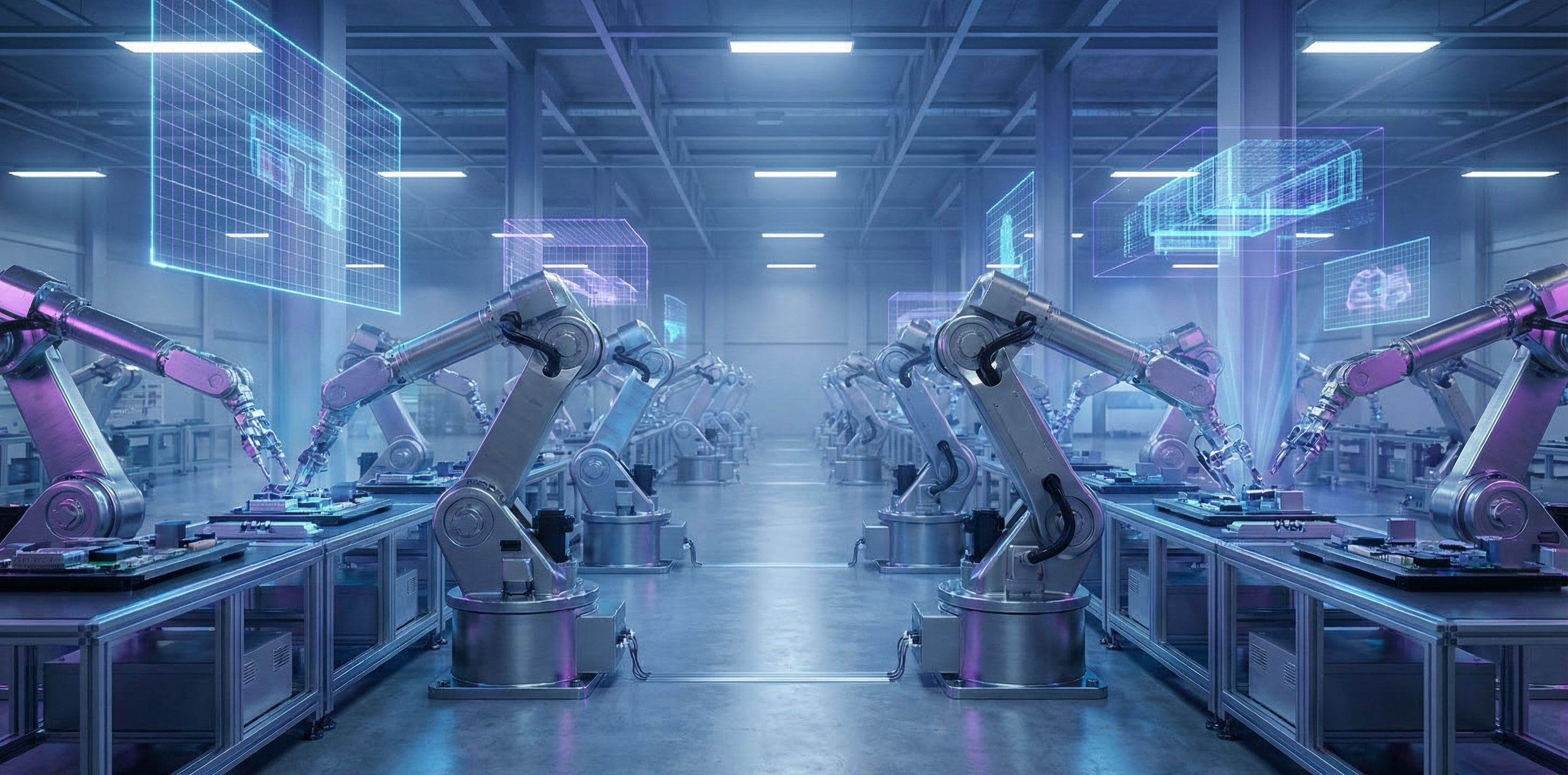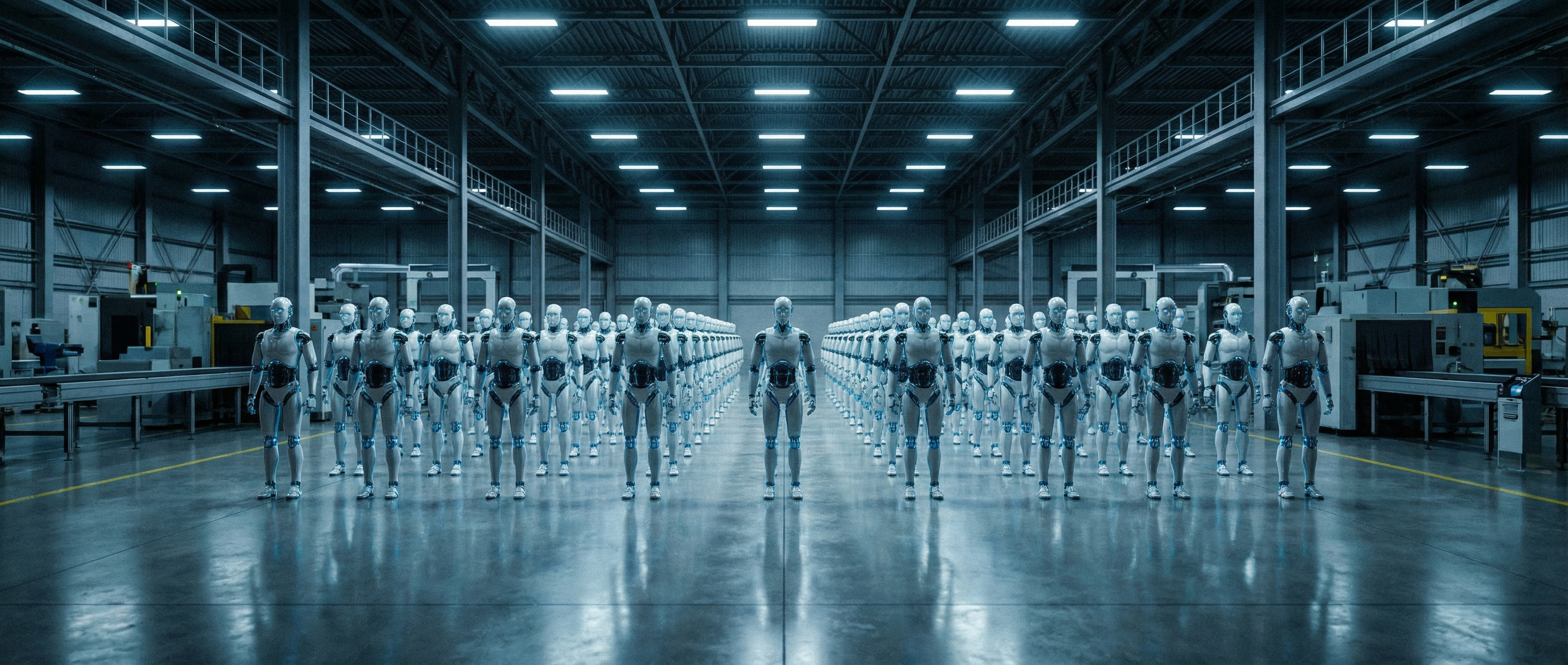
On March 30, Shanghai-based AGIBOT announced its 10,000th humanoid robot had rolled off the production line — becoming one of the first companies in the world to achieve that milestone at commercial scale. More striking than the number itself is the velocity: it took AGIBOT nearly two years to build the first 1,000 units, about a year to go from 1,000 to 5,000, and just three months to double from 5,000 to 10,000. Meanwhile, America's most-funded humanoid robot companies are still celebrating double-digit pilot deployments. The gap between where humanoid robotics is and where the money assumes it is has never been more visible.
The Milestone in Context
AGIBOT's 10,000-unit announcement came via press release, but the supporting data is what makes it credible. The company's production curve shows a classic S-curve in acceleration: years of slow iteration followed by supply chain maturation and a dramatic throughput spike. The jump from 5,000 to 10,000 in 90 days represents a more-than-four-times increase in production speed compared to the previous phase.
Peng Zhihui, AGIBOT's CTO, was direct about what the number signifies: "Reaching 10,000 units is not simply about producing more robots — it reflects a fundamental shift in our ability to scale. As our supply chain matures and manufacturing standardizes, we are seeing a pivot from small-scale, niche applications to robust, large-scale commercial demand."
That framing matters. The humanoid robotics industry has spent years making the case that mass production is imminent. AGIBOT is one of the first companies to provide hard evidence that the manufacturing infrastructure is actually there. The question is whether the rest of the field — particularly Western companies — can point to anything comparable.
Where These Robots Are Actually Working
AGIBOT's deployment profile is broad enough to suggest it isn't a single-customer story. According to the company, its robots are operating across logistics, showroom navigation, retail, hospitality, and education, with a growing presence on industrial production lines performing manufacturing support tasks.
Geographically, the deployment footprint is explicitly global. AGIBOT says a "substantial number" of the 10,000 units are running outside China — in Europe, North America, Japan, South Korea, Southeast Asia, and the Middle East. What began as scattered pilot projects in international markets has evolved, in the company's description, into "repeated, large-scale rollouts." That is a materially different status from a proof-of-concept trial.
AGIBOT isn't alone in China's scaling push. BYD, the electric vehicle maker, has announced plans to reach 20,000 humanoid robots deployed across its own EV production lines by end of 2026 — up from approximately 1,500 in 2025. UBTECH, which makes the Walker S robot, is targeting 5,000 units in 2026 with a jump to 10,000 in 2027, already performing quality inspection on automotive factory floors. The pattern across China's robotics sector is consistent: companies are building production infrastructure and deploying at scale, not circling back for another funding round.
America's Humanoid Deployment Reality
The contrast with Western humanoid robot deployments is uncomfortable to look at directly.
Figure AI, which raised $1 billion at a $39 billion valuation in a Series C round that closed in late 2025, has its most-cited commercial deployment: a pilot with BMW at its Spartanburg, South Carolina plant. That pilot involves between 15 and 30 units. Figure's BotQ factory is scaling, but external commercial deployments remain in early-stage territory. The company's stated goal — thousands of robots in homes and logistics — remains on a multi-year horizon.
Agility Robotics, maker of the Digit humanoid, has arguably the most mature commercial track record among U.S. players. Its robots are operating in Amazon fulfillment centers, GXO logistics hubs, and Mercado Libre facilities — real revenue, real customers. But the deployment numbers remain in the hundreds, not thousands, and Agility's manufacturing capacity is still ramping.
Boston Dynamics' electric Atlas humanoid is generating enormous investor attention — Korean securities firms are projecting an eventual IPO at valuations ranging from $27 billion to over $100 billion — but all 2026 Atlas production units are already committed to internal customers: Hyundai's Robotics Metaplant Application Center and Google DeepMind. Commercial availability to outside customers is targeted for 2027 at the earliest. High-precision assembly workflows aren't on the roadmap until 2030.
Tesla's Optimus is in a category of its own, and not in a flattering way. Despite years of Elon Musk promising imminent mass deployment, Tesla's Q4 2025 earnings call included the candid admission that Optimus units are in a "factory learning phase" and are "not doing useful work." Gen 3 is moving through R&D, consumer sales aren't targeted until late 2027, and there is no standalone production figure to reference. The $20 billion in 2026 capital expenditure Tesla is directing at AI and robotics is real, but the robot itself is not yet a production asset.
Apptronik's Apollo has partnerships with Google DeepMind, Mercedes-Benz, and GXO, and closed a Series A-equivalent round that brought its total funding to $935 million at a roughly $5 billion valuation. But commercial deployments with Mercedes and GXO are in the 10–20 unit range — the scale of a serious pilot, not a market.
China's Standards Infrastructure — The Invisible Accelerant
One factor that rarely makes it into Western coverage of China's robotics surge is the regulatory and standards layer being built in parallel with hardware production. In late February 2026, China's Ministry of Industry and Information Technology published its first national standard system for humanoid robots and embodied intelligence — the "Humanoid Robot and Embodied Intelligence Standard System (2026 Edition)."
The framework was developed by a committee of over 120 researchers, executives, and policymakers from leading robotics firms and research institutes, organized around six pillars: foundational standards, neuromorphic computing, limbs and components, system integration, application scenarios, and safety and ethics. The explicit goal, as described by the committee's secretary-general Liang Liang, is to "reduce coordination and adaptation costs across the industrial chain, promote modularization, and avoid low-level redundant work."
This isn't just bureaucratic box-checking. A shared standards framework does something concrete for an industry: it reduces the friction of component sourcing, supply chain integration, and operator certification at the very moment production scale is increasing. For AGIBOT and its competitors, this framework is infrastructure — the invisible substrate that makes accelerating from 5,000 to 10,000 units in 90 days operationally possible. The United States has no equivalent national framework in place.
The Production Gap Is a Data Gap
There's a second-order consequence to the scale disparity that gets less attention: data. Humanoid robots running in real-world environments generate training data for their AI systems. At 10,000 units operating in logistics warehouses, factory floors, and retail showrooms, AGIBOT is accumulating embodied AI training data at a rate that no Western competitor can currently match in volume.
This is the flywheel that makes the production gap self-reinforcing. More deployed units mean more real-world interaction data. More data means faster improvement in robustness and generalization. Faster improvement means earlier access to the harder use cases — the complex assembly tasks, the unstructured environments, the scenarios where scale matters more than any single technical breakthrough. The companies that deploy first don't just win market share: they win the data advantage that compounds over time.
AGIBOT's Peng Zhihui acknowledged this explicitly, noting that "ongoing usage is helping refine system performance, improve reliability, and expand application capabilities over time." At scale, he said, "progress is no longer driven by isolated deployments, but by coordinated advances across hardware, software, and supply chain systems." That is a description of an AI flywheel — and AGIBOT is further into it than any Western competitor.
What a $39 Billion Valuation Actually Buys
The humanoid robotics market is being valued as though production scale is a given. Figure AI at $39 billion, Boston Dynamics at a projected IPO range of $27–100 billion, Apptronik at $5 billion — these are bets on future production capacity, not current deployed fleets. The capital is real; the robots are, mostly, still being promised.
AGIBOT, by contrast, is a private company with no public valuation benchmark, no splashy Series C announcement, and no White House photo ops. What it has is 10,000 humanoid robots doing actual work in the field. In the logic of the robotics race, that is a more durable competitive asset than a headline funding round — and as of April 2026, it's one the Western field hasn't been able to match.
The humanoid robot era that everyone has been investing in has arrived. It's just arriving in Shanghai first.