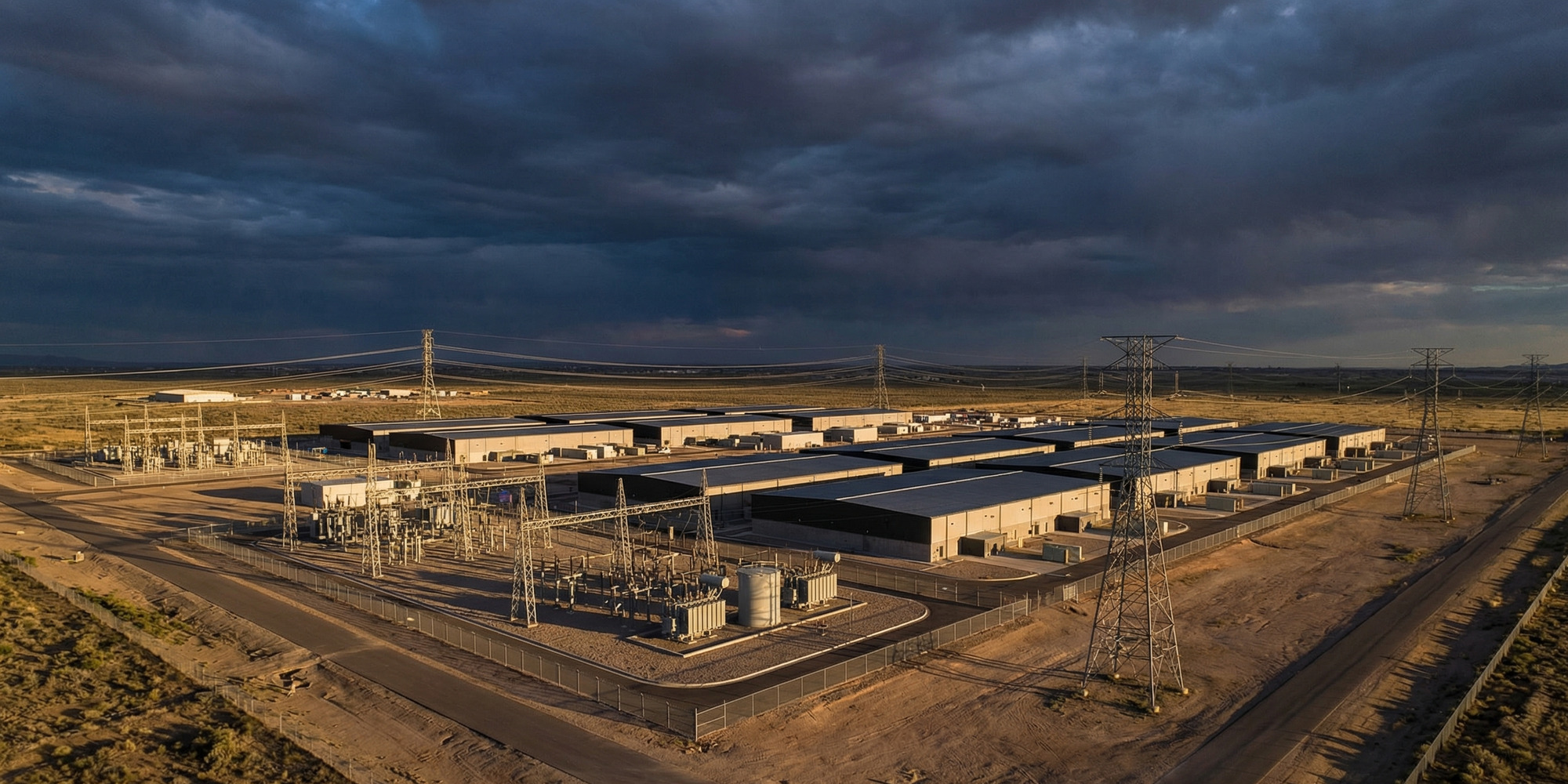
The United States' largest electrical grid operator has drawn a line in the sand. In a regulatory filing submitted to the Federal Energy Regulatory Commission this week, PJM Interconnection's independent market monitor formally objected to a power plant acquisition by AI infrastructure company TeraWulf — warning that diverting the plant's output to private data centers would shrink the electricity supply available to ordinary homes and businesses across the mid-Atlantic and Midwest. The move marks an escalation point in a tension that has been building for years: as AI's appetite for power grows exponentially, the infrastructure built to serve the public grid is increasingly being captured by the industry that needs it most.
The FERC Flash Point: TeraWulf, Morgantown, and the Market Monitor
TeraWulf Inc., which operates bitcoin mining and data center infrastructure, announced last month that it had agreed to acquire the Morgantown Generating Station, a Maryland power plant with approximately 200 megawatts of operational generation capacity that could potentially be expanded to 1,000 megawatts — enough to power roughly 750,000 homes.
Monitoring Analytics, LLC — the independent market monitor for PJM Interconnection, which coordinates the movement of electricity across 13 states and Washington D.C. — filed an objection with FERC on March 5th. The monitor demanded that TeraWulf commit to keeping Morgantown's electricity supply flowing into the broader PJM market, and not quietly redirecting it to serve its own data center operations.
"It remains unclear whether the proposed expansion relies on reactivating retired units, constructing entirely new generation, or modifying existing interconnection rights," Monitoring Analytics stated in its filing. "Without this information, it is impossible to evaluate whether the project will in fact contribute incremental supply to the grid."
The stakes aren't abstract. PJM's market monitor has been tracking a direct correlation between data center demand growth and rising electricity prices across its territory. Rising load from both existing and forecasted data centers has already pushed power bills higher for residential and commercial customers. The White House, multiple governors, and PJM itself have all floated proposals requiring data centers to build or otherwise supply new generation capacity to cover their electricity use — rather than simply drawing from the existing grid.
TeraWulf did not publicly name a potential customer for the expanded Morgantown capacity or outline how the power plant would interact with the broader market. That opacity is precisely what triggered the monitor's intervention.
The Scale Problem: 97 Gigawatts by 2030
To understand why regulators are growing alarmed, consider the numbers that industry analysts are now tracking. JLL's 2026 Global Data Center Outlook, published this week, projects that the sector will add nearly 100 gigawatts of new capacity between now and 2030 — effectively doubling global data center capacity in five years. That's not a linear trend; it's a vertical climb.
The report identifies a $3 trillion infrastructure investment supercycle through 2030, of which roughly $1.2 trillion represents real estate asset value creation from new facilities. Tenants — the hyperscalers, AI labs, and cloud providers filling those facilities — are expected to spend an additional $1 to $2 trillion equipping the space with IT hardware. The Americas, accounting for roughly 50% of global capacity today, is projected to grow at a 17% compound annual rate through 2030, outpacing every other global region.
The demand driver is AI inference. JLL's analysts forecast that by 2030, AI workloads could represent half of all data center traffic, with inference — running trained models to generate outputs — overtaking model training as the primary electricity consumer. That shift matters because inference is continuous and geographically distributed in ways that training runs are not. It means power demand will spread across more locations and more grid operators, not concentrate at a handful of hyperscale campuses.
The $600 Billion Escalation
Behind the infrastructure buildout is an unprecedented commitment of capital. Hyperscaler capital expenditures are projected to exceed $600 billion in 2026, a 36% increase over 2025, with Microsoft, Google, Meta, and Amazon collectively accounting for the bulk of that spending. AWS is expanding across Saudi Arabia ($5.3 billion), Germany's European Sovereign Cloud (€7.8 billion committed through 2040), Chile, and a new wave of Asia-Pacific deployments. Microsoft's Fairwater AI campuses — purpose-designed for massive AI workloads — are coming online in sequence across Atlanta, Wisconsin, and additional sites.
Yet scale is running into physics. Data Center Watch reported that, as of mid-2025, more than 36 data center projects representing $162 billion in investment had been either blocked or significantly delayed — not due to regulatory opposition to the facilities themselves, but because the electricity needed to power them simply wasn't available on the required timeline. Equipment lead times for large transformers stretch to three years in some markets. Grid interconnection queues are clogged. Local communities in power-constrained regions have grown hostile to new facilities that drive up residential electricity costs without generating proportionate local economic benefit.
The EIA's June 2025 forecast projected U.S. power demand would rise to 4,283 billion kilowatt-hours in 2026, driven substantially by data center load growth — a record high. Bloomberg's analysis of grid-level data suggests U.S. data center power demand could reach nearly 9% of total national electricity demand by 2035, the largest single-sector surge since the mass adoption of air conditioning in the 1960s.
Nuclear as the Long Game — and Its Limits
The tech industry's response to the power squeeze has, at this point, bifurcated into two strategies: secure existing capacity now at almost any cost, and build new capacity over the next decade using nuclear energy.
The nuclear deals have been headline-grabbing. Microsoft signed a $16 billion Power Purchase Agreement to restart Pennsylvania's Three Mile Island nuclear plant. Google committed to procuring power from Kairos Power's small modular reactors. Amazon struck a $20 billion arrangement tied to the Susquehanna nuclear facility. Meta issued a request for proposals seeking between 1 and 4 gigawatts of new nuclear generation capacity. In aggregate, hyperscalers have contracted more than 10 gigawatts of new or reactivated nuclear capacity.
The problem is timing. SMR technology at commercial scale remains years away for most providers, with widespread deployment unlikely before the mid-2030s according to analysts at World Wide Technology. The nuclear PPA agreements for existing plants provide some near-term relief, but the Three Mile Island restart itself was delayed and subject to extensive regulatory scrutiny. The fundamental mismatch is that data center demand is scaling now, in 2026, while the dedicated power supply chain won't be operational until well into the next decade.
In the interim, hyperscalers are filling the gap with natural gas — a strategy that sits awkwardly alongside their publicly stated commitments to 100% renewable energy. As logistics research firm Logistics Viewpoints observed last December, the major cloud providers are increasingly prioritizing "speed to power" over "immediacy of green power" — a visible contradiction that is drawing increasing scrutiny from regulators and sustainability advocates alike.
The Policy Scramble: States, FERC, and the White House
The TeraWulf-Morgantown dispute is unlikely to be an isolated incident. It reflects a broader regulatory awakening to the fact that the existing rules governing electricity markets were written before AI data centers existed as a demand category. Several fault lines are now visible:
Co-location and "behind-the-meter" deals — where data centers connect directly to power plants without routing electricity through the public grid — have proliferated as a way to circumvent interconnection queues. Regulators are increasingly scrutinizing whether these arrangements effectively remove generation capacity from the public market, harming other ratepayers. FERC has already issued guidance on this, but enforcement remains inconsistent.
State-level moratoria are beginning to appear. Northern Virginia, the world's densest concentration of data centers, has effectively run out of available power capacity in multiple counties, with Loudoun County alone hosting more than 100 data center facilities. Utility Dominion Energy proposed its first residential base-rate increase since 1992, adding approximately $8.51 per month to typical household bills in 2026, driven substantially by data center load growth.
The White House and PJM have both floated "additionality" requirements — mandating that data centers build or fund new generation equal to their consumption rather than drawing entirely from existing capacity. Implementation details remain contested, and opponents argue that such requirements could deter the very investment in AI infrastructure that U.S. competitiveness depends on. The tension between grid equity and industrial policy has no clean resolution.
What the Regulators Are Actually Saying
The language in Monitoring Analytics' FERC filing is worth reading carefully. The market monitor isn't opposing data center development. It's opposing opacity. The concern is that TeraWulf's acquisition of Morgantown could proceed, the generation capacity could be quietly redirected to serve private customers, and the public grid would lose supply it currently depends on — with no compensating new capacity added anywhere.
That precise scenario — existing generation capacity captured by private industrial users, reducing public availability without replacement — is what regulators across multiple states are increasingly trying to prevent. The Morgantown situation differs from the nuclear PPAs in an important respect: the major tech companies' nuclear deals generally involve bringing new or previously retired capacity back online. TeraWulf's filing raises the question of whether operational capacity serving the market today would simply be redirected.
FERC's decision on the objection will set a precedent. If the monitor's position prevails, future data center developers seeking to acquire generation assets will face mandatory disclosure requirements and potentially binding commitments to maintain public grid supply. If it doesn't, the template for quietly acquiring and redirecting grid capacity becomes available to every infrastructure developer with sufficient capital.
The Structural Reality of 2026
The data center industry has grown accustomed to operating in a regulatory environment that largely treated its power needs as a private infrastructure problem. That era is ending. The JLL forecast of 97 gigawatts of new capacity by 2030 is not just an industry number — it is a number that every grid operator, utility regulator, and state legislature in the country now has to plan around.
The FERC filing from PJM's market monitor is a signal, not a solution. It doesn't resolve the fundamental imbalance between demand growth and grid capacity. What it does do is establish that regulators are willing to intervene when private actors attempt to capture public infrastructure — and that the era of frictionless data center expansion, unencumbered by grid-equity considerations, is over.
The AI industry will get the power it needs. The question being litigated in regulatory filings, state legislatures, and utility commission hearings across the country is who else pays for it, and how much of the existing grid gets redirected in the process.