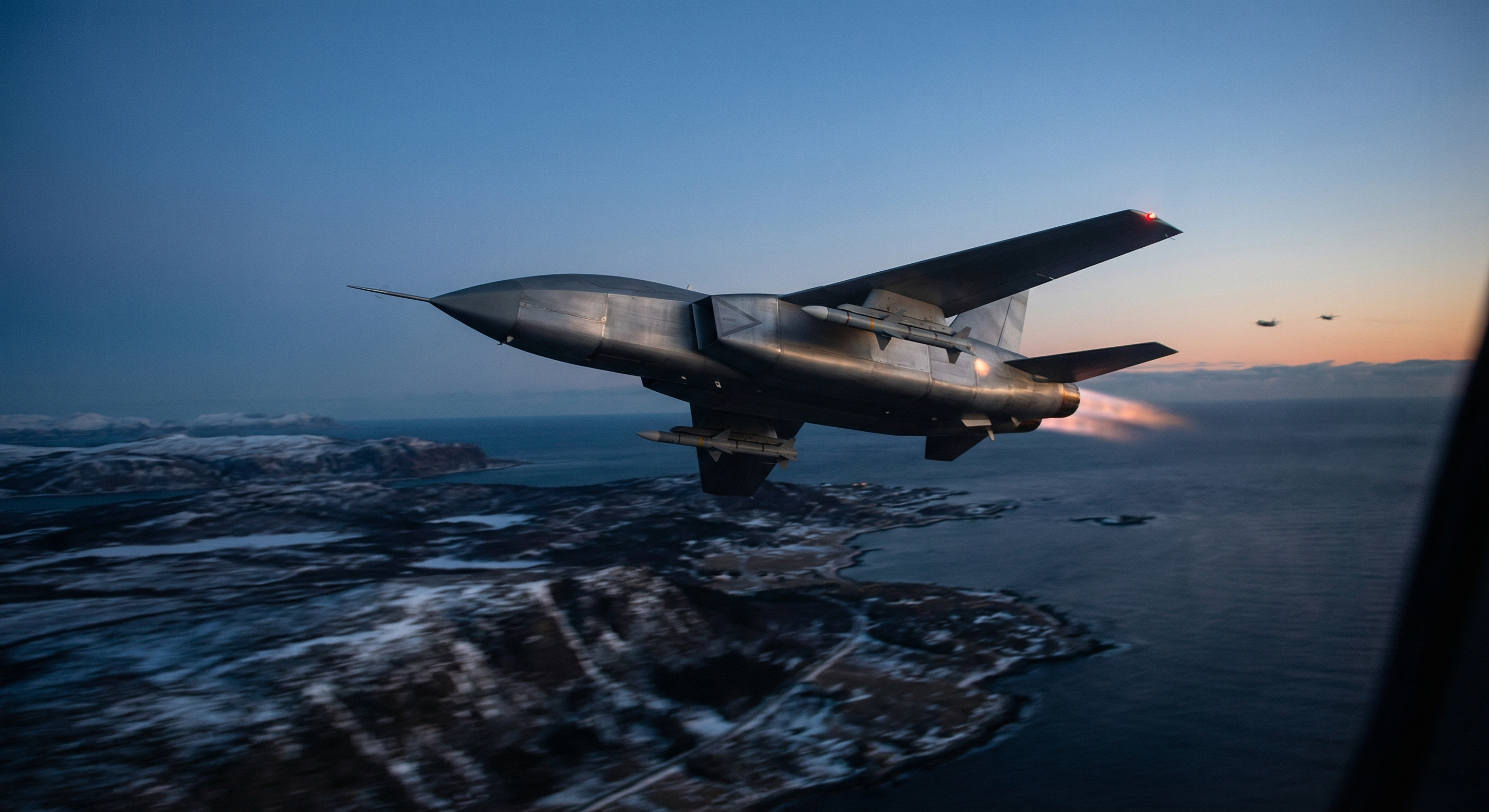
On March 30, 2026, at a military training area in northern Germany, a reusable autonomous drone autonomously hunted, classified, and killed another drone using a missile that weighs less than two kilograms and costs a fraction of conventional interceptors. The Airbus Bird of Prey and the Frankenburg Technologies Mark I missile didn't just complete a successful first demonstration — they introduced a new cost curve to one of modern warfare's most pressing unsolved problems.
The Cost-Asymmetry Problem That's Breaking Western Air Defense
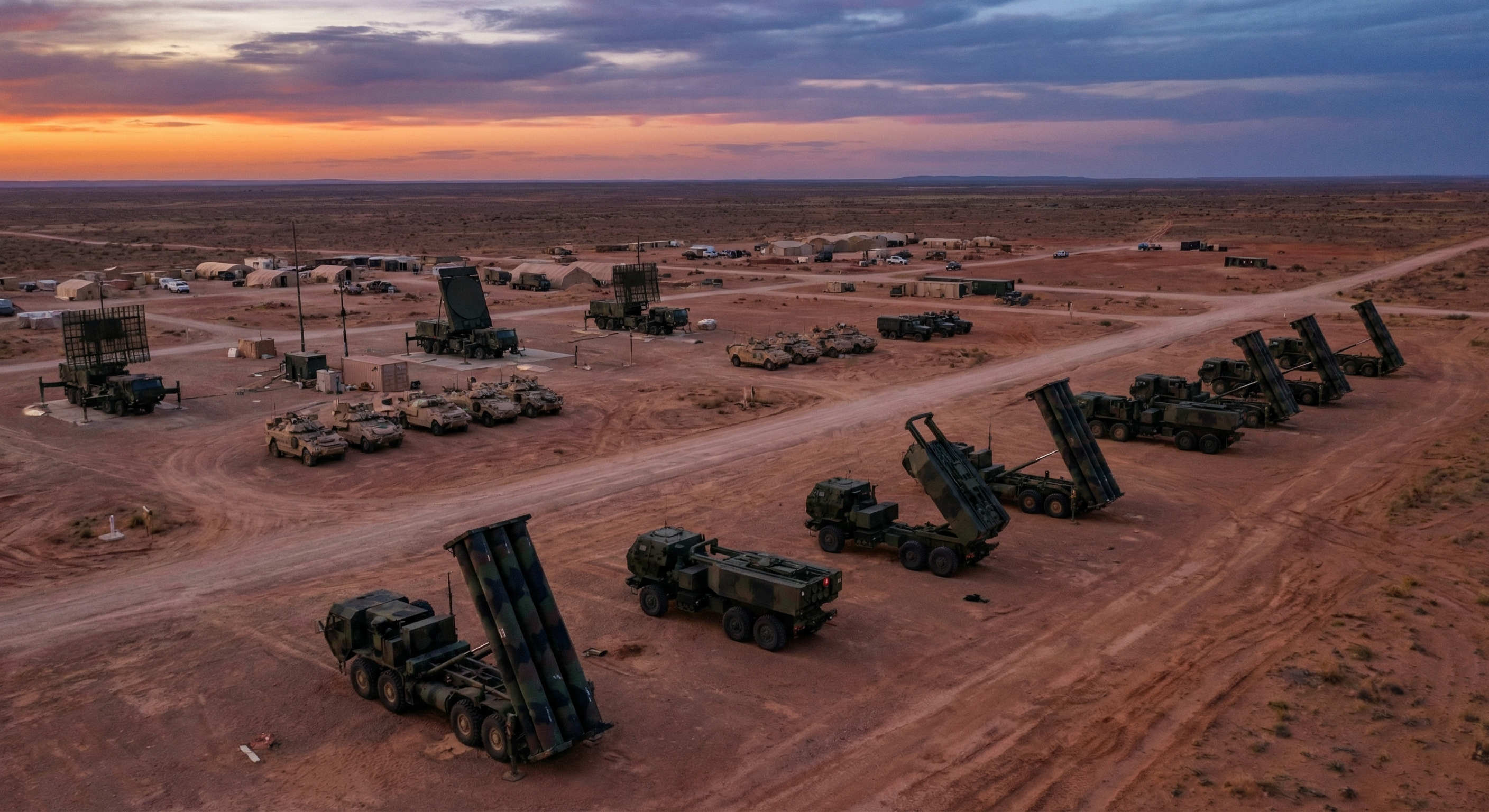
Iran's Shahed-136 attack drone costs roughly $50,000 to manufacture. A single Patriot PAC-3 missile, the gold standard of Western air defense, runs approximately $4 million per interceptor. The exchange ratio — 80:1 in Tehran's favor — is not a minor inefficiency in NATO's air defense posture. It is a structural crack that adversaries have been deliberately exploiting for three years.
Since Russia began deploying Shahed drones against Ukrainian cities in 2022, and since Iran's own Shahed stockpiles entered the Middle East conflict in 2025, Western militaries have been forced to confront an uncomfortable arithmetic: high-end air defense missiles are a finite, expensive, and irreplaceable resource. Shooting $4 million Patriot interceptors at $50,000 attack drones is economically untenable at scale. The Pentagon's "Arsenal of Freedom" production surge announced last week partially addresses supply constraints — but it does nothing to fix the price ratio.
That is exactly the gap that Airbus and Frankenburg Technologies claim to address. And on March 30, they showed the first evidence it can work.
What Bird of Prey Actually Is
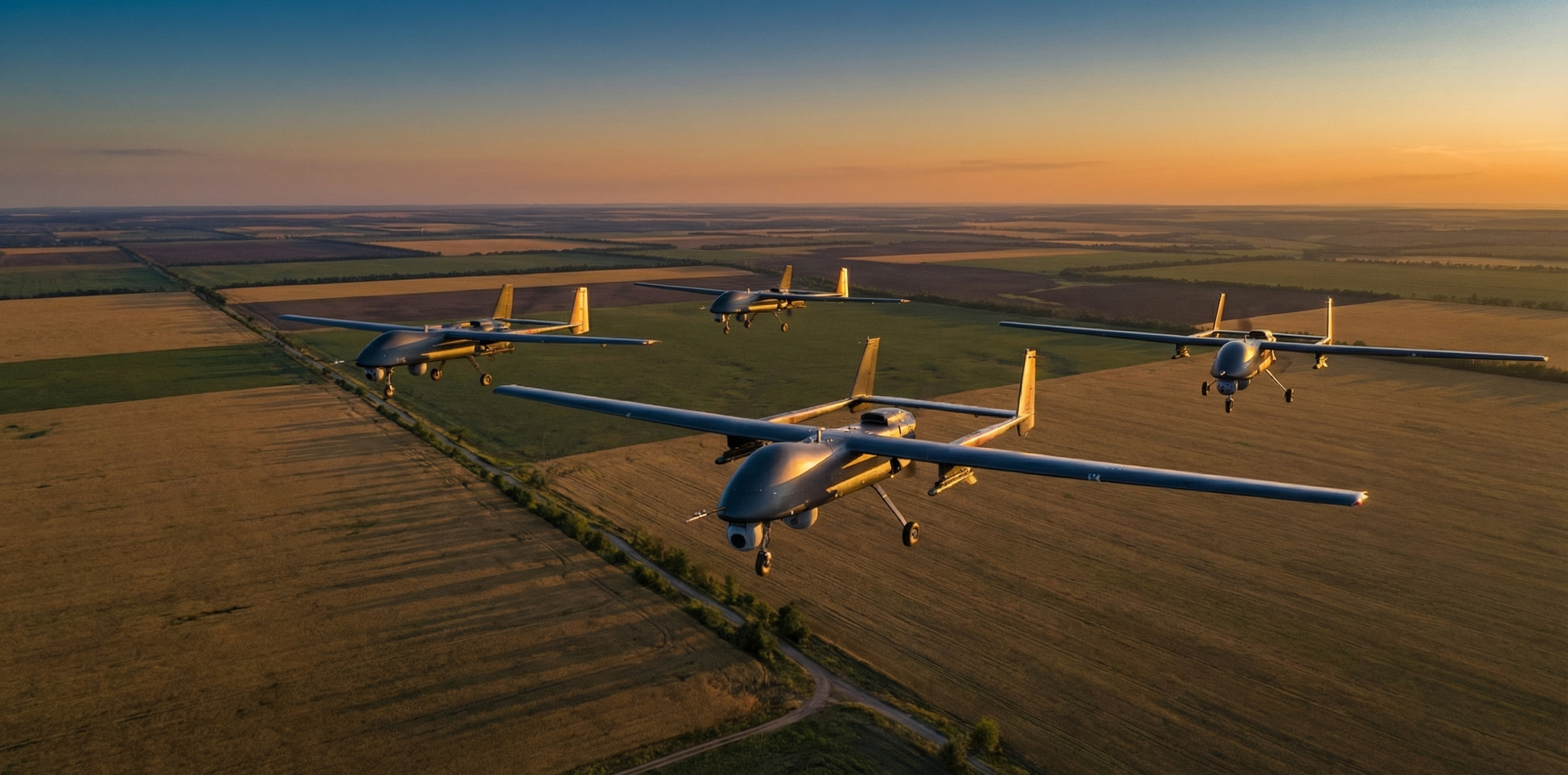
The Bird of Prey is a reusable, jet-powered interceptor drone based on a modified version of the Airbus Do-DT25 target drone, a platform Airbus already uses to train radar and missile operators. The prototype sports a 2.5-meter wingspan, 3.1-meter length, and a maximum takeoff weight of 160 kilograms — roughly the size of a large motorcycle. Its published top speed of 300 knots (555 km/h) makes it significantly faster than the subsonic Shahed drones it is designed to intercept.
The prototype configuration carries four Frankenburg Mark I air-to-air missiles. The production version will carry up to eight. The Bird of Prey is reusable — it recovers after a mission and can be rearmed, meaning a single airframe can perform multiple sorties and multiple intercepts before requiring significant maintenance.
The AI component is not incidental. In the March 30 demonstration, the Bird of Prey autonomously performed the full engagement sequence: search, detection, classification, and weapons release. This is critical. Against swarms of dozens or hundreds of one-way attack drones, human operators become the bottleneck. Removing them from individual intercept decisions — while keeping a human in the broader command loop — is the only way to achieve intercept rates at the scale of modern drone saturation attacks.
According to the joint press release from Airbus and Frankenburg, the entire system integration took nine months from project start to the first demonstration flight. That timeline is notable. NATO procurement cycles are typically measured in years; this system went from concept to live-fire demo in less than a year, underscoring the urgency both companies — and presumably their government clients — attach to the counter-drone problem.
The Mark I Missile: A New Class of Interceptor
The Frankenburg Technologies Mark I missile is the other half of the equation, and it may be the more consequential innovation. At 65 centimeters long and weighing less than 2 kilograms, it is the lightest guided interceptor missile developed to date, according to the companies. It is high-subsonic, fire-and-forget, and carries a fragmentation warhead designed to neutralize targets at short proximity rather than through direct impact.
The engagement range is 1.5 kilometers — short by conventional air defense standards, but appropriate for the terminal-defense role the system is designed to fill. The Mark I is explicitly designed for mass manufacture at low cost. Frankenburg CEO Kusti Salm describes the vision plainly: missiles that are "ten times more affordable, a hundred times faster to produce, and in quantities far exceeding current industry capabilities." The company's stated mission is to "equip the free world with the technologies needed to win the war" — language that reflects the directness of a defense startup founded in the shadow of active conflict.
The cost per intercept math has not been formally disclosed. But an "order-of-magnitude reduction in cost per intercept" — Frankenburg's own characterization — would put the Mark I engagement cost somewhere in the range of $10,000–$100,000 depending on the baseline comparison. Even at the high end, that is a dramatic improvement over a Patriot missile. Combined with the reusable Bird of Prey airframe, which can engage multiple targets per mission, the economics of large-scale drone defense start to look tractable for the first time.
NATO Integration: The Force Multiplier Argument
Counter-drone platforms are only as useful as their integration into existing command structures. A standalone interceptor that operates on its own network, requires dedicated operators, and can't share threat data with adjacent systems is an expensive island. Airbus has been explicit about avoiding this failure mode.
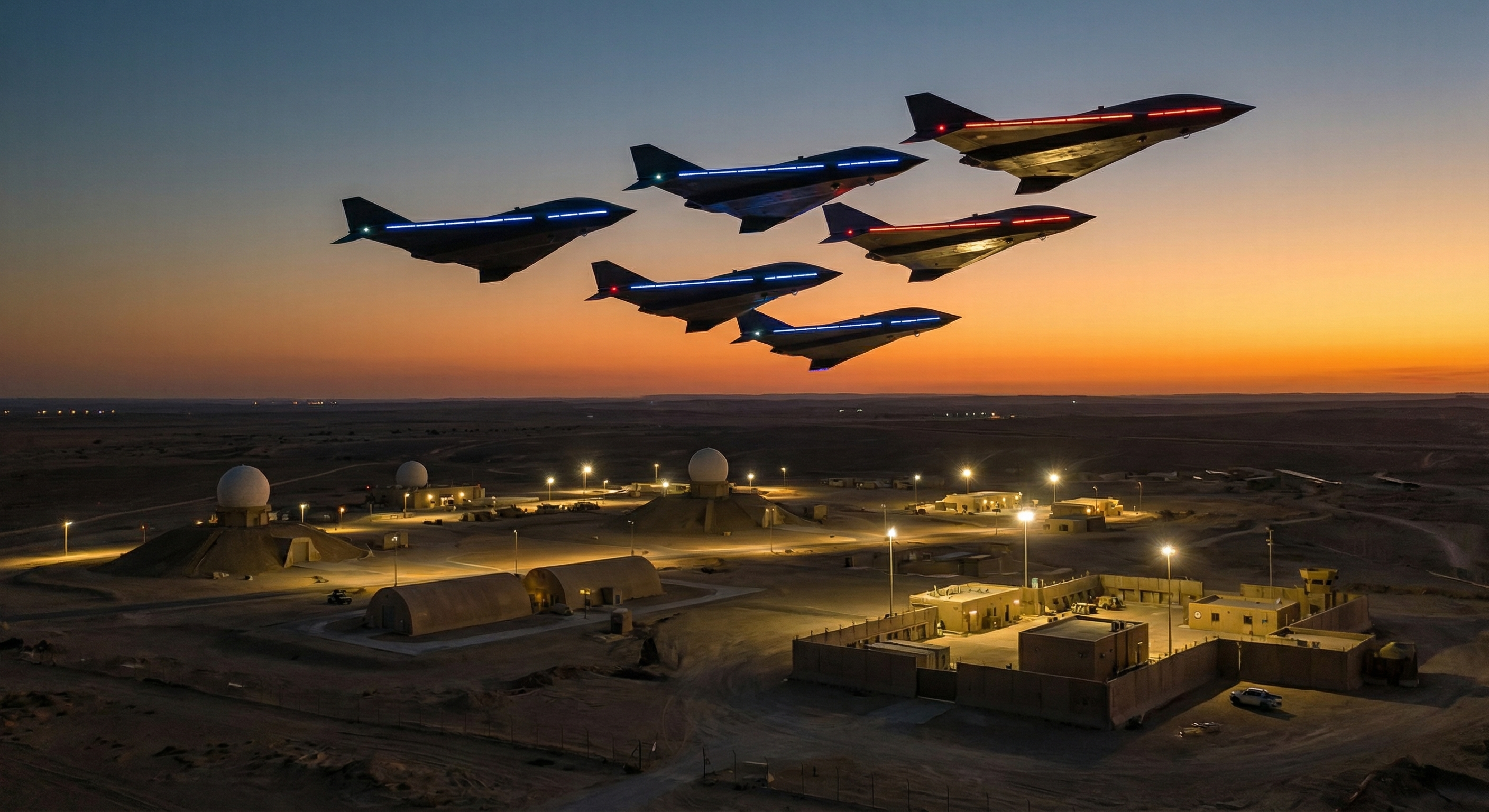
Bird of Prey is designed to plug directly into NATO's integrated air defense architecture via Airbus's Integrated Battle Management System (IBMS). IBMS is already deployed across multiple NATO member nations as a command-and-control backbone that fuses sensor data from radar networks, satellite feeds, and ground-based systems into a common operational picture. By connecting Bird of Prey to IBMS, Airbus positions it not as a standalone product but as a node in an existing network — one that can receive threat coordinates from ground radar, act autonomously on intercept, and report engagement results back to the same command structure that handles Patriot and SHORAD batteries.
"The integration of Bird of Prey into Airbus' air defence battle management suite IBMS acts as a force multiplier," said Mike Schoellhorn, CEO of Airbus Defence and Space, in the official announcement. A drone interceptor that can be cued by NATO's existing sensor architecture and deconflicted from friendly aircraft through the same C2 systems already in place is categorically more deployable than a system that requires its own dedicated command chain.
Why Northern Germany, Why Now
The choice of a German military training area for the demonstration flight is not coincidental. Germany is in the middle of a rapid rearmament push under Chancellor Friedrich Merz, with a constitutional amendment passed in March 2026 removing defense spending from debt brake constraints and authorizing hundreds of billions of euros in new military investment over the coming decade. Counter-drone capability is near the top of the Bundeswehr's shopping list — Ukrainian drone strikes have reached the Baltics, raising immediate questions about NATO territory air defense, and Germany's own air defense architecture depends heavily on the Patriot system that has now been combat-tested to near-exhaustion in Ukraine.
Europe more broadly is scrambling. The EU's top security official said last week that European nations can no longer rely on the United States for air defense missiles — a stark acknowledgment of the supply constraints Operation Epic Fury has exposed. That political backdrop creates a powerful sales environment for a European-built, NATO-integrated, mass-producible counter-drone platform that demonstrably works.
Airbus and Frankenburg are targeting exactly this moment. Additional test flights with a live warhead are planned throughout 2026, with the explicit goal of demonstrating full capabilities to "interested potential customers." Germany is almost certainly first in line. Poland, which has been building the largest land army in continental Europe, is another obvious candidate. So are the Baltic states, which have been investing aggressively in air defense following the Ukrainian drone incidents on their territory.
What Bird of Prey Doesn't Solve
The system's limitations are worth naming clearly. The Mark I's 1.5-kilometer engagement range means Bird of Prey operates as a terminal defense layer — intercepting threats in the final phase of their approach rather than at standoff range. Against saturation attacks by dozens of drones simultaneously, a platform carrying 8 missiles faces a hard numerical ceiling before rearming. At this stage, the platform has not been tested with live warheads, electronic countermeasures, or GPS jamming — conditions that define actual combat environments. And autonomous classification systems have an error rate; a system that fires on commercial drones or misidentifies friendly aircraft creates its own set of strategic problems.
The AI autonomy dimension also enters contested legal and ethical territory. The UN's 2026 autonomous weapons framework is still being negotiated, and NATO member states have not reached consensus on rules of engagement for autonomous intercept systems. An autonomous drone that fires missiles without human authorization per engagement — even against clear drone targets — will face scrutiny from arms control advocates and will require careful legal frameworks before full operational deployment.
These are real constraints. But they are also the constraints of a first-generation system that completed its first successful demonstration less than 24 hours ago. The point is not that Bird of Prey is ready to field today. The point is that the cost curve it represents — autonomous, reusable, magazine-fed, mass-producible — is the direction the entire counter-drone industry is being pulled, and Airbus just validated the concept at operational scale.
The Bigger Picture: Drone vs. Drone as the New Air Defense Paradigm
Bird of Prey is the European establishment's answer to a problem that Ukrainian and Israeli startups have been racing to solve from the bottom up. Ukraine's The Fourth Law, founded by Petcube co-founder Yaroslav Azhnyuk, has deployed more than thousands of AI autonomy modules that increase drone strike success rates by up to four times. Israeli firms have been developing drone-interception systems since the Iron Dome era. American venture-backed defense startups like Anduril and Shield AI are working on similar architectures with larger funding bases.
What Airbus brings is institutional integration. The NATO IBMS connection, the defense procurement relationships across Germany, France, Spain, and the UK, and the manufacturing scale to produce Bird of Prey and Mark I missiles in volume are not things a startup can replicate quickly. Frankenburg Technologies' nine-month integration timeline shows what's possible when a startup brings an innovative missile design and an established defense prime provides the platform, certification pathway, and customer relationships.
The model — agile defense startups providing the novel munition, established primes providing the platform and integration — may be the template for how Europe accelerates counter-drone capability over the next several years. Frankenburg is not the only missile startup working in this space. The pipeline of ventures developing low-cost, AI-guided interceptors for drone defense is growing. Bird of Prey shows that the platform side of that equation is now commercially available at a proven specification.
For Western militaries that have been watching their Patriot stockpiles drain at an unsustainable rate, the most important number from Monday's demonstration in northern Germany isn't the missile's weight, range, or cost. It's the timeline: nine months from project start to first live intercept. If the full system can reach operational readiness by late 2026 or early 2027, it arrives just in time to matter.