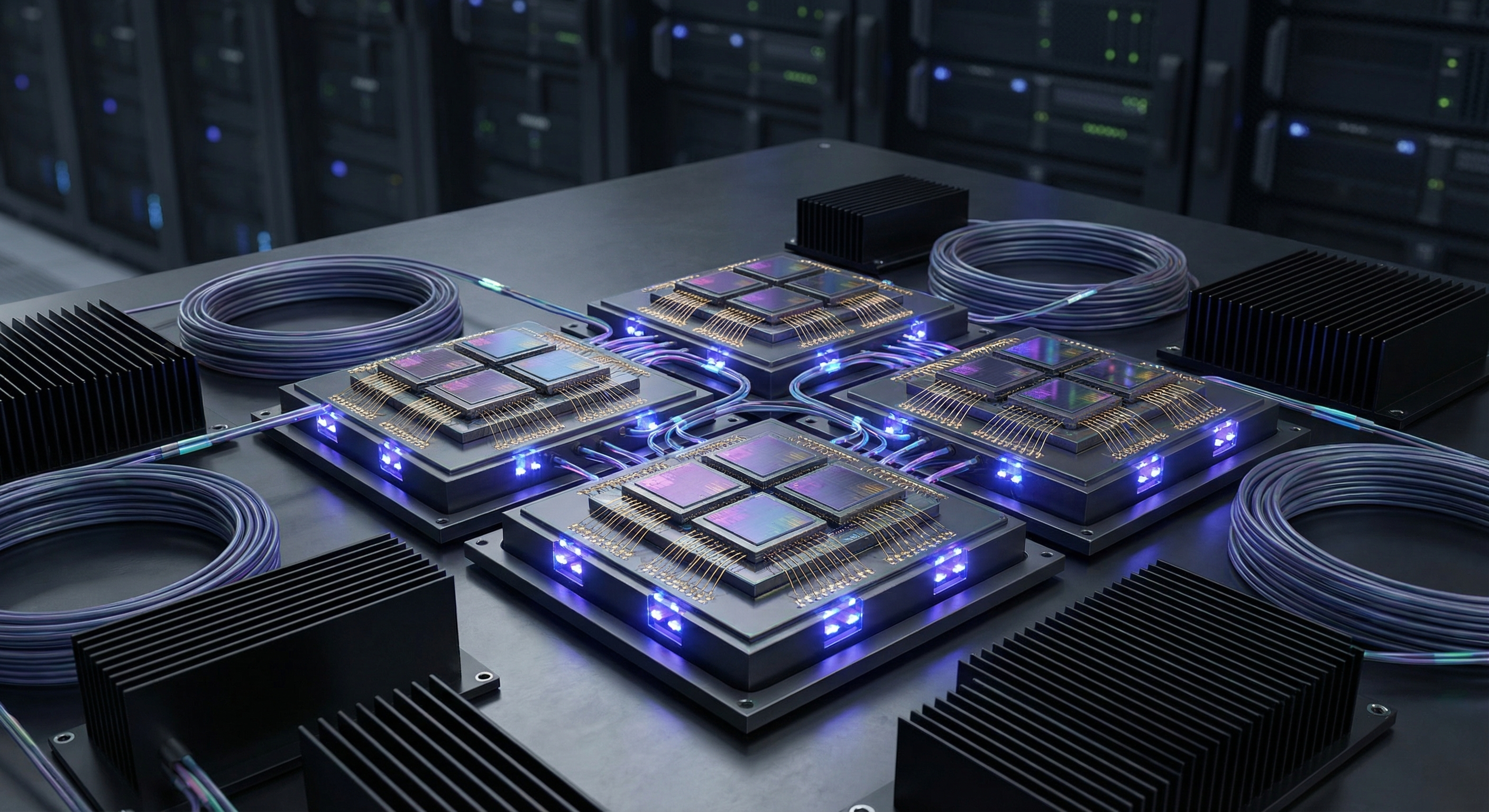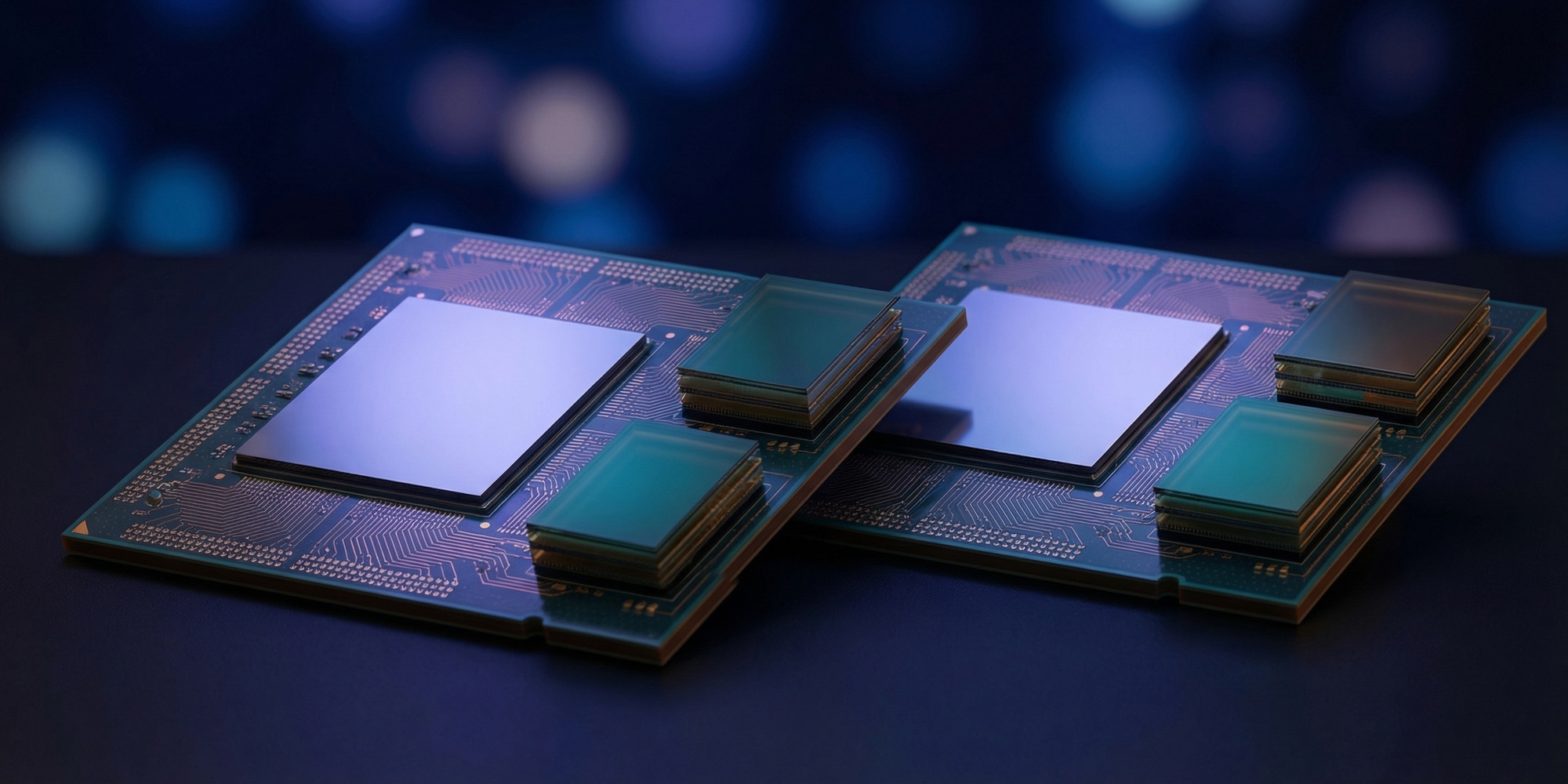
When AMD launched its Instinct MI300X accelerator, it did something no competing chip had done: it packed 192 gigabytes of HBM3 memory onto a single package, delivering 5.3 terabytes per second of memory bandwidth. For large language model inference — the workload consuming the most GPU capacity at the world's biggest AI companies — that specification wasn't just good. It was architecturally disruptive. And yet, two years into the MI300X era, NVIDIA still controls more than 80% of the AI accelerator market. Understanding why that gap persists tells you almost everything about how the AI chip market actually works.
The Memory Equation That Changed the Hardware Conversation
Before the MI300X, the standard unit of AI infrastructure was the NVIDIA H100 SXM5, which ships with 80 gigabytes of HBM3e and approximately 3.35 terabytes per second of bandwidth. That configuration — and its pricing, around $25,000–$35,000 per card at peak demand in 2023 — became the de facto baseline against which every other accelerator was measured.
The MI300X changed the terms of the debate. Its 192GB memory capacity means that large models which require multiple H100s running in tensor-parallel configurations — a complex, latency-introducing setup — can run on a single MI300X with memory to spare. For a 70-billion parameter model like Meta's Llama 2 70B, which doesn't fit cleanly on a single 80GB H100 without precision tricks, the MI300X offers genuine operational simplicity. One card, full model, no partitioning overhead.
Memory bandwidth matters even more than capacity for inference throughput. When a model is generating tokens, the GPU is not doing heavy matrix math — it's loading model weights from memory on every forward pass. The rate at which those weights can be loaded directly determines how fast tokens appear. AMD's 5.3 TB/s bandwidth advantage over the H100's 3.35 TB/s translates directly to better tokens-per-second performance in memory-bandwidth-limited inference regimes, which describes the majority of production LLM deployments at anything less than the largest batch sizes.
Real Deployments: Where AMD Is Actually Winning
The MI300X is not a paper product. It is in production at several of the largest cloud infrastructure providers, and the deployments are real, not marginal.
Microsoft Azure launched its ND MI300X v5 series in 2024, offering eight-GPU VM instances for large-scale LLM fine-tuning and inference. Azure's public documentation explicitly positions the MI300X as suitable for models that exceed 80GB VRAM requirements — the exact use case AMD designed for. Oracle Cloud Infrastructure added MI300X-backed instances for similar high-memory inference workloads, extending AMD's cloud reach beyond a single provider.
Meta — which operates one of the world's largest AI compute fleets — has publicly disclosed deploying AMD Instinct GPUs alongside NVIDIA hardware in its infrastructure. The company's approach mirrors what many large operators are beginning to adopt: a heterogeneous compute strategy in which NVIDIA hardware dominates training and AMD handles inference at scale where the memory economics are more favorable. This is not a consolidation story for AMD. But it is a foothold that would have been unimaginable five years ago.
AMD reported that its data center GPU revenue grew substantially through 2024 and 2025, with the MI300X family as the primary driver. Lisa Su, AMD's CEO, set a $7.5 billion data center AI accelerator revenue target for 2025 — an aggressive number that nonetheless reflected genuine market traction, not aspirational positioning. The MI300X had become, in two years, the only commercially significant alternative to NVIDIA at hyperscale.
What the CUDA Moat Actually Is
To understand why AMD's hardware advantage has not translated into market share dominance, you need to understand CUDA — and specifically why CUDA is far more than a programming language.
CUDA, NVIDIA's Compute Unified Device Architecture, launched in 2006. It was the first framework that let developers write general-purpose code for GPUs without learning graphics programming. For eighteen years, NVIDIA has built on top of that foundation with an expanding ecosystem of libraries, frameworks, and tools that now constitute the practical definition of how AI workloads run in production.
cuDNN — NVIDIA's deep neural network library — is hand-optimized for every architecture the company ships and integrates into PyTorch, TensorFlow, and JAX at levels that directly affect training throughput. TensorRT, NVIDIA's inference optimization framework, provides model compilation, quantization, and runtime scheduling primitives that production deployments depend on. NVIDIA's NIM microservices bundle optimized inference containers for popular models. RAPIDS provides GPU-accelerated data science. The NCCL library handles multi-GPU communication for distributed training in ways that have been tuned against real production clusters for years.
Every machine learning researcher who spent the last decade writing CUDA kernels, every framework team that hard-coded cuDNN calls into their backward passes, every operations team that built deployment pipelines around TensorRT — all of it runs only on NVIDIA hardware. The technical debt of switching is not a simple API translation problem. It is, in many cases, a multi-year software re-engineering project with uncertain performance outcomes at the end.
AMD's ROCm Counter-Strategy
AMD has been investing aggressively in ROCm, its open-source GPU compute stack and the principal means by which AMD software reaches developers. The progress since 2022 is real and should not be dismissed. PyTorch's ROCm backend has reached functional parity for most standard training workloads. Major model architectures — transformers, diffusion models, state space models — run on AMD hardware via ROCm without requiring rewrites.
But "functional parity" and "performance parity" are different things. ROCm lacks the depth of hand-tuned kernels that NVIDIA's ecosystem has accumulated. A PyTorch matmul on a MI300X runs correctly; it does not always run as fast as the equivalent CUDA call on an H100 with cuBLAS tuning applied. For training workloads where the bottleneck is raw compute — large matrix multiplications, attention layers — those kernel-level differences compound across millions of training steps.
AMD has attempted to close this gap through its acquisition strategy. The acquisition of Nod.ai in 2023 brought in a team specializing in compiler optimization for AI workloads, with expertise in making models run efficiently on non-NVIDIA hardware. The MIOpen library — AMD's response to cuDNN — continues to expand. But the honest assessment from engineers who deploy at scale is consistent: ROCm inference for well-supported models is competitive; ROCm training for cutting-edge architectures requiring custom CUDA extensions often is not.
The MI350 Roadmap and What AMD Is Building Toward
AMD's response to the architecture gap is generational. The MI350 accelerator, based on the CDNA 4 architecture, was designed from the ground up to close the performance distance with NVIDIA's Blackwell generation. The architectural goals include substantially higher compute throughput in FP8 precision — the format increasingly used for large-scale inference and training — and continued expansion of the HBM capacity envelope.
The MI400 generation, AMD's response to NVIDIA's upcoming Rubin architecture, is in development with an eye toward delivering competitive performance at the system level, not just the chip level. AMD has acknowledged that the competitive battleground has shifted from single-GPU benchmarks to system-level performance — the kind measured by MLCommons' MLPerf benchmarks, which test real training and inference workloads across multi-node configurations.
MLPerf results over the past two years have shown AMD closing the gap in inference categories — particularly for large model serving — while remaining behind in training-intensive benchmarks. This is consistent with the memory-bandwidth advantage narrative: AMD wins where memory matters most and loses where sustained compute throughput and software optimization depth matter most.
NVIDIA's Response: The H200 Closes the Gap
NVIDIA did not ignore AMD's memory advantage. The H200 — a direct response to the MI300X — ships with 141GB of HBM3e, nearly doubling the H100's 80GB capacity while maintaining NVIDIA's software ecosystem advantage. The H200 doesn't match the MI300X's 192GB, but it eliminates the scenario where the MI300X is the only single-card solution for 70B+ parameter models.
More significantly, the GB200 NVL72 system — NVIDIA's Vera Rubin-based AI factory platform — shifts the competitive frame entirely. With 72 GPUs sharing 13.5 terabytes of total HBM3e across NVLink, the GB200 NVL72 eliminates memory constraints at a system level. No single model, at any commercially relevant size, exhausts 13.5TB of addressable memory. The memory argument that made the MI300X's 192GB compelling in 2024 becomes less decisive when NVIDIA ships a platform where memory is structurally abundant.
This is the pattern NVIDIA has consistently executed: allow competitors to exploit architectural gaps, then close those gaps with the next generation while preserving the software moat that makes migration costly. The H200 was the tactical response to the MI300X. The GB200 NVL72 is the strategic response — reframing the competitive conversation around system-level capability rather than per-chip specifications.
What Infrastructure Buyers Should Actually Think About in 2026
The MI300X remains a compelling inference choice in specific, well-defined scenarios: deploying large open-source models (Llama 3.1 405B, Mixtral 8x22B, and their successors) where memory capacity is the primary constraint; running high-throughput inference on supported model architectures via vLLM or similar frameworks with ROCm support; and situations where NVIDIA allocation constraints — which remain real in 2026's still-supply-constrained market — make AMD hardware the practical option.
For training, the calculus is harder. Unless a team is willing to invest significant engineering resources in ROCm validation, CUDA-extension porting, and performance tuning, the NVIDIA ecosystem advantage dominates. The cost is not the hardware purchase price. It is the engineering time required to make custom workloads run at production performance on a different stack.
The most sophisticated infrastructure operators have figured out the hybrid play: NVIDIA for training and research, AMD for production inference on validated model architectures. That strategy extracts AMD's memory economics for the high-volume, cost-sensitive inference tier while keeping NVIDIA's software depth for the research and training workflows where custom kernels and bleeding-edge framework support matter most.
The Gap Is Closing. Slowly.
Two years ago, the MI300X was a chip with a single decisive hardware advantage and a software ecosystem that was a serious liability. Today, the hardware story is stronger — the MI350 extends AMD's memory leadership while improving compute throughput — and the software story is measurably better, even if the gap to CUDA remains wide. AMD has done more in two years to close the AI accelerator deficit than it did in the preceding decade.
But NVIDIA has not stood still. The Blackwell generation, the GB200 NVL72, and the coming Rubin platform are not incremental updates — they represent a systematic effort to eliminate every architectural advantage AMD has identified and exploited. The CUDA moat, meanwhile, grows with every year that developers write new framework integrations, optimize new model architectures, and build production pipelines that assume NVIDIA hardware.
AMD's path to breaking that moat is not primarily a hardware problem. It is a software problem. The company that can make ROCm as deep, as well-tuned, and as reliably performant as CUDA across the full spectrum of AI workloads is the company that can genuinely challenge NVIDIA's dominance. The MI300X proved AMD can build the chip. The harder question is whether AMD can build the ecosystem. That answer will take considerably longer to become clear.