The MacBook Pro M5 Max isn't a spec bump. It's Apple's most significant silicon rearchitecture since the M1, and for the AI hardware world, the story isn't the laptop — it's what's under the hood. Apple's new M5 Pro and M5 Max chips, which began shipping on March 11, 2026, introduce a "Fusion Architecture" that fundamentally changes how the company builds its high-end silicon, while embedding AI acceleration directly into every GPU core. The result: up to 4× the AI performance of the M4 generation, and the most credible case yet for serious machine learning inference running on a laptop.
The Fusion Break: What Dual-Die Means for Pro Silicon
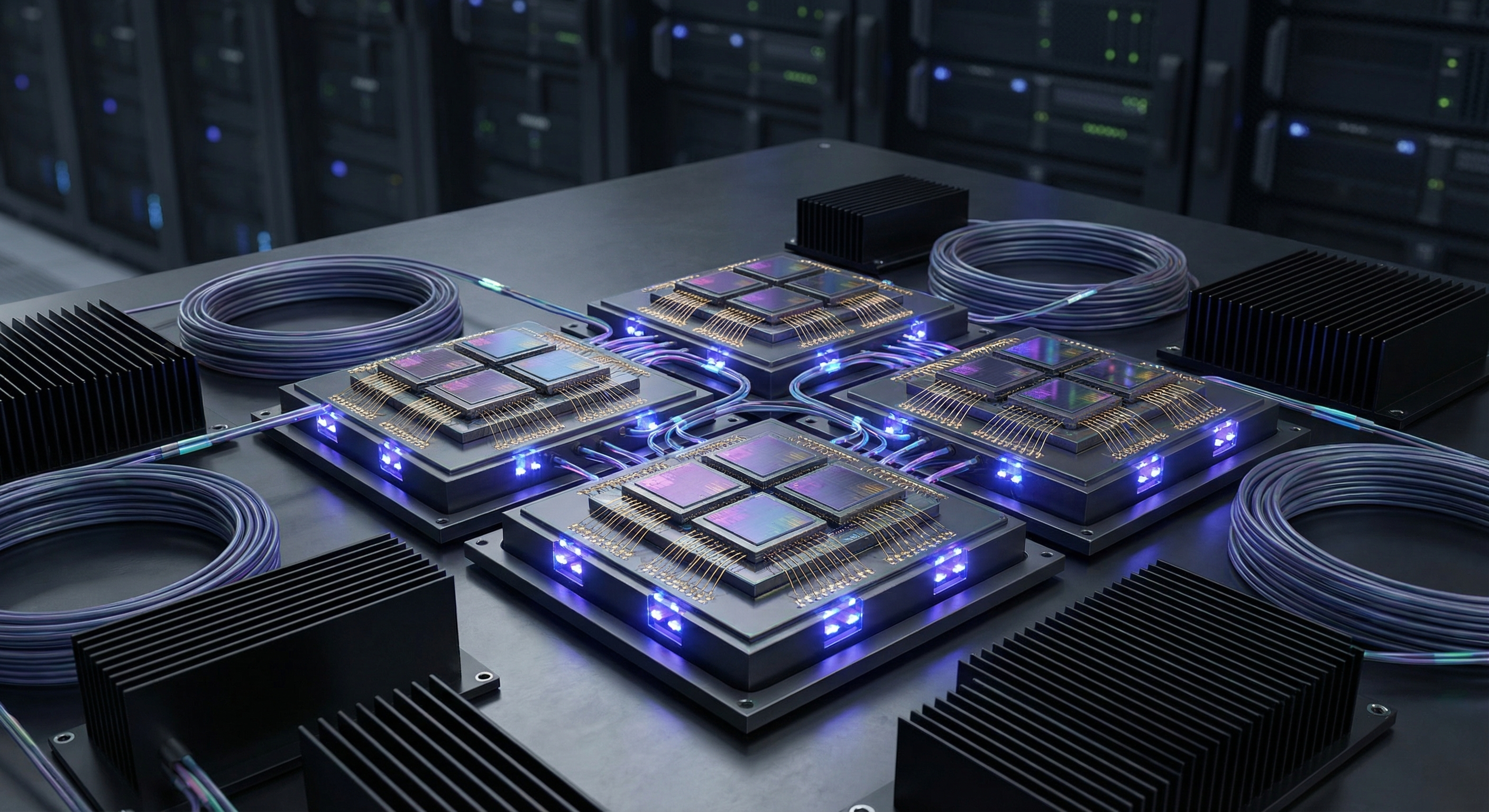
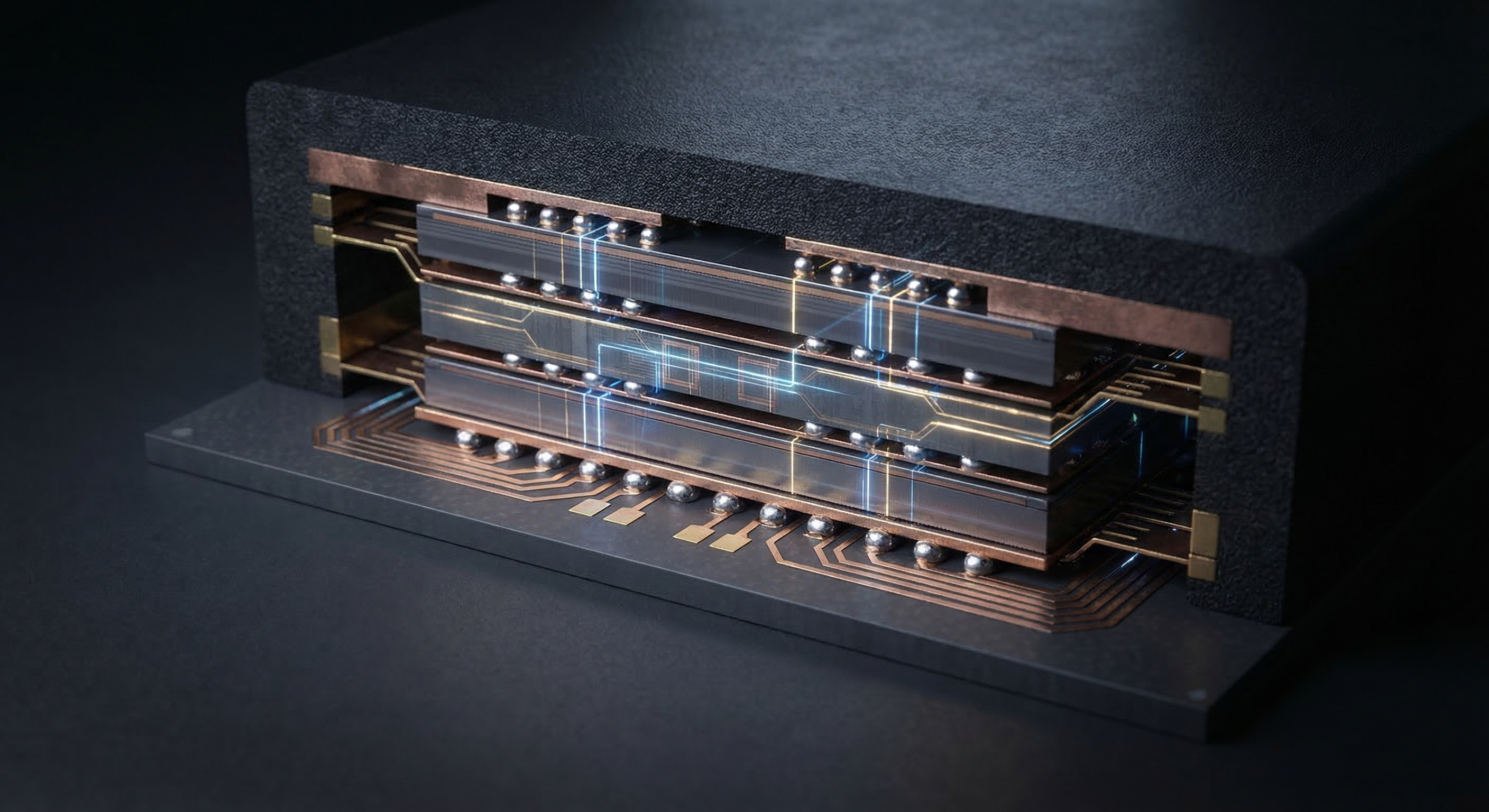
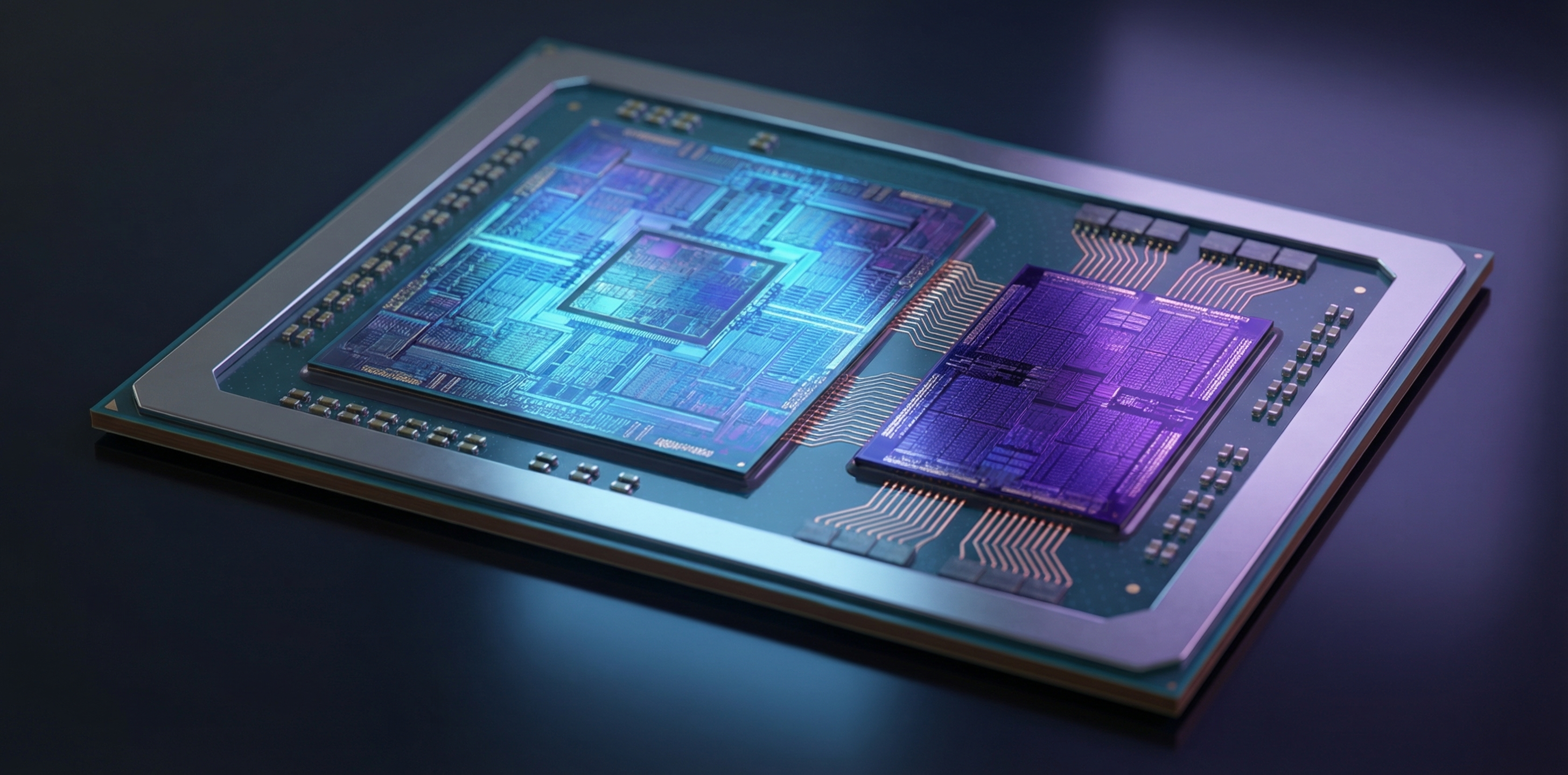
The headline architectural change in M5 Pro and M5 Max is one that Apple has kept deliberately quiet: these chips are no longer monolithic dies. According to Apple's own chip announcement, M5 Pro and M5 Max are built using a dual-die "Fusion Architecture" — the same die-bonding technique previously reserved for the M-Ultra line, now applied to Pro and Max tier chips for the first time.
In practical terms, this means the CPU complex (including the Neural Engine, I/O controllers, and Thunderbolt logic) sits on one die, while the GPU complex (including the GPU cores, memory controllers, and the new Neural Accelerators) lives on a separate die. The two dies are bonded together using Apple's UltraFusion packaging technology, with an interconnect Apple says delivers hundreds of gigabytes per second of inter-die bandwidth — effectively hiding the seam from software.
The motivation is straightforward: beyond a certain transistor count, you hit the limits of what a single die can physically yield at high quality. By splitting the chip, Apple can manufacture each half at better yields, then bond them together — scaling GPU compute and memory bandwidth further than a single die would allow. It's the same logic that made the M1 Ultra possible; now it's filtering down to the mainstream Pro and Max lineup.
The immediate consequence of this design is where the memory controller lives: on the GPU die, alongside the memory bandwidth machinery. Ars Technica's deep-dive benchmark review confirmed that the M5 Max's memory bandwidth of 614 GB/s (up from 546 GB/s on M4 Max) is largely a function of this new layout — more GPU cores, more memory channels, all co-located on the GPU die where they're needed most.
Neural Accelerators in Every Core
The more consequential AI hardware story isn't the Fusion Architecture itself — it's what Apple did with the GPU cores it gained by splitting the die. Rather than adding a centralized Neural Processing Unit block as a separate compute island (the industry-standard approach), Apple has embedded a dedicated Neural Accelerator inside each individual GPU core.
This is architecturally unusual. Qualcomm, AMD, and Intel all use centralized NPU blocks — a single accelerator tile that AI workloads queue into. Apple's approach distributes the acceleration across all 20 (M5 Pro) or 40 (M5 Max) GPU cores simultaneously. Each core can independently execute neural network operations in parallel with traditional graphics workloads, without competing for a shared NPU resource.
The practical implication for AI throughput is significant. Large language model inference — which is dominated by matrix multiplication and attention computation — maps naturally to massively parallel execution. With 40 GPU cores each containing their own Neural Accelerator, the M5 Max can process AI workloads with a degree of parallelism that a centralized NPU simply can't match at this power envelope.
Apple's numbers are striking: the company claims LLM prompt processing is 3.9× faster than M4 Pro and 6.9× faster than M1 Pro. For AI image generation, the M5 Max delivers 3.8× the speed of M4 Max and 8× the speed of M1 Max. Johny Srouji, Apple's senior vice president of Hardware Technologies, called it "the most powerful Neural Engine we've ever built, with a fundamentally new architecture that puts AI acceleration exactly where the computation happens."
That last clause — "where the computation happens" — is the key design philosophy. Moving Neural Accelerators out of the centralized Neural Engine and into each GPU core reduces latency, eliminates the memory bandwidth cost of shuffling activations to a separate compute block, and lets GPU-resident workloads (like local AI image generation or on-device video upscaling) run without context switching.
The 16-core Neural Engine is still present, now with a higher-bandwidth connection to unified memory, handling CPU-side AI inference like Siri and on-device language tasks. But the GPU-side Neural Accelerators are what enable the headline AI performance numbers.
The CPU Story: Super Cores and the Death of Efficiency Cores
M5 Pro and M5 Max both feature an 18-core CPU — a combination of 6 "super cores" (Apple's highest-performance CPU cores to date, which the company calls the world's fastest) and 12 new "performance cores." What's absent is notable: efficiency cores are gone entirely from this tier.
The decision to eliminate efficiency cores from Pro and Max chips reflects the intended use case. Professional workloads — ML training, video transcode, 3D rendering, software compilation — care about sustained peak throughput, not background-task efficiency. The 12 new performance cores replace the role that efficiency cores previously played at the mid-tier, running at lower frequencies when headroom permits, while the 6 super cores engage for demanding work.
Ars Technica's benchmarks found single-core performance roughly 10% ahead of the M4 Max, while multi-core performance ranged from 10–30% better depending on the workload (Cinebench R23 was the outlier at the high end). That's not the generational leap of M1 to M3, but for the substantial installed base of M1 and M2 Pro/Max users, the upgrade case is compelling.
All of this runs on TSMC's N3P process node — the third-generation 3nm node, which delivers improved transistor density and power efficiency over the N3E process used in M4. The combination of N3P and the Fusion Architecture is what makes the 614 GB/s memory bandwidth of the M5 Max possible without a corresponding explosion in thermal output.
The Memory Race: 614 GB/s and What It Means for AI
Memory bandwidth is the unglamorous constraint that determines how fast an AI model can actually run. GPUs are fast; feeding them data fast enough is the hard part. This is why NVIDIA's Blackwell architecture, the Vera Rubin HBM4 memory arms race, and data center interconnect battles all trace back to the same root problem: AI compute is memory-bound.
Apple's unified memory architecture has always been its answer to this problem at the laptop scale. Instead of discrete VRAM (which the GPU can access fast) and system DRAM (which the CPU accesses more slowly), the M-series chips share a single high-bandwidth memory pool accessible by both at full speed. The M5 Max's 614 GB/s — achievable with configurations up to 128 GB of LPDDR5X — means a 70-billion-parameter model can fit entirely in memory and run inference without paging.
To put that in context: NVIDIA's H100 SXM has 3.35 TB/s of HBM3 bandwidth and 80 GB of VRAM, at roughly 700W. The M5 Max delivers 614 GB/s within a 40W thermal envelope and up to 128 GB of addressable memory. The bandwidth-to-power ratio is in a different class — and for inference workloads (rather than training), memory capacity often matters more than raw flops.
M5 Pro configurations reach 307 GB/s with up to 64 GB of memory, while the baseline M5 provides 153 GB/s with up to 32 GB. The memory configs — 24, 48, 64, and 128 GB on M5 Max — are designed to accommodate model weights ranging from small fine-tuned 7B models to full 70B deployments without quantization sacrifice.
What This Means for Edge AI
The practical consequence of M5 Max's architecture is that serious LLM inference is now genuinely portable. Running a Llama 3 70B model locally, with full precision, at usable token speeds, on a laptop — that was a data center proposition two years ago. It's now a MacBook Pro 16-inch proposition.
For enterprises, the implications are meaningful. On-device AI inference eliminates round-trip latency to cloud APIs, removes the data privacy exposure of sending queries to third-party servers, and cuts inference cost to zero per query (beyond the amortized hardware cost). For legal, healthcare, financial, and government organizations with strict data residency requirements, this matters immediately.
For developers, the M5 Max enables a workflow that wasn't viable before: iterating on model fine-tuning locally, running evals against small test sets, and only moving to cloud GPUs for full training runs. Apple's MLX framework, optimized for Apple Silicon's unified memory model, is mature enough to support this workflow end-to-end. With M5 Max, the local inference step is fast enough to be genuinely practical rather than a proof-of-concept curiosity.
The numbers back this up. Apple's own testing clocks LLM prompt processing at 3.9× the speed of M4 Pro — not for a specialized benchmark, but for real model inference. At 6.9× the speed of M1 Pro, the gap between "previous generation developer machine" and "current state of the art" is large enough to reshape daily developer workflow.
The Bigger Picture: Apple's Bet on the Edge
Every major AI hardware announcement this year has pointed toward the same destination: compute moving closer to the data. NVIDIA's gigawatt-scale Vera Rubin deals are building the central compute layer. Apple's M5 architecture is building the edge layer — a serious inference node that fits in a backpack.
These aren't competing visions; they're complementary. The centralized compute infrastructure will handle model training, large-scale fine-tuning, and the inference workloads that require fleet-scale deployment. The edge — MacBooks, enterprise workstations, eventually iPhones with M-class descendants — handles latency-sensitive inference, private data workloads, and the long tail of queries that don't need a data center.
What makes M5 Pro and M5 Max notable in this landscape isn't that they're the fastest consumer chips on the market. It's that they represent a coherent architectural philosophy: AI acceleration is not a bolt-on feature, it's a first-class design constraint at every level of the chip. Neural Accelerators in every GPU core. Unified memory architecture that treats model weights as first-class citizens. Memory bandwidth scaled to serve inference at 128 GB of capacity.
The Fusion Architecture is the enabler that makes all of this possible at Pro and Max scale. And if the pattern holds — Ultra joins Pro and Max with a unified design in the next generation — the M5 Ultra will likely push this to 80 GPU cores, 1.2 TB/s of memory bandwidth, and 256 GB of unified memory. That's Mac Pro territory that starts competing with entry-level data center accelerators on inference performance per watt.
Apple has never been a company that chases FLOP counts. It builds systems — and the M5 generation is the clearest expression yet of what an AI-first silicon system looks like when designed from the memory bus up.