In January 2026, 52 of the U.S. Navy's roughly 290 battle-force ships sat in maintenance depots — unable to sail, unable to fight. The year before, only 41 percent of those ships completed repairs on time, against a 71-percent goal. That gap is not an accounting problem. It is a national security problem. Now the Navy is betting a Pittsburgh startup's wall-climbing robots can close it.
On March 17, the U.S. Navy and the General Services Administration awarded Gecko Robotics a five-year indefinite-delivery, indefinite-quantity contract with a ceiling of $71 million to deploy its AI-powered inspection robots across the service's surface fleet. The initial task order — worth up to $54 million over the contract period — focuses on 18 ships in the U.S. Pacific Fleet, covering destroyers, amphibious warships, and littoral combat ships. Crucially, the contract is structured as a government-wide vehicle through the GSA: every branch of the Department of Defense can now draw on it.
"Readiness isn't just a metric, it's all that matters," said Jake Loosararian, Gecko's co-founder and CEO, at the announcement. "This growing partnership is about unfair advantages Gecko is deploying to our Navy — and how prediction, through our robotics and AI products, ensures our brave men and women are the most advantaged in the world."
What Gecko's Robots Actually Do
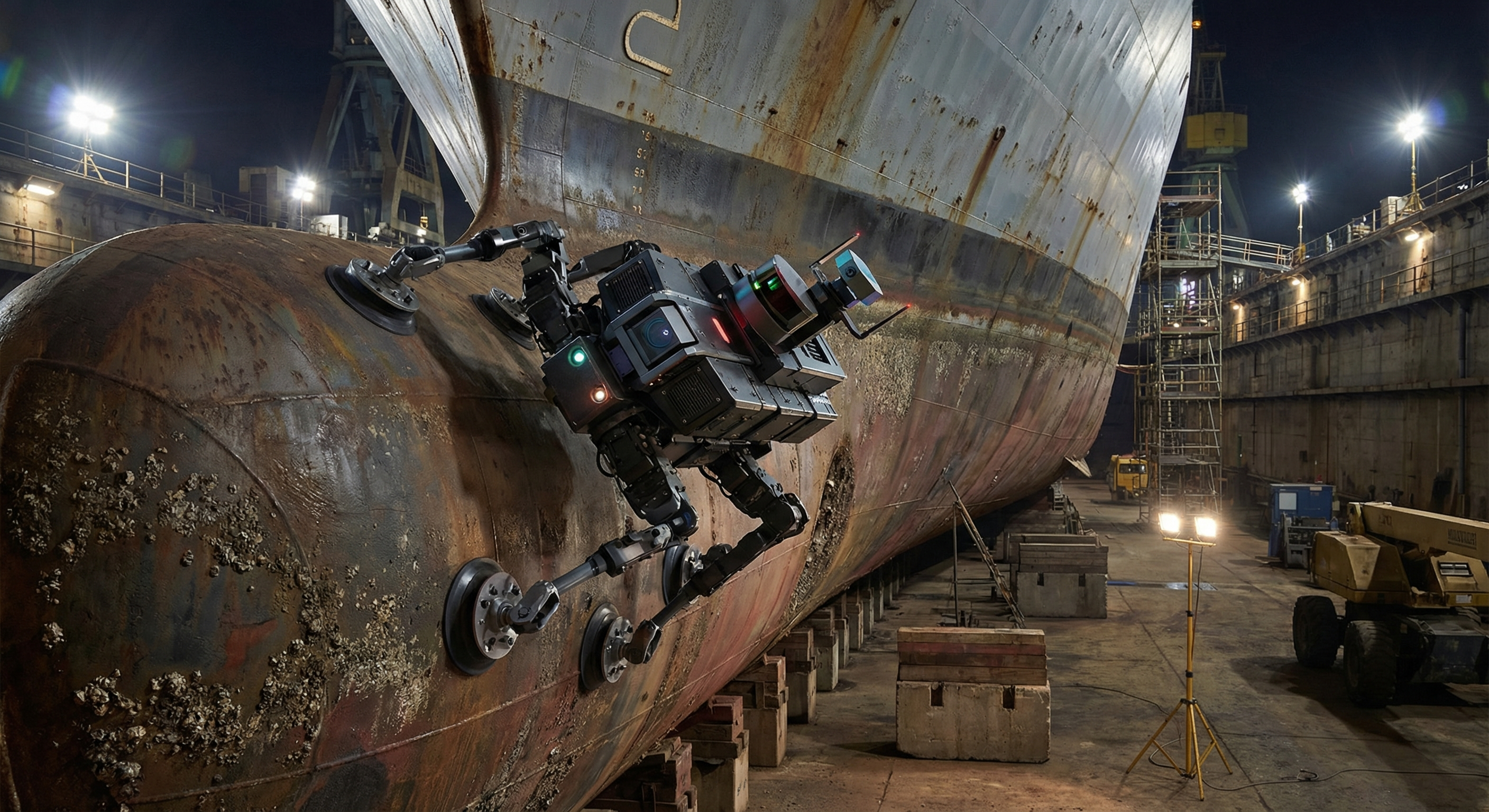
Gecko Robotics was founded in Pittsburgh in 2013, originally to solve a very different problem: inspecting the aging steel walls of industrial power plants. The company built robots that could crawl across vertical and inverted surfaces using powerful magnetic and vacuum adhesion — scanning for corrosion, cracks, and thinning steel that human inspectors might miss or simply couldn't reach safely.
That capability translates directly to naval warfare. Gecko's wall-climbing robots, drones, and fixed sensors can assess ship hulls, decks, welds, joints, and structural connections with a level of thoroughness that has no manual equivalent. The company's AI software builds digital models of each vessel in real time — predicting not just what is failing now, but what will fail next, and in what sequence.
The speed advantage is the headline number: Gecko says its systems identify repairs up to 50 times faster and more accurately than conventional human inspection methods. That is not a marginal improvement. In the context of naval maintenance — where a single delayed repair creates a cascading backlog across shipyard scheduling, parts procurement, and crew availability — 50x is transformational. The company provided one concrete data point: a single robotic evaluation and digital rendering of a flight deck eliminated over three months of potential maintenance delay days.
Equally important is when Gecko deploys. The company doesn't just inspect ships in drydock. It sends robots ahead of a vessel's arrival — conducting full structural assessments while a ship is still at sea — so that the right personnel, parts, and repair plans are waiting when it docks. That change alone collapses the administrative delay that accounts for a substantial fraction of maintenance cycle overruns.
The Navy's Maintenance Crisis, by the Numbers
The severity of the problem Gecko is being hired to solve cannot be overstated. At any given moment, the Navy has dozens of battle-force ships unavailable for deployment due to repair delays. In January, NAVSEA commander Adm. Jim Downey reported 52 ships in maintenance — a number that has been stubbornly high for years.
In 2025, the service hit only 41 percent of on-time completions against a 71-percent goal. Downey reset the target for 2026 to "north of 60 percent," framing it as a realistic recovery rather than an aspirational reach. The Chief of Naval Operations has set a longer-term target of 80 percent fleet readiness by 2027 — a level the Navy hasn't achieved in recent memory.
The consequences of falling short extend well beyond budget overruns. In a 2024 congressional hearing, Rep. Ken Calvert observed that the maintenance backlog was causing "significant impacts to global operations." Analysts studying a potential conflict with China have been blunter: a U.S. Navy unable to surge its Pacific Fleet within weeks — not months — faces a strategic disadvantage that no weapon system can offset.
The Navy already has a proof point. Gecko has been working with the service since at least 2025, with efforts spanning destroyers, amphibious ships, aircraft carriers, and both Virginia and Columbia-class nuclear submarine programs. The new contract formalizes and dramatically scales that relationship.
The AI Architecture Behind the Robots
Gecko's technology is best understood as a data acquisition and predictive intelligence system that happens to move on walls. The robots themselves — crawling, climbing, flying, and diving variants — are sensors on legs. Their output is point clouds, thermal readings, acoustic signatures, and high-resolution imagery, all ingested by an AI platform that builds a continuously updated digital twin of each inspected asset.
The predictive maintenance layer is what separates Gecko from a smarter inspection flashlight. By training on fleet-wide structural data across thousands of assets in energy, oil and gas, and manufacturing sectors — in addition to Navy ships — the system can flag failure risks that aren't yet visible to the human eye, identify which welds will need replacement within a maintenance cycle, and generate prioritized repair work orders before a ship ever enters drydock.
"We're leveraging autonomy and AI to deploy technologies prior to a ship or a submarine coming into a dry dock facility so that we have an understanding of, 'What's the material health of this asset?'" Gecko president Troy Demmer explained at the Defense One Tech Summit last June. "How do we make targeted, efficient repairs so that we can get that asset back in the fight?"
Navy CTO Justin Fanelli has praised Gecko's model for moving the needle "not by percentage points, but by orders of magnitude" — contrasting it with incremental technology adoption programs that have historically underdelivered on the efficiency gains they promised. The government-wide contracting vehicle structure is itself an acknowledgment that this is no longer a pilot program: the Navy wants every service to have access to this capability without re-running its own procurement cycles.
Broader Strategic Implications
The Gecko contract fits neatly into a larger pattern of the U.S. military attempting to solve chronic readiness problems through commercial robotics and AI — rather than waiting for defense-native solutions that may arrive later and cost more.
That pattern has been accelerating. In the past several months, the Navy stood up a new Portfolio Acquisition Executive specifically for Robotics and Autonomous Systems, consolidating $19 billion in autonomous programs under a single command. The Army signed a $20 billion enterprise AI contract with Anduril. The Air Force flew its first autonomous loyal wingman with a swappable AI stack. The Pentagon confirmed AI is embedded in active kill chains.
But there's a dimension of the Gecko deal that distinguishes it from those headline-grabbing combat programs: it targets the part of military readiness that doesn't make the news. Combat AI systems matter only if the platforms that carry them are operational. A destroyer stuck in drydock because no one spotted a corroding weld three months ago contributes nothing to Pacific deterrence, regardless of what software it runs.
Gecko is also threading a needle that many defense technology companies struggle with. Its platform was built for commercial infrastructure — power plants, pipelines, refineries — and the dual-use nature of that background makes it both more battle-tested and less tied to defense budget cycles. Senator Dave McCormick, citing the company's Pennsylvania roots, put it in generational terms: "The partnership between Gecko Robotics and the U.S. Navy shows how engineers, researchers, and skilled tradesmen from a great Pennsylvania company are leading advances in technology, artificial intelligence, autonomous systems, and robotics — and giving our military the capabilities it needs for the next generation of American defense."
What Comes Next
The initial 18-ship Pacific Fleet deployment will be the proving ground. If Gecko's on-time maintenance completion rates hold at scale — and if the predictive maintenance models translate from aircraft carriers to destroyers without significant degradation — the GSA vehicle structure means the Air Force, Army, and Marine Corps can begin drawing on Gecko's inspection robots for their own assets without fresh contracting cycles. The company has already worked on jets and ground equipment, not just ships.
Loosararian and Demmer have also signaled that the vision extends upstream of maintenance entirely. Gecko is deploying robotics "in the supply chains, way upstream of the shipyards" — inspecting forgings and castings before they even arrive at a construction facility. If quality data from the manufacturing line feeds the same AI models that track a ship's in-service structural health, the Navy could theoretically compress years of ship construction delays the same way it is now compressing maintenance delays.
The 80 percent readiness target for 2027 is ambitious. The gap between 41 percent on-time completions and 80 percent fleet readiness is not one contract's work to close. But for the first time in years, the Navy has a technology pathway to that goal that's grounded in demonstrated performance — and it doesn't require a human to dangle from a ship's hull to get there.