The U.S. Navy has a math problem. Building a single Virginia-class attack submarine takes 13 million labor hours. A Columbia-class ballistic missile boat takes 34 million. Buying two attack submarines and one missile boat per year — the Navy's stated strategic goal — requires generating roughly 70 million hours of skilled manufacturing work annually. The problem: those workers don't exist, and years of effort to grow the shipyard workforce haven't closed the gap fast enough. Last week, the Navy placed a $900 million bet that a four-year-old startup called Hadrian has found a different answer: automate the factories themselves.
A Ribbon-Cutting in Alabama
On March 20, 2026, Navy Secretary John Phelan stood at a ribbon-cutting ceremony in Cherokee, Alabama — near Muscle Shoals — and described something unusual in the world of defense procurement. "This is not just another factory," Phelan told attendees. "This is a different model. Hadrian does not just machine parts. They build integrated production systems: raw material in, test-ready hardware out. A single system doing what used to require dozens of suppliers."
The facility, dubbed Factory 4, sits on 46 acres and is designed to eventually employ up to 1,000 workers producing components and systems for Columbia- and Virginia-class submarines — with plans to expand to other maritime programs. The $900 million contract, funded through last year's reconciliation bill, covers "non-recurring engineering across three facilities" — meaning Factory 4 is just the opening chapter of a larger plan. Hadrian's full vision is a $2.4 billion buildout spanning three factories: one for precision machining, and two more focused on castings, forgings, and other critical materials.
The contract is the most significant single award to a manufacturing startup in the submarine industrial base's recent history — and a signal that the Navy is ready to try something structurally different after years of watching its production targets slip.
The Depth of the Workforce Crisis
The numbers behind the Navy's submarine shortage are stark. Vice Admiral Robert Gaucher, recently confirmed as the Navy's first dedicated "submarine-production czar," laid out the challenge bluntly at the McAleese defense programs conference in March: "We are not at our required construction cadence, and that's the challenge ahead of me."
The three-lever framework Gaucher described — growing the workforce, increasing productivity, and improving parts delivery timing — has been the Navy's playbook for years. Since 2018, the service has poured roughly $9.8 billion into the submarine industrial base, including facility upgrades and workforce expansion at private suppliers. Hiring has improved at major shipbuilders, wages have risen, and the Congressional Research Service has tracked cautious productivity gains. But the fundamental constraint hasn't broken: there simply aren't enough trained people.
"The number-one problem that the Navy's identified is we can't find enough skilled workers, so we have to automate our way out of this problem," Hadrian CEO Chris Power told reporters at the Factory 4 opening. That framing — automation not as cost-cutting but as the only viable path to scale — is the thesis behind everything Hadrian has built.
What Makes Hadrian Different
American shipyards and their supplier networks already use robotics and automation in various applications. The difference with Hadrian's approach is architectural. Rather than bolting automation onto existing manual processes, Hadrian designs its factories from the ground up around automated production systems — with human workers configured to supervise and maintain those systems rather than perform the underlying manufacturing tasks themselves.
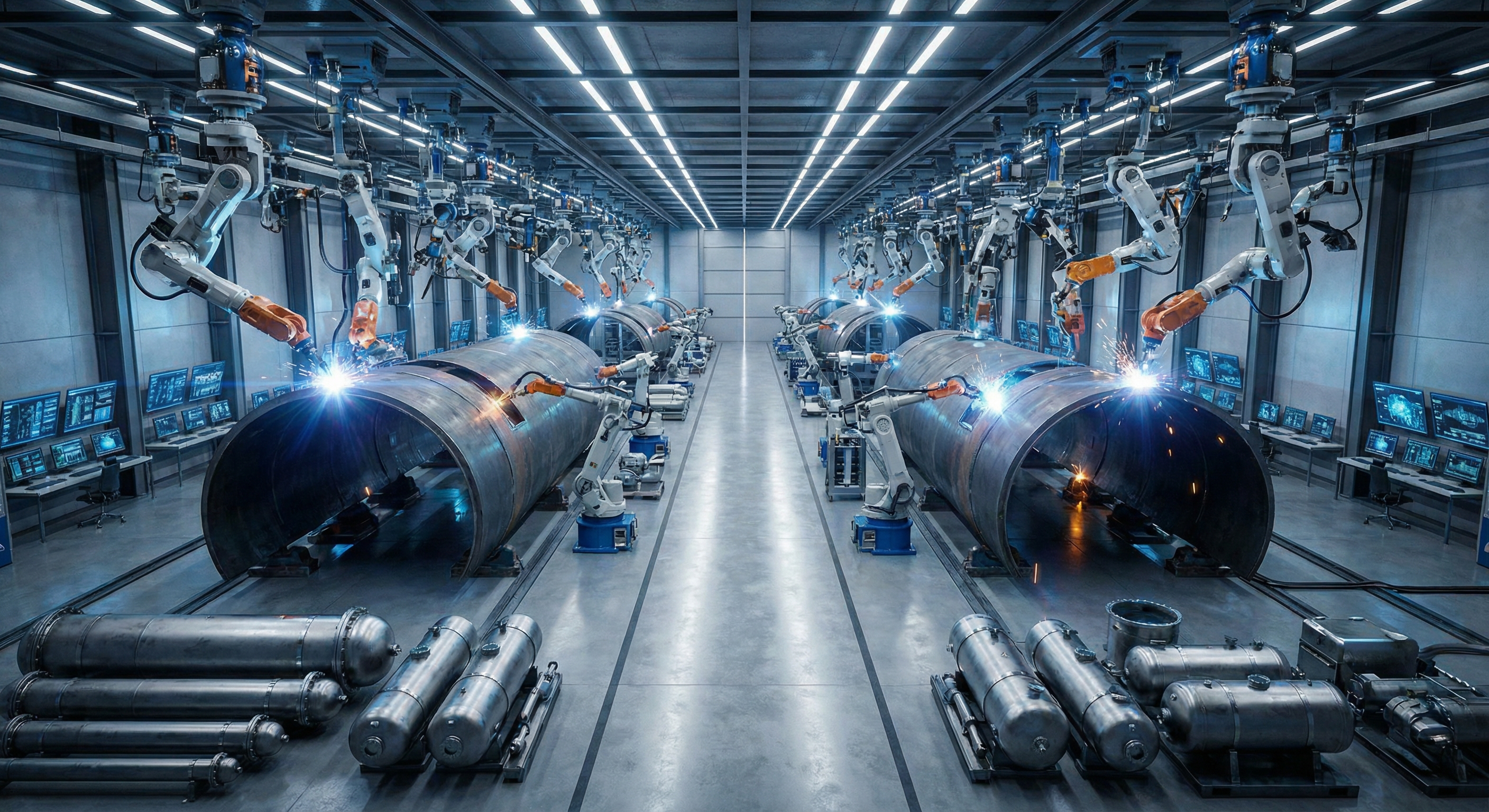
The factory will deploy robotics and automation across welding, machining, fabrication, assembly, inspection, and testing. Hadrian's stated goal is to automate 80 percent of the work in the facility. The remaining 20 percent — the work that still requires humans — is designed to be trainable in as little as 30 days, a dramatic compression from the years of apprenticeship typically required to produce skilled submarine component manufacturers.
Power describes the model as one that enables factories to absorb unexpected orders without the painful hire-and-fire cycles that plague traditional defense suppliers: "You need these factories hot and ready to go, and you can't necessarily plan everything. Opus enables us to have that capacity idle in capital equipment and robotics, and not have to say, hire or fire people."
Opus: The AI Brain Running Factory 4
Underpinning Factory 4 is Hadrian's proprietary software platform, Opus — which the company describes as "the full stack, AI-powered platform for Factory Autonomy." Opus handles production planning, machine coordination, supply chain management, and quality control across the facility, creating what amounts to a single software-defined production system that replaces the fragmented network of vendors and subcontractors that would otherwise supply submarine parts.
Running an AI-powered production system for submarine components isn't straightforward. The Navy's SUBSAFE program — the rigorous certification regime created after the USS Thresher sank in 1963 — imposes some of the most exacting quality and traceability requirements in American manufacturing. Power confirmed that Opus will be specifically tuned to meet SUBSAFE standards, which include comprehensive documentation of materials, processes, and inspections for every component that touches a submarine's hull or pressure boundary.
That integration between AI-driven production and SUBSAFE compliance is arguably the most technically challenging aspect of what Hadrian is attempting. The Navy has not historically allowed automated systems to be primary decision-makers in SUBSAFE-critical processes. Factory 4's success will depend on demonstrating that AI-coordinated production can meet — or exceed — the traceability and reliability standards that human-centric processes have maintained for decades.
The Golden Fleet Context
The Hadrian contract doesn't exist in isolation. It's one piece of a broader push to rebuild American naval industrial capacity that has gathered speed under the Trump administration's "Golden Fleet" agenda — a plan calling for a larger Navy complete with a new frigate class and a revived battleship concept.
Over the past year, the Navy has been reshaping its industrial partnerships and procurement approach. It cancelled the troubled Constellation-class frigate program and redirected resources. It struck a deal with Palantir to apply AI to shipyard scheduling and supply-chain management. And Secretary Phelan has been aggressive in pursuing non-traditional defense manufacturers — Hadrian's contract follows the pattern of Gecko Robotics' recent $71M contract for AI-powered ship inspection and the Navy's broader restructuring of its autonomous systems procurement under a new Portfolio Acquisition Executive framework.
The common thread is technology-forward approaches to problems that traditional procurement channels haven't solved. In each case, the Navy is turning to companies that design around automation and AI from the start — not as features added to legacy processes but as the fundamental operational model.
Production Timeline and What to Watch
Factory 4 is expected to reach full production capacity within two years, with initial materials deliveries planned in the next 12 months. Hadrian has not yet announced the locations or detailed specifications for the other two facilities in its $2.4 billion plan — those announcements are expected in the coming months.
The metrics that will matter: whether Factory 4 achieves its 80% automation target, whether SUBSAFE certification proceeds without significant delays, and whether the 30-day worker training model actually produces qualified operators at scale. If all three track, it becomes a template that could be replicated far beyond submarine components — into surface ships, aircraft components, and other defense manufacturing domains where workforce constraints have become a strategic vulnerability.
The Navy's submarine crisis has been building for years. A workforce shortage that took decades to develop won't be solved by a single factory in Alabama, no matter how sophisticated its robotics stack. But the Hadrian contract represents a meaningful departure from the approach that hasn't been working — a $900 million wager that the right answer to a people shortage is to need fewer people, and to make the ones you have dramatically more productive through automation. Whether Factory 4 delivers on that promise will be one of the more consequential technology bets in the defense industrial base over the next two years.