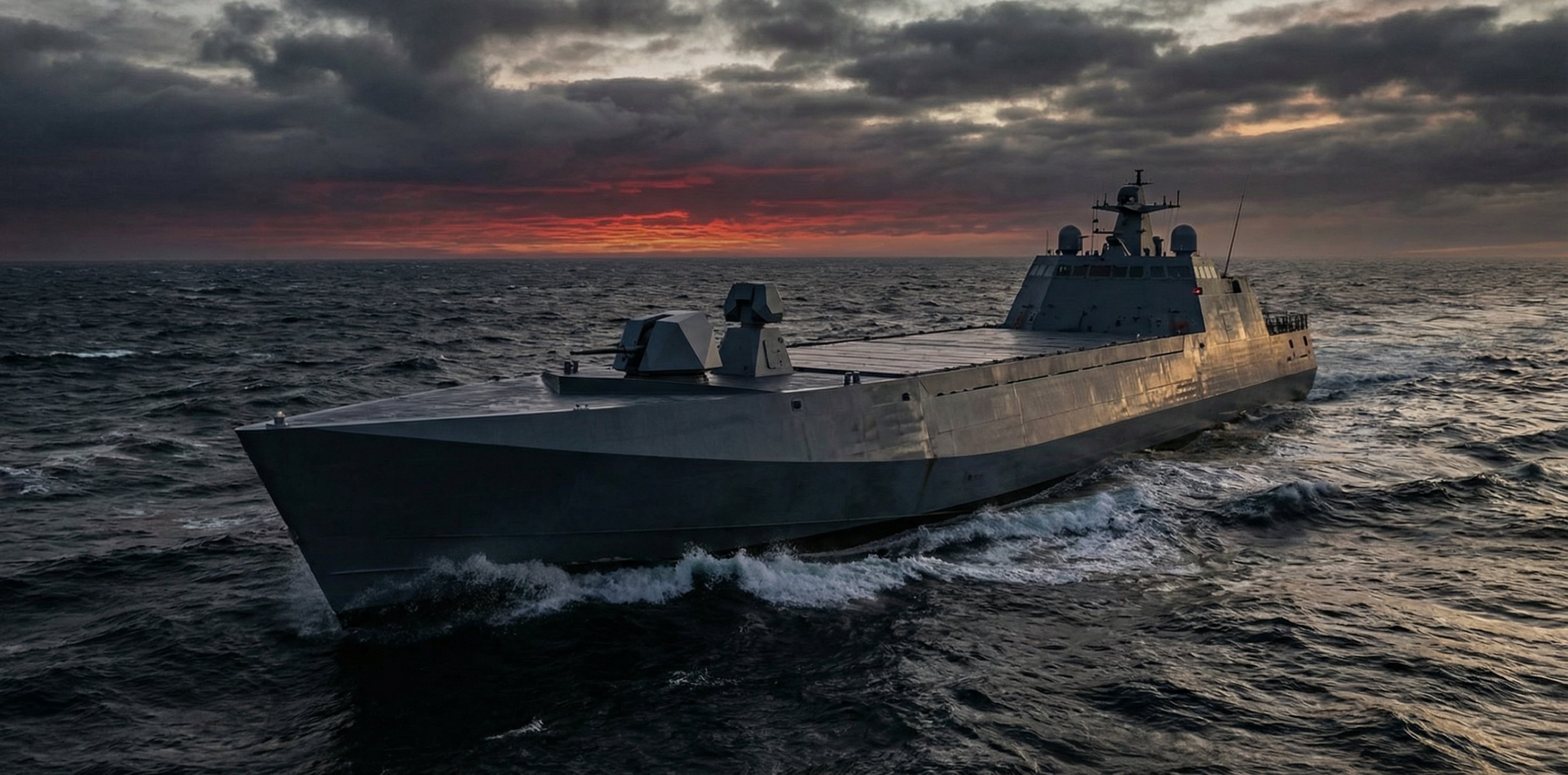
The U.S. military is designing out one of warfare's most ancient vulnerabilities: the supply ship that can be captured. A Defense Innovation Unit solicitation published March 2, 2026, calls for small, expendable autonomous cargo vessels capable of hauling military supplies through contested littoral waters — and remotely sinking themselves if capture becomes imminent. The proposal deadline is March 16, and the Pentagon wants deliverable prototypes within 180 days of contract award.
The specification reads like a fever dream born from the intersection of Silicon Valley logistics engineering and Pacific theater war-gaming: a low-profile robotic freighter that fits on a commercial tractor-trailer, navigates GPS-denied ocean corridors up to 2,000 miles, and vanishes beneath the waves on command.
The Logistics Problem Driving This
The DIU solicitation states the challenge plainly: the Department of Defense "faces a littoral contested logistics challenge." Distributed operations in austere, contested coastal environments face "all-domain threats targeting logistics capabilities, locations, and activities." The implication — though the document doesn't name China — is obvious to anyone tracking Pacific force posture.
Modern anti-access/area-denial (A2/AD) weapons systems, including long-range precision missiles, hypersonic glide vehicles, and sea-denial mine networks, have made traditional maritime logistics extraordinarily dangerous in high-intensity conflict scenarios. Moving supplies by large crewed vessels to distributed island outposts in the Western Pacific — the core operational challenge of any Taiwan contingency or South China Sea conflict — could mean putting thousands of sailors at risk on ships that paint enormous radar targets.
The autonomous cargo vessel concept is an answer to that dilemma. Send robots. Let them absorb the risk. If they're intercepted, sink them.
What DIU Actually Wants: The Technical Specs
The solicitation is detailed enough to reveal the Pentagon's design philosophy. Key requirements include:
- Cargo capacity: Minimum 9-ton payload. Must carry six 3,000-pound Joint Modular Intermodal Containers (JMICs) or two 5,100-pound containers. Standard warehouse pallets and PALCONs are explicitly listed.
- Speed: Minimum 12 knots fully laden in NATO sea state 4 conditions. Slower than commercial vessels by design — the Pentagon is prioritizing range and survivability over speed.
- Range: 1,000 to 2,000 nautical miles under full load, in sea state 5 conditions (waves up to 13 feet).
- Form factor: Low-profile hull to minimize radar cross-section. Must fit on a commercial tractor-trailer for strategic airlift or road transport.
- Delivery timeline: Prototypes within 180 days of contract award — an aggressive timeline that signals this is urgent operational need, not a long-horizon R&D program.
The navigation requirements are where the specification gets genuinely sophisticated. Ships must operate with GPS and active sensors under normal conditions, but shift to "passive sensing during emissions control (EMCON) conditions or when communications are lost." Emissions control — running dark to avoid radar and signals detection — is a standard naval tactic. Requiring autonomous vessels to operate silently without GPS is a substantially harder engineering problem.
The GPS-Denied Navigation Challenge
The solicitation's most technically demanding requirement may be this one: "Companies will be expected to demonstrate assured Position, Navigation and Timing in DDIL [denied, degraded, intermittent, and limited communications] and GPS-degraded and denied environments."
This is not a minor footnote. GPS jamming and spoofing have become standard adversary tactics. Russia has demonstrated large-scale GPS degradation over the Baltic and Black Seas. China's electronic warfare capabilities in the Western Pacific theater are considered highly capable of GPS disruption across hundreds of miles of contested ocean.
A cargo vessel that loses GPS and then also loses communication — because it's in EMCON or jammed — must still navigate to its destination, avoid collisions, and execute the mission. That requires inertial navigation systems, star-tracker or celestial navigation backups, acoustic positioning, terrain-following sonar, or some combination thereof. The vessel must also be able to "receive reprogramming for new destinations while at sea" — meaning the navigation system can't be purely pre-programmed. It needs real-time route modification capability even under degraded conditions.
Several defense startups are already working in this space. Blue Water Autonomy's "Liberty" — an autonomous naval vessel built on a Damen patrol boat hull with a distinctive vertical bow for rough-sea performance — was unveiled in February 2026. Shield AI, Saildrone, and L3Harris Technologies all have autonomous maritime programs that could respond to this solicitation.
The Self-Scuttle Requirement: More Than a Footnote
Buried in the solicitation's security requirements is a specification that would be extraordinary in any commercial maritime context: vessels must be "resistant to tampering while underway with the ability to remotely scuttle the vessel."
Scuttling — deliberately sinking a vessel — has been used throughout naval history to prevent strategic assets from falling into enemy hands. The German High Seas Fleet at Scapa Flow in 1919. The French fleet at Toulon in 1942. What's new is building the capability into an autonomous system from the outset, with remote triggering.
The requirement signals the Pentagon's acceptance that some of these vessels will be lost in contested operations, and that the intelligence value of their cargo, navigation systems, and autonomous control software must not fall into adversary hands. A captured autonomous vessel — particularly one running sophisticated GPS-denied navigation or encrypted communication protocols — could yield significant intelligence.
The self-scuttle requirement also has a secondary effect: it makes these vessels inherently expendable in the accounting sense. If the platform is designed to be sunk when necessary, procurement decisions can optimize for cost and rapid production rather than survivability. That aligns with the broader Pentagon trend of preferring large numbers of cheap autonomous systems over small numbers of expensive crewed platforms.
Strategic Context: The Pacific Logistics Gap
The timing of this solicitation is not coincidental. Pentagon spending plans have doubled down on autonomous systems across all domains, allocating billions toward air, land, and sea robots in the fiscal year 2026 budget. The FY 2026 National Defense Authorization Act authorized tens of billions to rebuild munitions stockpiles and directed the Army to expand robotic automation in manufacturing — a policy environment that makes the autonomous logistics push all but inevitable.
The core problem DIU is trying to solve with autonomous cargo ships is what defense analysts call the "tyranny of distance" in the Pacific. American forward bases in Guam, the Philippines, Japan, and potential conflict zones in the Taiwan Strait are separated by thousands of miles of ocean. Keeping those positions supplied during a high-intensity conflict means running logistics convoys through seas potentially controlled by adversary submarines, surface ships, and anti-ship missile systems.
Autonomous vessels change that calculus. They don't require crew extraction if the mission fails. They can run at night, in emissions-controlled mode, using minimal radar signatures. Multiple vessels can be dispatched simultaneously to present a distributed targeting problem for adversary systems. If one is sunk or self-scuttles, the material loss is acceptable — the crew loss is zero.
U.S. sea drones are also being positioned explicitly to narrow China's growing naval numerical advantage. The PLAN (People's Liberation Army Navy) has more surface combatants than the U.S. Navy by hull count. Autonomous systems don't close that gap in firepower terms, but they dramatically complicate adversary decision-making and extend the effective logistics reach of U.S. forces without commensurate risk to personnel.
Industry Response and Timeline
The March 16 proposal deadline gives industry less than two weeks to respond — another indicator that this is an accelerated acquisition program, not a standard deliberate procurement cycle. The 180-day prototype delivery requirement further compresses timelines. Companies responding will almost certainly need existing technology platforms they can adapt rather than clean-sheet designs.
The commercial autonomous maritime sector has grown substantially over the past three years. Norwegian firms like Kongsberg and Vard have deployed autonomous cargo vessels on coastal shipping routes. Saildrone operates large unmanned surface vehicles for ocean data collection and Coast Guard surveillance missions. Textron Systems' Common Unmanned Surface Vehicle (CUSV) has been deployed with the Navy for mine countermeasure missions. Any of these companies, or startups building on similar platforms, could theoretically respond within the timeline.
What's unusual is the expendability requirement. Commercial autonomous vessels are engineered for longevity and safety certification. A vessel designed to be cheap enough to lose and equipped with a self-destruct mechanism is a fundamentally different design philosophy — one that commercial maritime has no parallel for. The responding companies will likely be defense-focused firms or commercial players with existing military relationships.
The Broader Autonomous Logistics Picture
The DIU autonomous cargo ship solicitation is one piece of a larger Pentagon autonomous logistics architecture taking shape in 2026. The Army is building autonomous ground vehicles for forward logistics. The Air Force is developing autonomous cargo drone programs. The Navy has been expanding its unmanned surface and underwater vehicle programs aggressively.
The common thread: remove humans from the most dangerous parts of the logistics chain. Artillery shells can be moved by autonomous ground vehicles. Forward resupply drops can be done by autonomous air vehicles. Coastal logistics can be done by autonomous surface vessels. The result is a military logistics system that becomes substantially more resilient precisely because it doesn't require crew protection as a design constraint.
This isn't just about saving lives in a future conflict — though that's the headline justification. It's about fundamentally changing the risk calculus of forward operations. If the cost of a logistics failure is platform loss rather than crew loss, commanders can accept more operational risk. That translates directly into more aggressive positioning, faster operational tempo, and the ability to sustain distributed forces in environments that would previously be considered too dangerous to supply.
What Comes Next
If DIU awards a contract in April following the March 16 proposal deadline, prototypes would be due by October 2026. That timeline aligns with the Pentagon's stated goal of having autonomous maritime logistics capability operational before any potential Pacific contingency in the 2027-2028 window — a timeframe that multiple defense analysts have flagged as the period of maximum risk in cross-strait tensions.
The specification's requirement for multiple transit modes — pier-to-pier, ship-to-ship, and ship-to-shore — suggests these vessels are designed to plug into existing naval logistics chains rather than replace them entirely. They're force multipliers for Military Sealift Command operations, not substitutes for human-crewed logistics vessels in permissive environments.
Whether the technology meets the timeline is an open question. GPS-denied autonomous navigation in 13-foot seas, with remote scuttle capability and tamper-resistance, while fitting on a tractor-trailer, is a demanding specification. But the Pentagon's track record with DIU-accelerated programs — including autonomous drone procurement and the Army's robots-first combat strategy — suggests that when urgency meets funding, the defense industrial base can move faster than conventional procurement timelines suggest.
For adversaries trying to plan around U.S. logistics vulnerabilities, the message is clear: the Pentagon is engineering around the chokepoints that anti-access strategy depends on. Robot ships that can self-destruct are, among other things, a direct counter to the strategy of threatening supply lines to deny U.S. power projection.