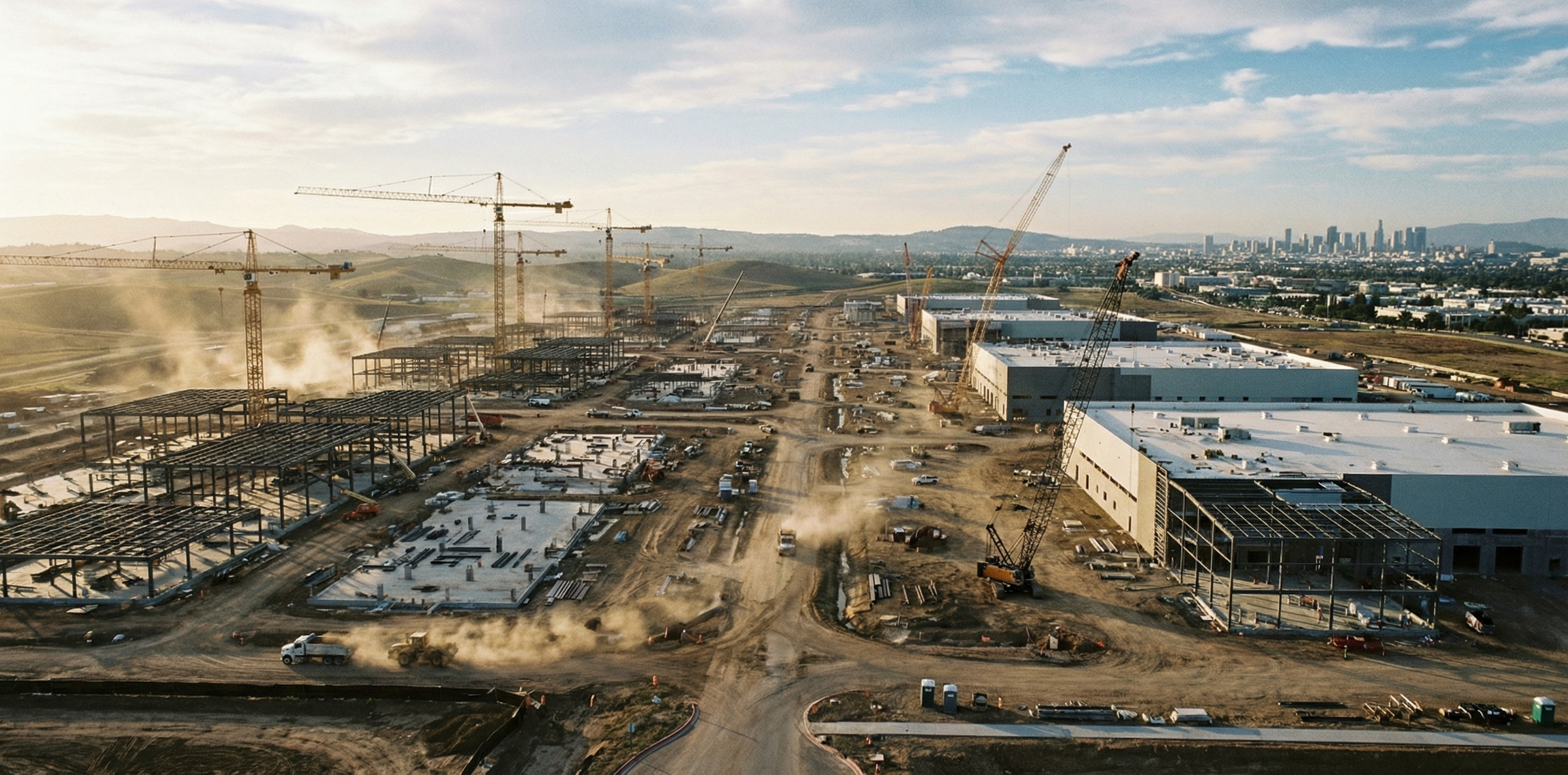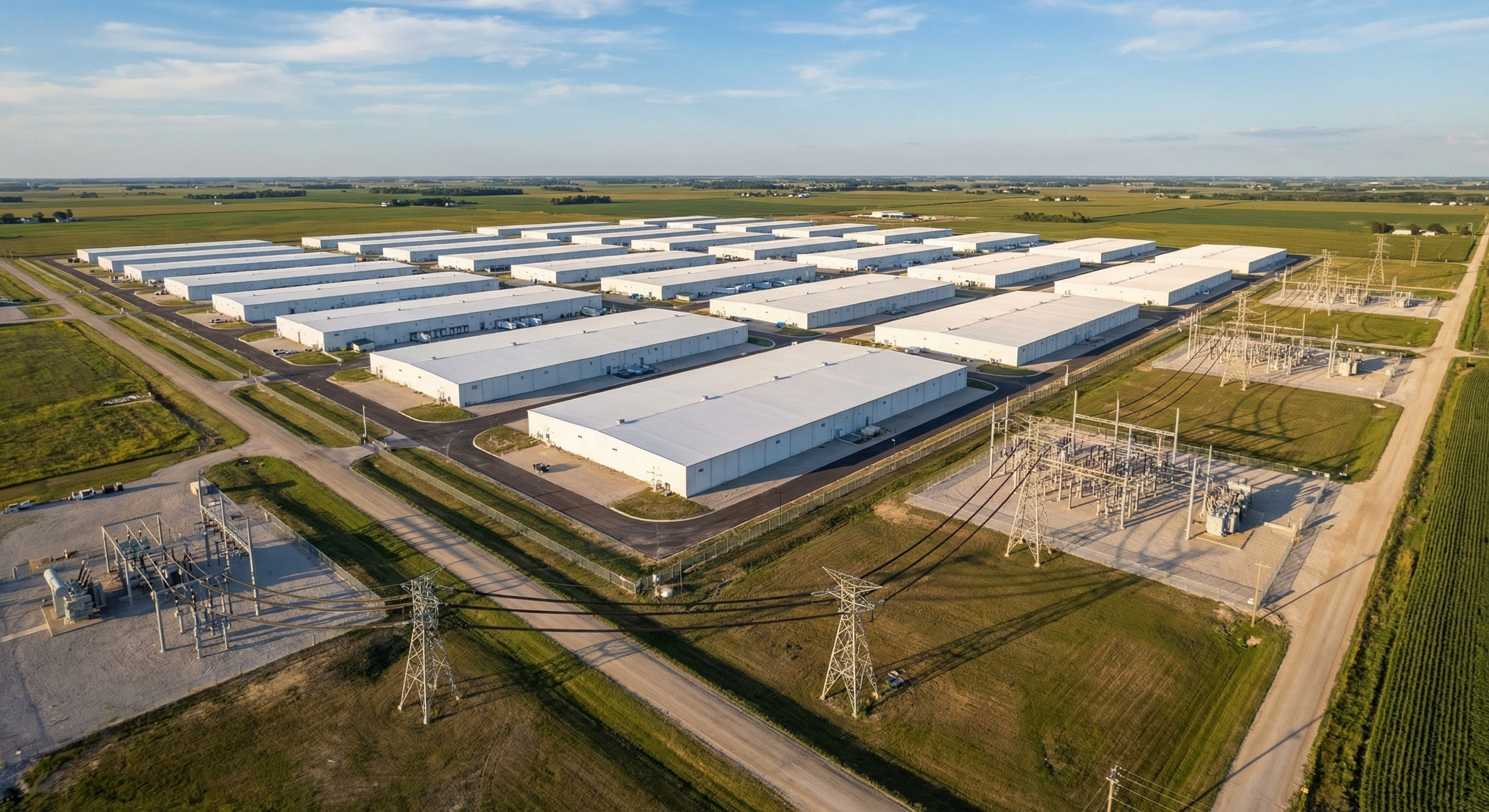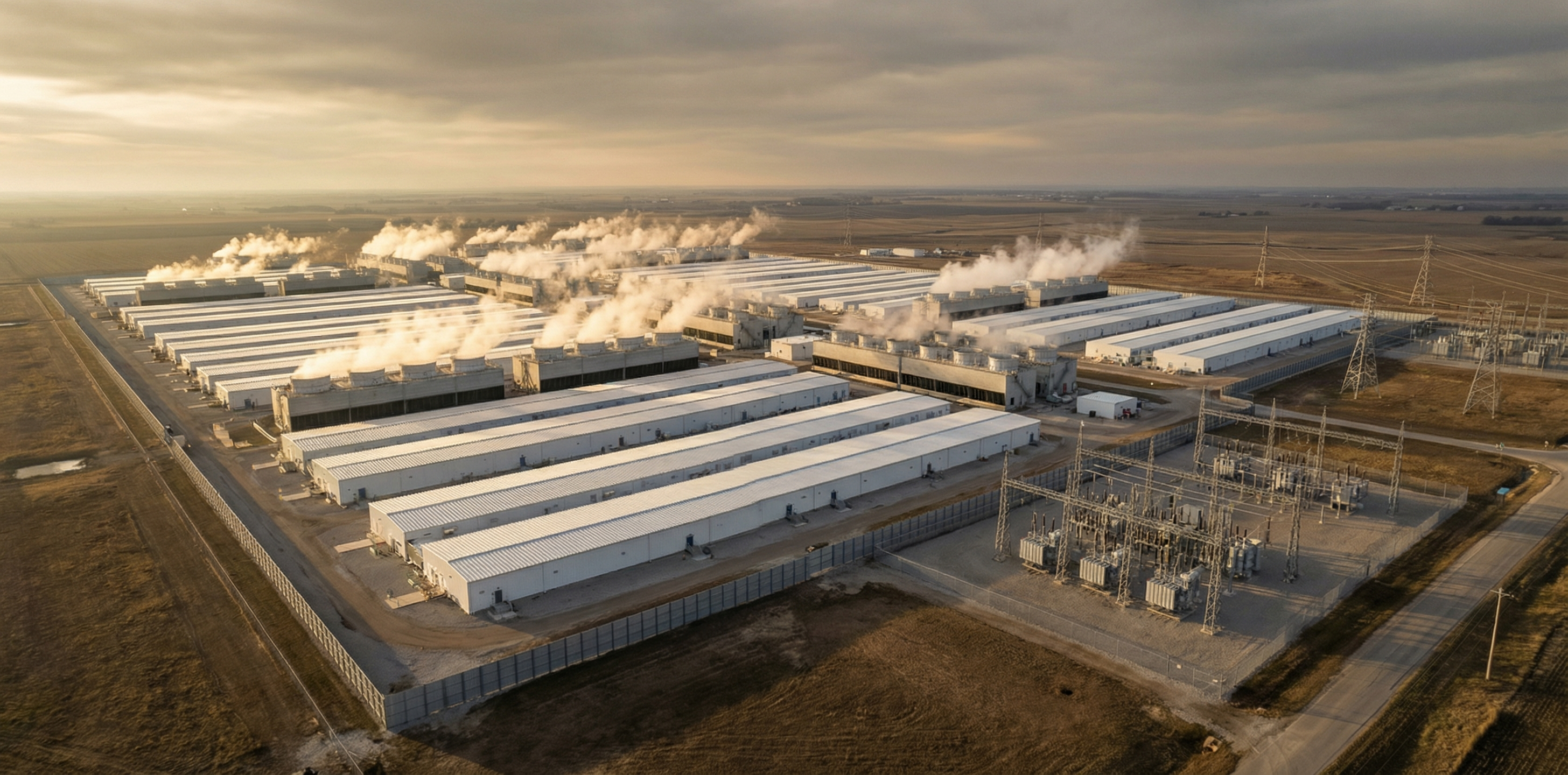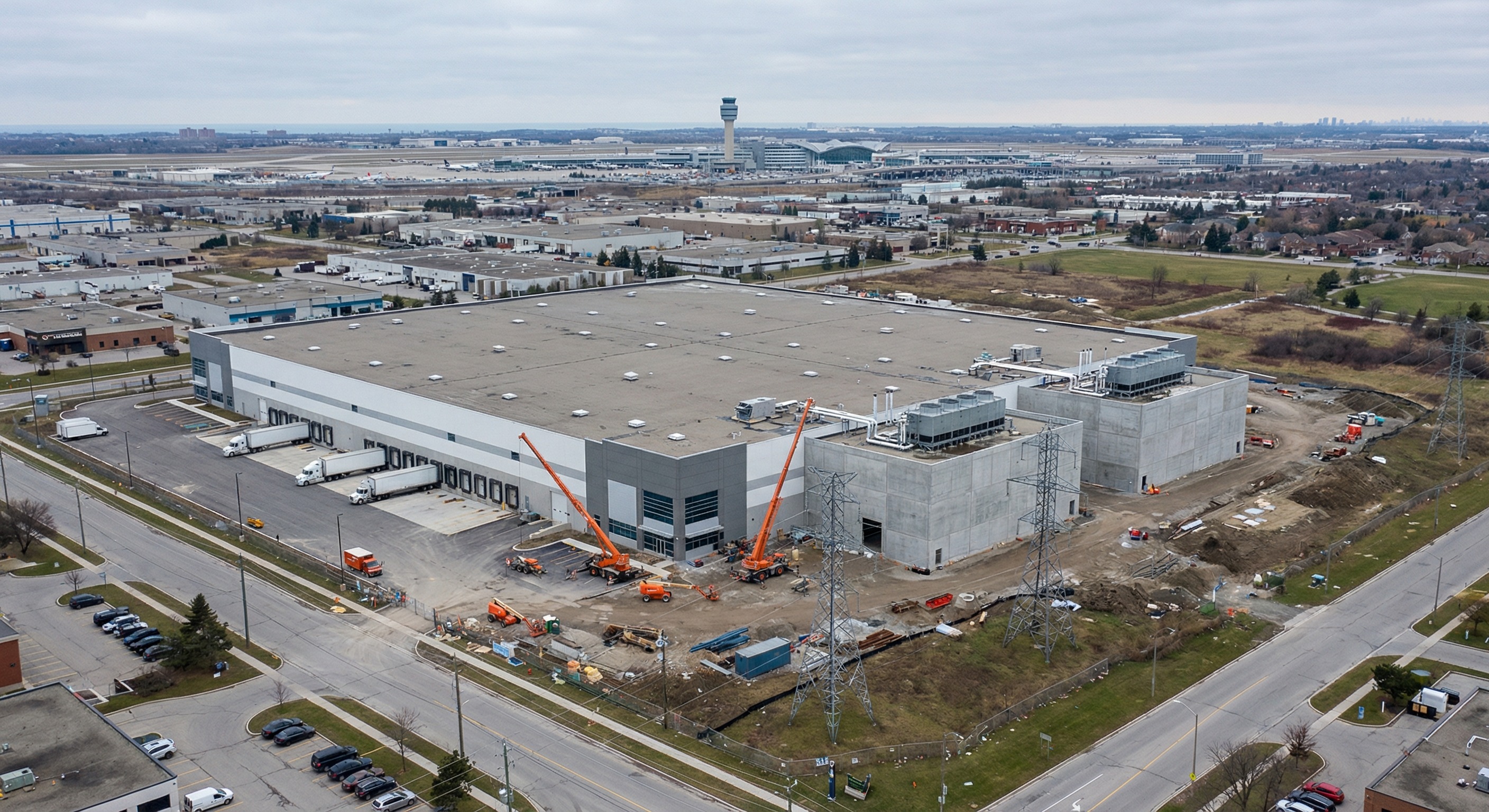
On March 30, Prologis — the world's largest industrial real estate investment trust, with $120 billion in assets and more than 1.2 billion square feet of logistics space across 19 countries — filed permits to develop a data center and industrial buildings complex in Mississauga, Ontario, according to Data Center Dynamics. The filing is specific: data center and industrial, on land it already owns outside Toronto's urban core. To anyone tracking the AI infrastructure land race, the signal is clear. The institutions that won the logistics real estate boom of the last two decades are now positioning to win the data center boom of the next ten years — and they're bringing advantages that traditional data center operators cannot easily replicate.
The Financial Arithmetic Is Impossible to Ignore
To understand why Prologis — a company whose identity is built on moving boxes rather than bits — is building data centers, start with the numbers. A high-quality logistics warehouse in a major North American market commands roughly $12 to $25 per square foot per year in rental income. A Tier III colocation data center in the same geography can generate $150 to $350 per square foot annually — or, measured by the unit that actually matters in this market, $80 to $180 per kilowatt per month for premium space with guaranteed power redundancy.
Run the math on a practical scale. A 200,000-square-foot distribution center in the Greater Toronto Area brings in roughly $3 million to $4 million in annual rent at industrial rates. Convert that same footprint to a data center with a power density of 80 watts per square foot and you have a 16-megawatt facility. At conservative colocation rates of $100 per kilowatt per month, that's $19 million annually. Deploy it at higher density — 150 watts per square foot, which is standard for AI inference workloads — and the potential revenue climbs above $35 million per year. The asset hasn't moved. The infrastructure has been upgraded. The revenue multiplier is eight to twelve times.
Industrial REITs have been aware of this math for years. What changed in 2025 and into Q1 2026 was the urgency. The five largest hyperscalers have committed more than $690 billion in infrastructure spending for 2026 alone, and their ability to execute on that commitment is constrained not by capital or intent but by the simple fact that suitable land with power access is running out in traditional data center markets. That scarcity has pushed development into second-tier markets, across international borders, and — most significantly — into the hands of property owners who already hold the land.
Prologis's Structural Advantages
Prologis is not entering the data center business the way a tech startup enters a new category. It is leveraging decades of infrastructure that turns out to be nearly purpose-built for what the AI era demands.
Industrial real estate clusters around the same geographic features as data centers: proximity to major transportation corridors, access to high-voltage power infrastructure, and location in zoned industrial areas with minimal community resistance to large, high-power, noisy facilities. Prologis properties sit adjacent to airports, intermodal rail yards, and freeway interchanges — locations that by definition have existing 69 kilovolt, 115 kilovolt, or higher-voltage power connections. Those connections, originally sized for industrial manufacturing and cold storage loads, are exactly what data centers need and what is most expensive and time-consuming to build from scratch.
The structural characteristics of modern logistics warehouses are also more data-center-compatible than they appear. Contemporary distribution centers are built with floor loads of 300 to 600 pounds per square foot — necessary for pallet racking and heavy goods. Data center raised floors with fully equipped server racks typically require 200 to 400 pounds per square foot. The structural envelope, in many cases, already qualifies. Wide-span column-free interiors, 36- to 40-foot clear heights, and reinforced loading areas for moving heavy equipment all transfer directly to data center use.
Prologis also brings a development machine that most data center operators cannot match. The company permitted and built more than 50 million square feet of logistics development globally in 2024. It knows how to navigate local governments, procure construction materials at scale, manage general contractors across multiple continents, and operate large facilities under strict customer SLAs. These are the exact competencies that determine whether a data center gets online in 18 months or four years.
Why Mississauga — and Why Canada
The specific choice of Mississauga is worth examining beyond the obvious "it's near Toronto" explanation. Mississauga is already one of North America's most significant logistics hubs: Toronto Pearson International Airport, Canada's busiest cargo facility, anchors the city's western industrial corridor, where Prologis has held properties for over a decade. That corridor is lined with 115-kilovolt and 230-kilovolt transmission infrastructure built to serve manufacturing and aviation fuel facilities — exactly the kind of high-voltage backbone that avoids the months-long interconnection queues that are choking data center projects in Northern Virginia and Phoenix.
Canada itself presents structural advantages that have attracted increasing hyperscaler attention. Electricity rates in Ontario — particularly for large industrial customers — run significantly lower than in comparable US markets. Ontario's power mix skews heavily nuclear and hydroelectric, which matters to hyperscalers with net-zero commitments and sustainability reporting obligations. Average annual temperatures in Mississauga allow economizer cooling for a substantial portion of the year, reducing mechanical cooling loads and improving power usage effectiveness (PUE) relative to warmer-climate facilities.
There is also a regulatory angle. Canada's privacy regime — the Personal Information Protection and Electronic Documents Act (PIPEDA) and its provincial equivalents — is stricter than US federal standards in some respects but operates under a more stable, less politically volatile framework than the patchwork of state-level US regulations that have complicated data center permitting in California, New York, and increasingly Virginia. For enterprise customers with cross-border data residency requirements, Canadian colocation offers a legitimate sovereign alternative to US-only infrastructure.
The AI talent cluster is a secondary but real factor. Toronto is home to the Vector Institute for Artificial Intelligence, the University of Toronto's machine learning group — the lab that produced Geoffrey Hinton and Ilya Sutskever — and a growing concentration of Canadian AI companies including Cohere, D-ID, and Ada. Enterprises building AI infrastructure benefit from proximity to the talent that optimizes and operates it.
The Wave Behind Prologis
Prologis is the most prominent industrial REIT making this move, but it is not alone. The week that Prologis filed its Mississauga permits, Data Center Dynamics also reported that Japan's Tokyu Corporation had announced a pilot program to deploy data centers along its Tokyo railway corridor — the conglomerate best known as a railway and retail operator in the greater Tokyo metropolitan area — citing the line's existing fiber connectivity, established electrical infrastructure serving station facilities, and available land adjacent to rail depots.
The Tokyu announcement is structurally similar to the Prologis play: a non-technology real estate operator with captive land, existing power and fiber corridors, and an asset base that was never designed for digital infrastructure but turns out to be well-positioned for it. Rail corridors in particular have an often-overlooked advantage — utility right-of-way. Fiber runs along railway lines because easements follow rail routes. Power lines follow the same easements. A data center built at a railway junction inherits connectivity infrastructure that hyperscalers would otherwise spend years and hundreds of millions to build.
The same logic applies to utilities themselves. Several US regional utilities have quietly begun developing "data center parks" adjacent to their generation and transmission assets — positioning themselves as landlords for customers who want power and real estate bundled under a single contract. Ameren in the Midwest, Duke Energy in the Carolinas, and Dominion Energy in Virginia have all made moves in this direction, ranging from formal data center park programs to behind-the-meter power purchase agreements structured to accommodate data center tenants. The common thread: entities with infrastructure that data centers need, recognizing that selling capacity as a bundled product is more profitable than selling it as a commodity.
The Traditional Data Center Operators' Dilemma
The entry of industrial REITs and non-traditional players into data center development is a direct consequence of the failure mode that traditional operators have been experiencing for the past two years. Equinix, Digital Realty, Iron Mountain, and their peers built their businesses on a model that worked brilliantly in the cloud build-out era: identify established data center markets (Northern Virginia, Silicon Valley, Chicago, Frankfurt, Singapore), acquire or build facilities in those markets, and sign long-term lease agreements with hyperscalers and enterprises.
That model hit a structural ceiling when AI demand arrived at a scale that traditional market absorption couldn't accommodate. Powered land in Northern Virginia is now trading above $1 million per acre in some cases, and the region's power grid has reached a point where new large-scale interconnections face multi-year queues. Phoenix, which became a secondary data center market precisely because it was less constrained than Northern Virginia, has hit its own grid limits. The same story is playing out in Dallas, Atlanta, and Chicago: strong markets, exhausted power capacity, rising land costs, and increasingly resistant local governments dealing with the community impact of constant construction.
Traditional operators have responded by expanding into new geographies — secondary and tertiary US markets, European cities outside the established Frankfurt-Amsterdam-London-Dublin corridor, Southeast Asian hubs. But expanding into new markets requires years of site acquisition, permitting, utility negotiations, and construction. It requires developing relationships with local governments that have no prior history of data center development. It requires building the brand and operational credibility needed to attract hyperscaler customers who need proven SLA performance.
Industrial REITs walk into this environment with pre-existing relationships, pre-permitted land, pre-established utility accounts, and proven operational organizations. They don't need to build from scratch — they need to upgrade what they already have.
The Challenges Are Real
None of this means the industrial-to-data-center pivot is without friction. The gap between an industrial building and an operational data center is substantial, and underestimating it has derailed conversion projects before.
Power density is the central challenge. An industrial warehouse draws 2 to 5 watts per square foot for lighting, minimal HVAC, and modest equipment loads. A modern AI inference facility needs 50 to 150 watts per square foot — a difference of 10 to 75 times. That means that the power infrastructure serving the industrial building is almost certainly inadequate. You're not just rewiring — you're rebuilding the entire electrical delivery chain from the utility substation through switchgear, UPS systems, power distribution units, and cooling infrastructure. The cost per megawatt for this work, including structural reinforcement for raised floors, liquid cooling loops, and emergency generation, runs $8 million to $15 million per megawatt in current market conditions. A 20-megawatt data center on converted industrial land still requires a $160 million to $300 million infrastructure investment before the first server rack ships.
Fiber connectivity is a secondary but important gap. Industrial parks are wired for freight, not data. Dark fiber routes may not pass close enough to create a cost-effective last-mile connection. Prologis's decision to co-develop "data center and industrial buildings" in Mississauga — rather than pure data center — suggests a hybrid approach: using the industrial components to serve logistics tenants while leveraging common infrastructure investment to enable the data center portion. This bundled approach reduces stranded cost risk if the data center market softens while maintaining the development's overall financial viability.
Security and operational profiles are also different in ways that matter to data center customers. Enterprise and hyperscaler SLAs specify physical security requirements — perimeter fencing, biometric access controls, 24/7 security staff, vehicle barriers — that are genuinely unusual in a logistics park where daily container truck traffic is the norm. The operational integration between a logistics facility (which is intentionally designed for easy, high-throughput access) and a data center (which is intentionally designed for controlled, minimal-access operation) requires careful facility planning to avoid conflicts.
The Competitive Landscape Is Changing Permanently
The broader implication of the Prologis move — and the parallel moves by Tokyu, utilities, and other non-traditional entrants — is that the data center industry's competitive structure is changing in ways that will be difficult to reverse. As we analyzed in our March coverage of the hyperscaler power wall, the AI infrastructure buildout is large enough that it cannot be absorbed by any single category of operator. Traditional data center REITs will remain major players. Cloud providers will continue to build owned capacity. But the marginal supply — the incremental megawatts that determine whether AI companies can expand their inference capacity on schedule — will increasingly come from non-traditional operators with pre-positioned land and infrastructure.
That structural shift has investment implications. The "data center REIT" bucket, which investors have treated as a specialized asset class since the mid-2010s, is being diluted by operators who don't neatly fit that category: industrial REITs, utility companies, railway operators, sovereign wealth funds backing national AI infrastructure programs. The market is becoming harder to analyze using traditional sector metrics and easier to analyze by thinking about who controls two scarce inputs: land near high-voltage power infrastructure, and the regulatory and operational capability to convert that land to digital use.
By that measure, Prologis's Mississauga filing is not a quirky diversification move. It is a logical extension of an institutional position that Prologis has spent 35 years building: a global portfolio of strategically located, infrastructure-rich industrial real estate. The company didn't set out to build a data center business. The data center business came to it — and it is moving to meet it.
For the traditional data center operators, the non-traditional entrants are both competition and relief valve. The market needs new supply that established operators can't deliver fast enough alone. For Prologis, the data center move is a genuine strategic expansion that leverages its existing assets rather than abandoning them. For the AI companies waiting for compute capacity that can't come online fast enough, any new source of powered, connected, climate-controlled space is welcome regardless of whose REIT structure it sits under.
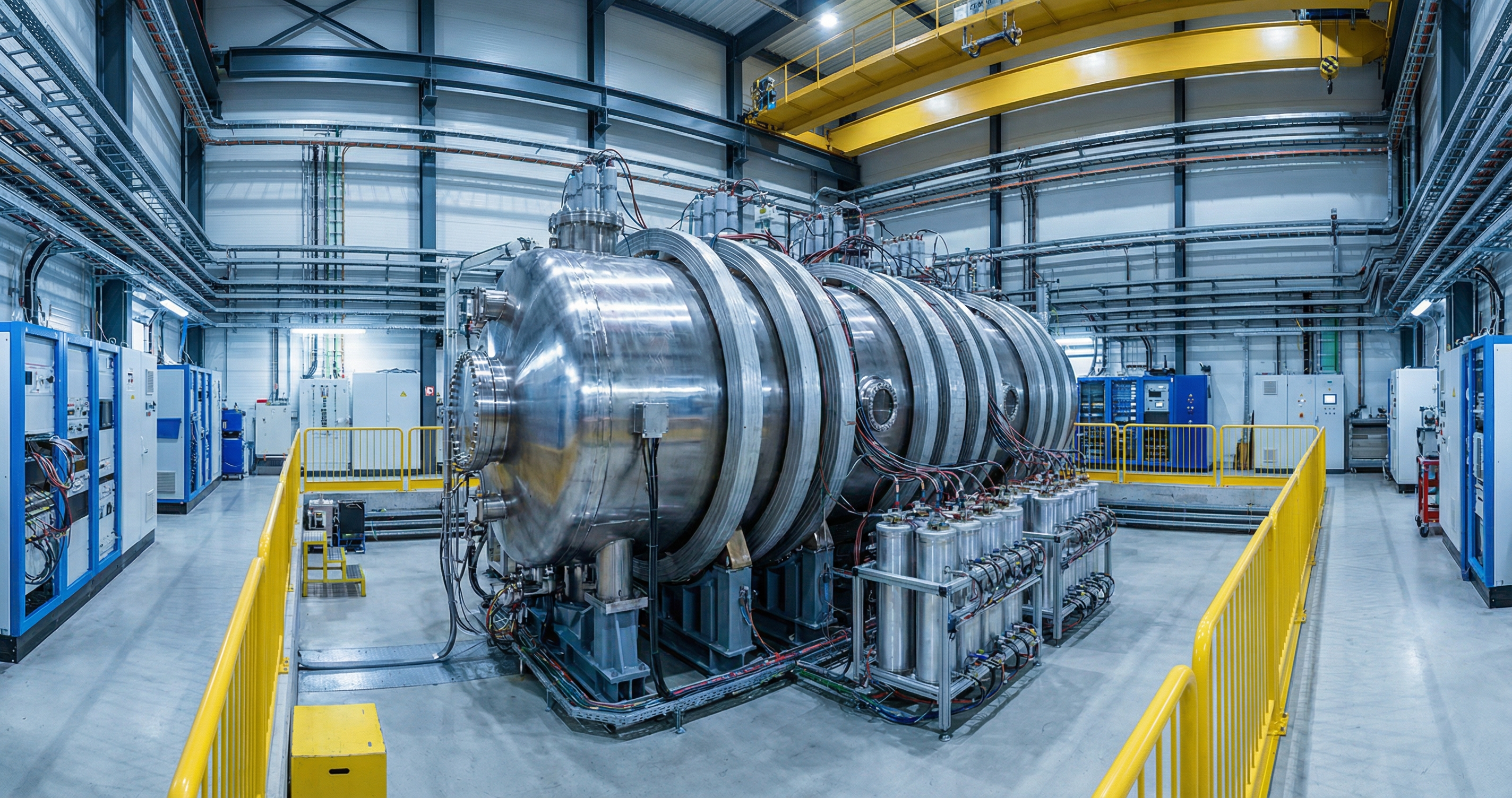
The warehouse is becoming a data center. The railway depot is becoming a server room. The utility substation is becoming a tech campus. Even fusion reactors are being built to serve AI infrastructure. The AI compute demand is so large that the entire built environment is being reorganized around it — and the organizations best positioned to capture that reorganization are the ones that already own the land.