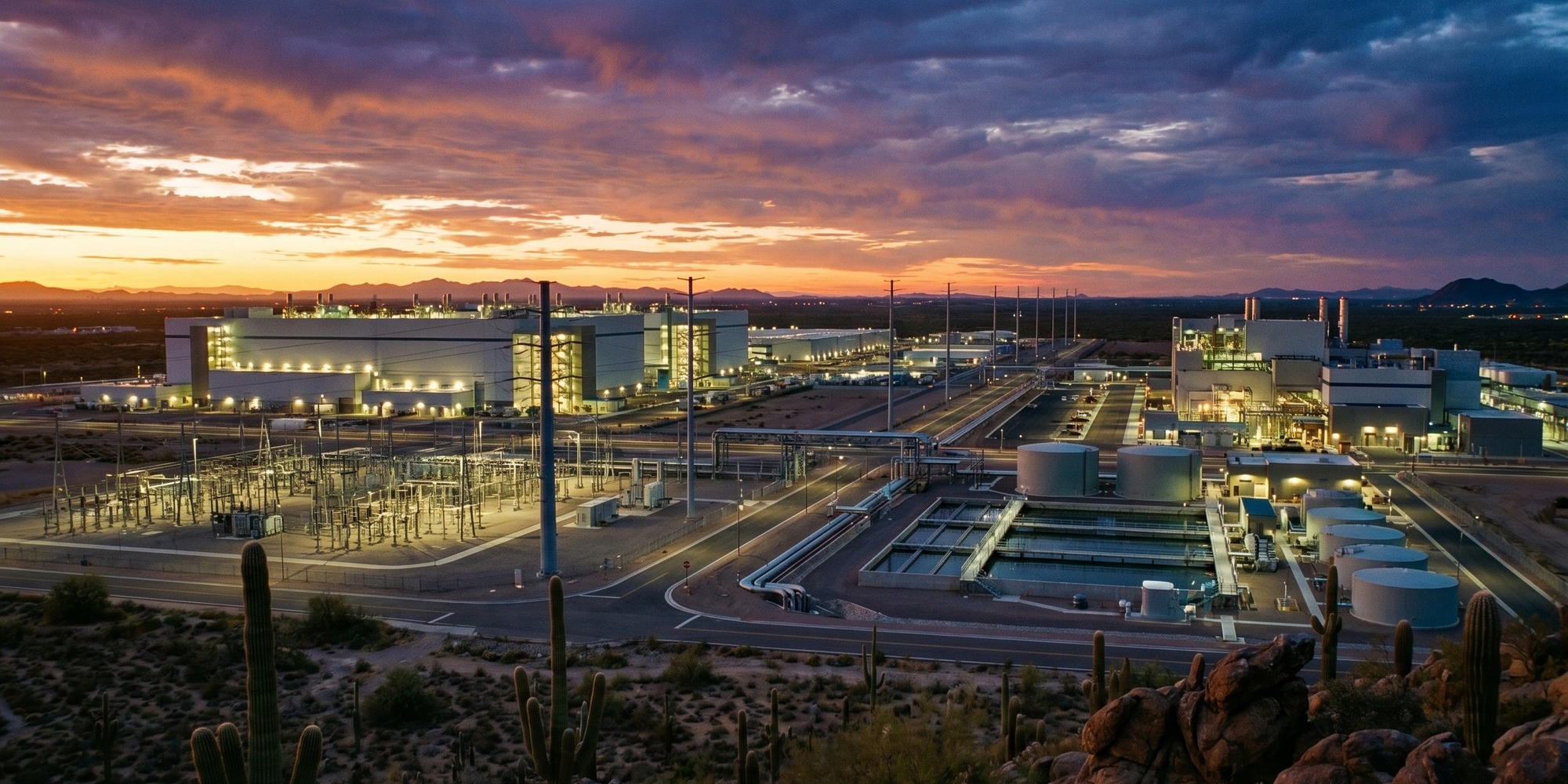
TSMC’s U.S. buildout used to be treated as an industrial-policy headline. It now looks more like infrastructure strategy: the company has moved into 4nm production in Arizona, has federal funding finalized, and has publicly tied its next Arizona phases to 2nm-class technology. For AI buyers, that changes the conversation from politics to risk management, lead times, and who gets priority when advanced capacity tightens again.
From Incentive Package to Operating Asset
The U.S. government and TSMC first framed Arizona around national resilience when Washington announced preliminary terms for CHIPS support in April 2024, including up to $6.6 billion in direct funding and potential loans under the CHIPS program (U.S. Department of Commerce; TSMC announcement).
That moved from intent to execution in November 2024, when the U.S. finalized the award at the same $6.6 billion level, effectively locking the federal-industrial bargain behind the project (Reuters, Nov. 15, 2024).
Then the key operational milestone landed: TSMC began producing 4nm chips in Arizona, according to U.S. Commerce Secretary Gina Raimondo’s January 2025 statement reported by Reuters (Reuters, Jan. 10, 2025). At that point, Arizona ceased to be purely a future hedge. It became part of present-tense advanced-node supply.
Why the 2nm Commitment Matters More Than the 4nm Milestone
The 4nm start proved the site can run advanced production. But the strategic value for AI is in TSMC’s stated plan to bring even more advanced capacity, including 2nm-class production, through later phases in Arizona (TSMC).
In practical terms, leading AI workloads are increasingly constrained by three things: compute density, power envelope, and memory bandwidth. As model sizes and inference concurrency grow, chip customers want each process-node transition not just for benchmark wins, but for better performance per watt and improved total cost of ownership in data centers already hitting thermal and power limits.
That means 2nm access is not a prestige question. It is a budget and deployment-timeline question, especially for firms trying to lock multi-year AI roadmaps that cannot tolerate sudden supply disruptions concentrated in one geography.
The Real Competitive Frame: Geography Plus Tooling
TSMC’s U.S. position is only one side of the advanced-manufacturing equation. The other is lithography and process ramp capability. Intel has emphasized that it completed installation and calibration phases for high-NA EUV infrastructure in Oregon, positioning itself to compete at the next process inflections (Intel High-NA press kit; Intel Foundry update).
ASML’s earlier collaboration roadmap with Intel made clear that high-NA deployment has been treated for years as a manufacturing-era change, not an incremental tool refresh (ASML and Intel, 2022).
Together, these moves signal that the next contest is not just who designs the best AI chip. It is who can secure reliable access to advanced-node output across multiple jurisdictions and multiple toolchain paths.
For AI Buyers, the New Risk Model Is Allocation Risk
During the last major capacity crunch, many buyers learned that signed demand did not guarantee timely wafers. Allocation, packaging bottlenecks, and backend dependencies mattered as much as front-end demand forecasts.
Arizona’s relevance, therefore, is not that it replaces Taiwan. It is that it offers a second advanced-node geography tied to U.S. industrial policy, customer pressure, and security priorities. In a future demand spike, that geography could change who gets served first, at what volume, and with what schedule confidence.
For hyperscalers and frontier-model labs, this is beginning to look like portfolio construction: diversify foundry geography, diversify package and assembly exposure, and preserve node migration optionality so that one disruption does not force a full roadmap slip.
What to Watch Over the Next 18 Months
First, watch schedule integrity for later Arizona phases and whether 2nm timing stays aligned with TSMC’s stated roadmap. A slip here would ripple across enterprise and cloud AI procurement cycles.
Second, watch customer disclosure. Any concrete confirmation from major AI silicon buyers about U.S.-fab volume allocation would signal that Arizona is being integrated into mainstream product planning, not just contingency planning.
Third, watch the tooling race around high-NA EUV and process yield. The winner is not whoever installs equipment first, but whoever converts tool readiness into predictable high-volume output.
Fourth, watch policy durability. CHIPS support helped underwrite this buildout, but long-cycle semiconductor projects depend on multiyear policy consistency. Any instability in that contract could reprice expansion risk.
Bottom Line
TSMC Arizona has crossed a threshold from geopolitical talking point to manufacturing asset. The next threshold is whether U.S.-based 2nm output arrives on time and at credible volume. If it does, AI infrastructure planning changes materially: procurement becomes less single-region fragile, and capacity negotiations become more strategic than reactive.
In that scenario, Arizona is not the center of global advanced manufacturing. But it does become something arguably more important for AI customers in the near term: a second lever they can actually pull.