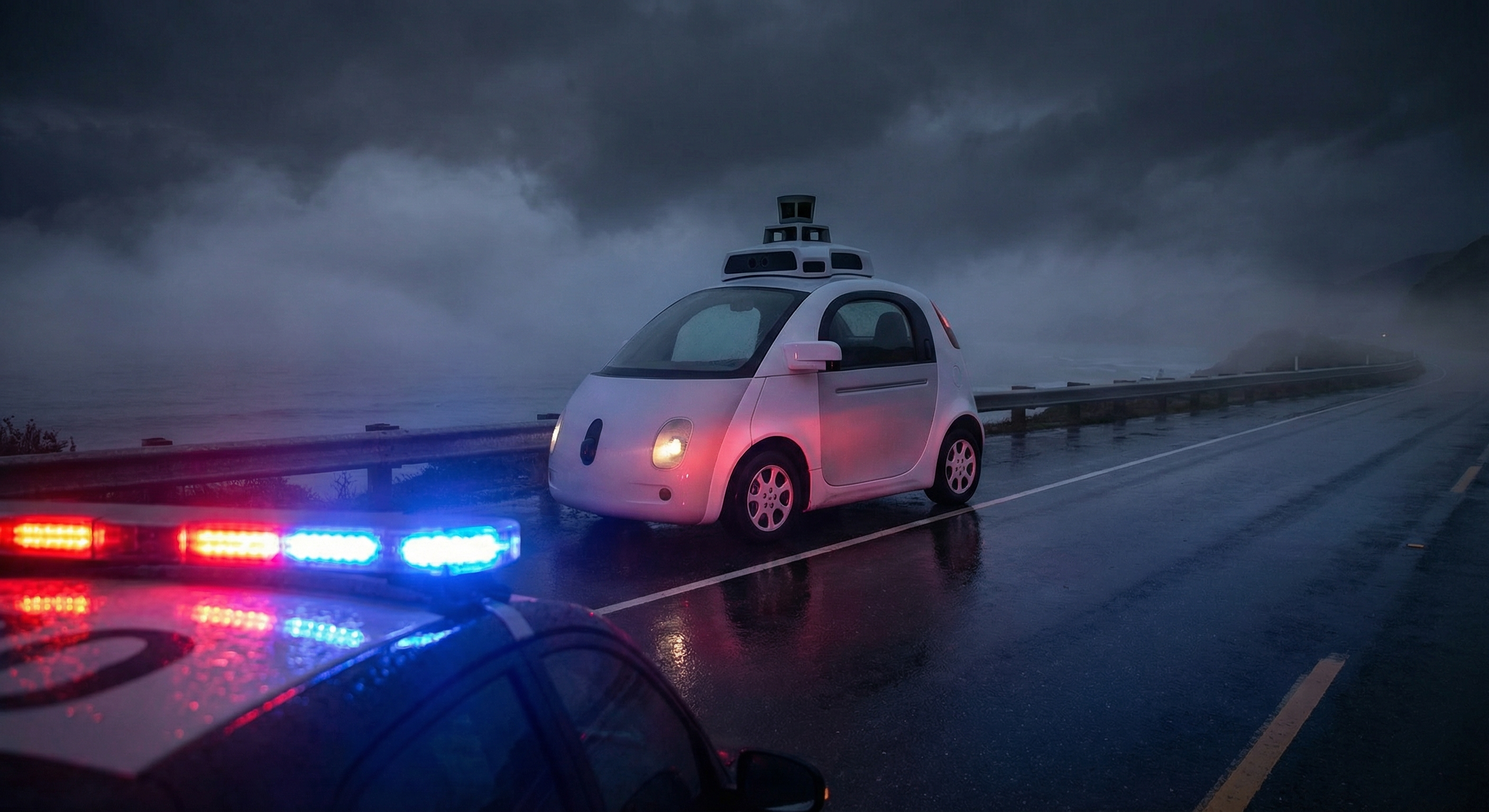
On a smoke-choked stretch of California's I-280 last August, a Waymo robotaxi did exactly what it was designed to do — it stopped. The problem was, it couldn't start again. With wildfire smoke thickening the air, California Highway Patrol officers redirecting traffic, and a passenger trapped inside, Waymo's remote assistance team did the only thing left in their playbook: they called 911. A CHP officer climbed behind the wheel and drove the self-driving car to safety. It was not the first time. And according to public records obtained by TechCrunch, it would not be the last.
Six Times and Counting
TechCrunch's investigation, built on 911 dispatch recordings and incident reports obtained through public records requests, documents at least six cases in which police officers, firefighters, or other first responders physically moved a Waymo vehicle because the company's own support infrastructure could not. The incidents span multiple states and circumstances — ranging from wildfires to power outages to active crime scenes.
The August 2025 Redwood City wildfire incident is perhaps the most vivid. Waymo's remote assistance team called area dispatch twice, explaining that their vehicle was stranded on the shoulder and could not reverse. According to the CHP incident report reviewed by TechCrunch, an officer arrived, entered the robotaxi, and drove it approximately half a mile to a park-and-ride lot. A Waymo roadside assistance worker then took over from there.
In at least two other cases, first responders had to intervene while responding to active crime scenes — including an officer who was in the middle of a mass shooting response when a stalled Waymo vehicle required attention. The specifics of those incidents have not been fully disclosed publicly, but TechCrunch confirmed their occurrence through the records request.
There is also the matter of the December 2025 San Francisco power outage, during which Waymo vehicles stalled across the city. The company said its roadside assistance team cleared "dozens" of stuck vehicles. But Waymo also acknowledged that a "handful" still required first responders — a quiet admission that its own emergency infrastructure has a ceiling.
What Waymo's Safety Net Actually Looks Like
To understand why first responders keep ending up behind the wheel of Waymos, it helps to understand the actual structure of the company's human backup system — something Waymo has been reluctant to publicize in detail.
At any given moment, approximately 70 remote assistance workers are monitoring Waymo's fleet of roughly 3,000 vehicles. These workers, confirmed in a February 2026 letter to Congress, are split roughly evenly between U.S. and Philippines-based operations centers. Their job is explicitly advisory: they do not steer, brake, or accelerate the vehicle. They provide directional guidance — helping the robotaxi decide whether it can proceed through a complex intersection, or whether a school bus is loading children.
That last use case became a flashpoint in January 2026, when the National Transportation Safety Board revealed that a remote assistance worker in Austin had incorrectly told a Waymo it could proceed past a school bus with stop arms deployed and flashing lights active. The robotaxi drove past the bus as children were loading. No injuries were reported, but the incident underscored the fragility of the remote assistance layer.
Waymo has defended its remote assistance program vigorously, noting that median one-way latency is approximately 150 milliseconds for U.S. workers and 250 milliseconds for Philippines-based workers — fast enough, the company says, to be operationally equivalent. But latency is not the issue in the cases documented by TechCrunch. The issue is what happens when remote guidance fails entirely and the vehicle cannot move at all.
That is where the second human layer comes in: the Event Response Team, a U.S.-based group that handles crashes and serious incidents. Below them sits the Roadside Assistance team — on-scene workers, some employed through third-party contractor Transdev, who physically reach the vehicle and move it. Waymo has declined to say how many roadside assistance workers it employs or what the current response time standard is.
The Policy Problem Lands in City Hall
On March 2, 2026, San Francisco city officials convened a hearing on the behavior of Waymo's robotaxis — specifically the December blackout episode and its aftermath. What emerged from the testimony was a picture of a city increasingly uncomfortable with the operational dependencies it has inherited by hosting the world's leading robotaxi fleet.
Mary Ellen Carroll, executive director of San Francisco's Department of Emergency Management, stated the position plainly: "What has started to happen is that our public safety officers and responders are having to be the ones to physically move [Waymos]. In a sense, they're becoming a default roadside assistance for these vehicles, which we do not think is tenable."
Her concern is not about any single incident. It is about systemic drift — the gradual normalization of a burden that was never part of the city's operational agreement with Waymo. Every minute a police officer spends moving a stranded robotaxi is a minute not spent responding to something else. And the frequency of these incidents is, by all accounts, rising in proportion to the size of Waymo's fleet.
Notably, Waymo's representatives did not mention the roadside assistance program during the March 2 hearing. The existence of that team — its size, its composition, its response standards — has been managed out of public view even as the incidents it is meant to prevent keep surfacing in the public record.
Congress, the Philippines, and Bipartisan Pressure
The roadside assistance story is the lesser-known sibling of a more visible controversy that broke in February 2026. Waymo's letter to Congress confirming Philippines-based remote workers triggered a bipartisan reaction — unusual in the current political climate — with both Democratic and Republican lawmakers raising questions about data security, worker oversight, and the safety implications of remote guidance from overseas call centers.
Waymo's position has been consistent: the workers are qualified, the latency is acceptable, and the geographic location of a guidance advisor does not materially affect safety outcomes. But the political optics of outsourced oversight for vehicles carrying American passengers have proven difficult to contain, and the remote assistance revelation has put the company on a defensive footing heading into its most ambitious expansion phase.
400,000 Rides a Week — and Growing
The scale of what Waymo has achieved is real and worth acknowledging plainly. The company operates more than 400,000 paid rides per week across roughly 3,000 vehicles in ten U.S. markets: Atlanta, Austin, Los Angeles, Dallas, Houston, Miami, Orlando, Phoenix, San Antonio, and the San Francisco Bay Area. Its autonomous safety record, while not publicly audited in the way air travel data is, has generally been cited favorably against comparable human-driven incidents.
That context matters. The incidents documented by TechCrunch represent a tiny fraction of Waymo's operational footprint. Six confirmed cases of first responders moving a vehicle — out of hundreds of thousands of weekly rides — is not, by any reasonable statistical measure, a crisis.
But Waymo's announced plans to expand to approximately 20 additional cities in 2026, having raised $1.6 billion in February to fund that growth, change the calculus significantly. When your fleet doubles or triples, the absolute frequency of edge cases climbs with it — even if the per-ride rate stays flat. The roadside assistance model that works today for 3,000 vehicles in 10 cities has to scale to 6,000 or 9,000 vehicles in 30 cities, in markets with different road conditions, different emergency response relationships, and different regulatory appetites.
The Expansion Paradox
There is a fundamental tension in Waymo's current position that the company has not yet resolved publicly. On one hand, it is racing to capture market share before competitors like Tesla's robotaxi service, Amazon's Zoox, and international players can catch up. Speed of expansion is a strategic necessity. On the other hand, the human infrastructure that backstops its technology — the remote assistants, the event response team, the roadside assistance workers — does not scale effortlessly. It requires hiring, training, and operational coordination across dozens of new jurisdictions simultaneously.
Waymo declined to tell TechCrunch how many roadside assistance workers it employs, which contractors support the program, or how it plans to scale the team as the fleet grows. That is a significant information gap for regulators, city planners, and first responders trying to plan for the new normal.
The silence is, in its own way, informative. The self-driving industry has long been characterized by a gap between the public narrative — autonomous, capable, safe — and the operational reality that includes remote workers, on-call drivers, and, increasingly, 911 calls to the nearest fire station. Waymo is the furthest along of any company in this space, and its challenges are thus the most visible. But they are not unique to Waymo.
What Comes Next
San Francisco is not the only city watching these developments. Austin, Atlanta, and Phoenix have growing Waymo footprints and their own emergency management relationships to manage. As Waymo moves toward its 20-city expansion, each of those new markets will inherit the same dynamic: a fleet that operates largely without incident but occasionally requires human intervention that the company's own infrastructure cannot always provide.
The question for regulators — and for the cities that have welcomed or are considering welcoming Waymo — is not whether the company's technology works. It largely does. The question is who bears the cost when it doesn't. Right now, that cost is being quietly absorbed by the public sector: police officers climbing into robotaxis, firefighters navigating autonomous vehicles through emergency zones, city officials fielding complaints about obstruction.
Waymo's answer — that its roadside team is the primary backstop and first responder involvement is rare — is technically accurate. It may also be insufficient as a long-term policy position. The March 2 San Francisco hearing was a warning shot. As the fleet grows and the incidents accumulate, the city's patience for serving as Waymo's unofficial fallback may not grow with it.
The self-driving future is, in a literal sense, already here. It just still has humans at the wheel — sometimes when you least expect it.