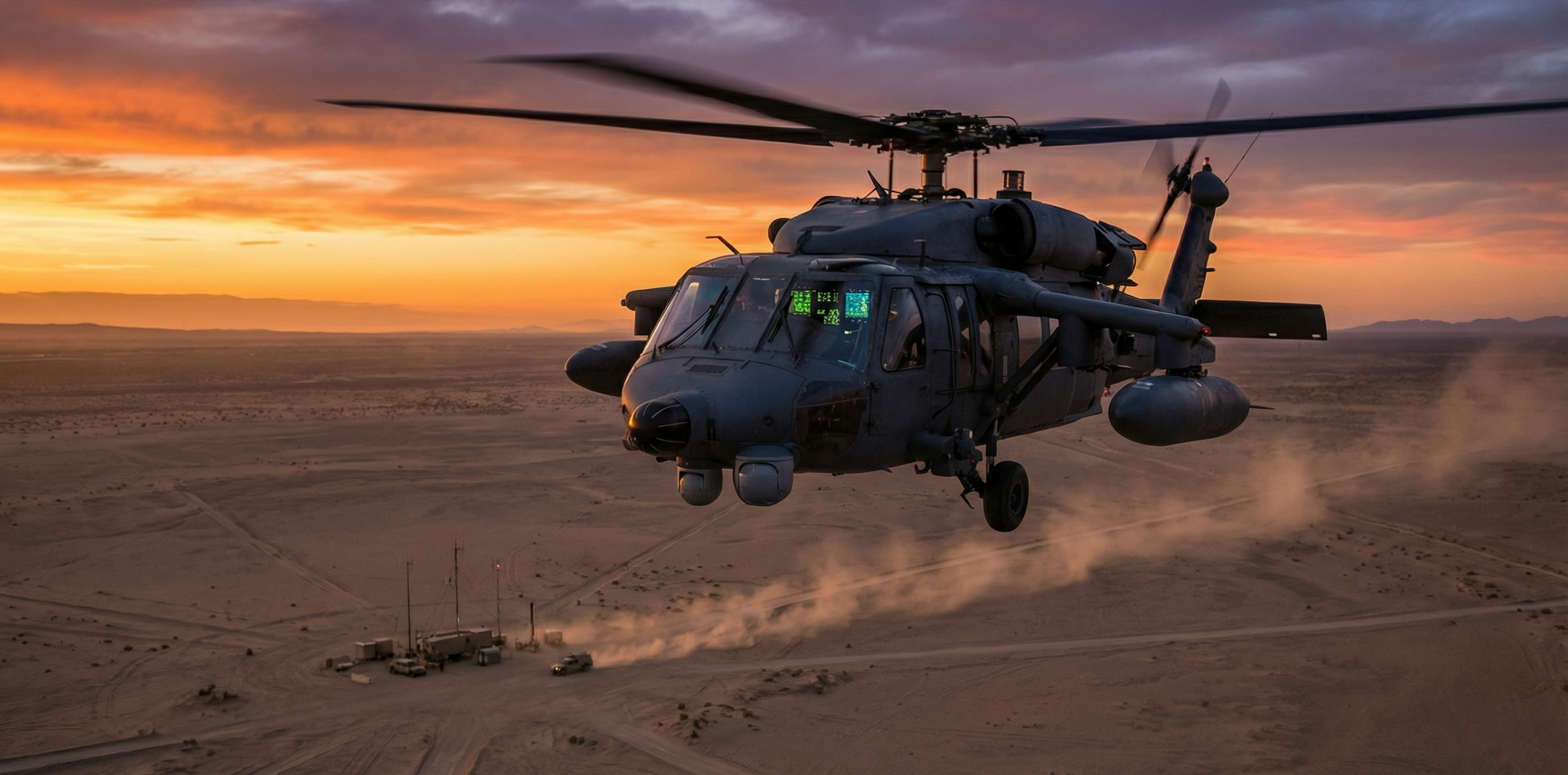
The U.S. Army has taken delivery of its first H-60Mx Black Hawk helicopter — a heavily modified variant of the service's most iconic rotorcraft, equipped with an autonomy suite capable of flying complex missions with zero crew aboard. The delivery marks the first concrete hardware step in the Army's Strategic Autonomy Flight Enabler program and signals an inflection point in military aviation: the era of pilotless rotary-wing combat operations is no longer theoretical.
A Black Hawk Without a Pilot
The aircraft, designated H-60Mx, was delivered to Army testing facilities and will immediately begin a rigorous evaluation of its ability to operate with a reduced crew — or entirely without one. According to a March 20 Army release, the helicopter uses autonomy software developed under a Defense Department program to enable flight with minimal human input, replacing traditional mechanical systems with "fly-by-wire" controls that allow onboard computers to interpret inputs and adjust flight surfaces in real time.
The centerpiece of the modification is Sikorsky's MATRIX Technology autonomy suite, which Sikorsky — a Lockheed Martin subsidiary — confirmed integrating onto the UH-60MX airframe earlier this week. MATRIX is a full-stack autonomy package that handles everything from flight-path optimization to situational awareness, merging GPS, radar altimetry, obstacle detection sensors, and inertial navigation to build a real-time picture of the operating environment that no human eye can match at speed.
"Functioning like a highly advanced digital co-pilot, the system can manage the most complex tasks of flight, from takeoff to landing," the Army statement reads. "This allows the helicopter to perform missions completely on its own or with a remote crew supervising from a secure ground station, offering unprecedented flexibility."
That phrase — "unprecedented flexibility" — understates the strategic shift at play. What the Army is describing is not a drone. The H-60Mx is a full-size, 22,000-pound rotary-wing platform that can be reconfigured for manned, optionally piloted, or fully autonomous operations depending on mission requirements. It represents a fundamentally new category of military aircraft: the switchable-autonomy workhorse.
ALIAS: A Decade of DARPA Groundwork
The technology driving the H-60Mx does not come from a startup moonshot. It traces back to DARPA's Aircrew Labor In-Cockpit Automation System, or ALIAS — a program launched more than a decade ago with the specific goal of developing removable autonomy kits that could be installed on aircraft already in service, without requiring new airframe designs.
ALIAS was conceived to address a fundamental challenge in military aviation: the most capable aircraft in the fleet — the ones with proven airframes, mature supply chains, and well-understood operational doctrines — are also the most expensive and labor-intensive to operate. A Black Hawk requires two trained pilots at minimum. Every autonomous system that can reduce that requirement without degrading capability represents an immediate multiplication of force.
The DARPA program proceeded through multiple phases of testing over more than a decade, with Sikorsky as a key contractor developing and refining the autonomy kit. By 2022, Lockheed Martin had achieved the first fully autonomous Black Hawk flight — a 30-minute mission completed without a human in the cockpit. That milestone validated the hardware; what the Army is doing now is validating it for operational use.
The progression matters. Laboratory demonstrations and operational delivery are separated by years of systems integration, failure-mode analysis, and certification work. The H-60Mx delivery represents the formal transition from "we proved it works" to "we are determining how to fight with it."
SAFE: The Army's Fleet-Wide Autonomy Ambition
The H-60Mx is not just a one-off test platform. The Army has explicitly designated it the "primary testbed" for the Strategic Autonomy Flight Enabler program, or SAFE — an initiative that, if successful, would deploy autonomy kits across the Army's entire Black Hawk fleet.
The scale of that ambition is significant. The Army operates hundreds of UH-60 Black Hawks across active-duty units, National Guard formations, and Special Operations forces. A retrofit program that converts even a fraction of that fleet to optionally piloted capability would represent one of the most consequential military aviation modernization programs in a generation — accomplished not by buying new aircraft, but by upgrading what already exists.
SAFE's design philosophy is deliberately modular. The autonomy kit is conceived as a bolt-on system — something that can be installed at a depot, removed for maintenance, and re-installed without permanent modification to the airframe. That modularity is what makes fleet-wide deployment feasible; it means individual aircraft do not have to be permanently committed to autonomous configurations, preserving the Army's flexibility to assign roles based on operational context.
The Army is also working with Texas A&M University's George H.W. Bush Combat Development Complex, which is using ALIAS technology to study how autonomous rotary-wing aircraft can be applied to non-combat missions — including combatting wildfires. The civilian application research is not incidental: it broadens the technology's political coalition and stress-tests the autonomy systems against unpredictable, unstructured environments that share key characteristics with contested combat airspace.
What the Testing Will Actually Determine
The Army has been careful to frame the H-60Mx as a test platform rather than a deployable system — but the testing program itself will answer questions that determine whether full autonomous operations are feasible in the near term or remain a decade-plus horizon.
The core technical questions center on edge cases. Autonomous flight in clear weather over a known course is a largely solved problem. The Army needs to know how the H-60Mx performs in brownout conditions — the blinding dust clouds that have caused numerous rotary-wing accidents in Afghanistan and Iraq — in electronic warfare environments where GPS can be denied or spoofed, and in the close-terrain, obstacle-dense environments of urban and mountainous operations.
The fly-by-wire system's real-time adjustment capability is directly relevant here. Mechanical flight controls degrade and jam; electronic systems operating through software can in theory compensate for partial hardware failures in ways that purely mechanical systems cannot. But software introduces its own failure modes — particularly when sensors feeding the autonomy layer deliver bad data.
There is also the question of command-and-control latency. Operating an autonomous aircraft remotely from a "secure ground station" requires reliable, low-latency communications that may not be available in all operational environments. The SAFE program will need to define what level of autonomous authority the aircraft should have when the link goes down — a question with significant doctrinal and legal implications given ongoing debates about human oversight of lethal autonomous systems.
Context: Where the H-60Mx Fits in the Autonomous Military Aviation Picture
The Army's Black Hawk program does not exist in isolation. The U.S. military is pursuing autonomous aviation across every domain simultaneously, with each service branch advancing its own programs in ways that are beginning to converge into a coherent force structure.
The Air Force's Collaborative Combat Aircraft program is developing AI-piloted fixed-wing jets designed to fly alongside crewed F-35s and F-22s. The Navy is expanding its autonomous maritime surface and undersea programs. Anduril's Lattice platform is already providing the Army with autonomous ground and air coordination capabilities under a $20 billion contract.
Defense technology firm Shield AI in late 2025 unveiled the X-BAT, an autonomous vertical-takeoff fighter designed to operate without runways — a direct competitor to the H-60Mx's operational niche in certain mission profiles. The competitive landscape is accelerating development timelines across all players.
What distinguishes the H-60Mx from most of these programs is its retrofit character. The CCA jets are clean-sheet designs built from the ground up for autonomous operation. The H-60Mx takes an aircraft that first flew in 1974, has been continuously upgraded, and is trusted by every echelon of the Army — and attempts to layer autonomy onto that operational legacy. If it works, it is a proof of concept for how the entire existing military aviation fleet could be transformed without the decades-long procurement cycles required for new platforms.
The Operational Stakes
The Army's official language about the H-60Mx emphasizes reduced crew workload and improved mission flexibility. The operational implications run considerably deeper.
Autonomous rotary-wing platforms would fundamentally change the calculus of high-risk resupply and medical evacuation missions. MEDEVAC operations are among the most dangerous in modern warfare — extracting casualties under fire requires flying into active threat environments at low altitude and low speed. An autonomous or remotely piloted MEDEVAC platform could perform the same function without putting additional lives at risk in the cockpit. The Army is aware of this potential; some of the ALIAS testing specifically evaluates autonomous cargo and slingload operations.
There are also implications for attritable operations — missions where the probability of aircraft loss is high enough that putting a crew aboard represents an unacceptable risk. Today, those missions are typically assigned to smaller UAS platforms that lack the payload and range of a full-size helicopter. The H-60Mx, operating autonomously, could perform higher-value attritable missions that are currently beyond the capability envelope of available drone systems.
The Army noted that a U.S. Army National Guardsman successfully operated an Optionally Piloted Vehicle Black Hawk using a touchscreen tablet during a 2025 training exercise — transporting a 2,900-pound water buffalo slingload. The ease-of-operation milestone is as strategically significant as the autonomy milestone itself: if soldiers with minimal aviation training can direct a Black Hawk's flight, the Army's logistics and support capacity multiplies dramatically.
What Comes Next
The H-60Mx will spend the coming months in rigorous testing with Army test pilots and engineers evaluating how effectively the autonomy systems can be controlled from the ground and how they perform in complex scenarios. The testing program will generate the data the Army needs to decide whether SAFE becomes a full acquisition program — one that could eventually retrofit the entire Black Hawk fleet.
The timeline for that decision is not yet public. What is clear is that the Army views autonomous rotary-wing aviation not as a futuristic aspiration but as a near-term capability requirement. The question the H-60Mx testing will answer is not whether autonomous Black Hawks will fly — it is how quickly they will fight.
For a military institution that has operated the Black Hawk for more than 40 years, that is a significant pivot. For adversaries watching U.S. military modernization, it is a signal worth taking seriously.